






Indian war memorial Korean War inaugurated by Rajnath Singh in South Korea highlights India’s humanitarian role, 60 Para Field Ambulance contribution and India-South Korea defence relations.
Rajnath Singh Unveils Indian War Memorial in South Korea Honouring Korean War Heroes
India and South Korea Strengthen Historical Ties
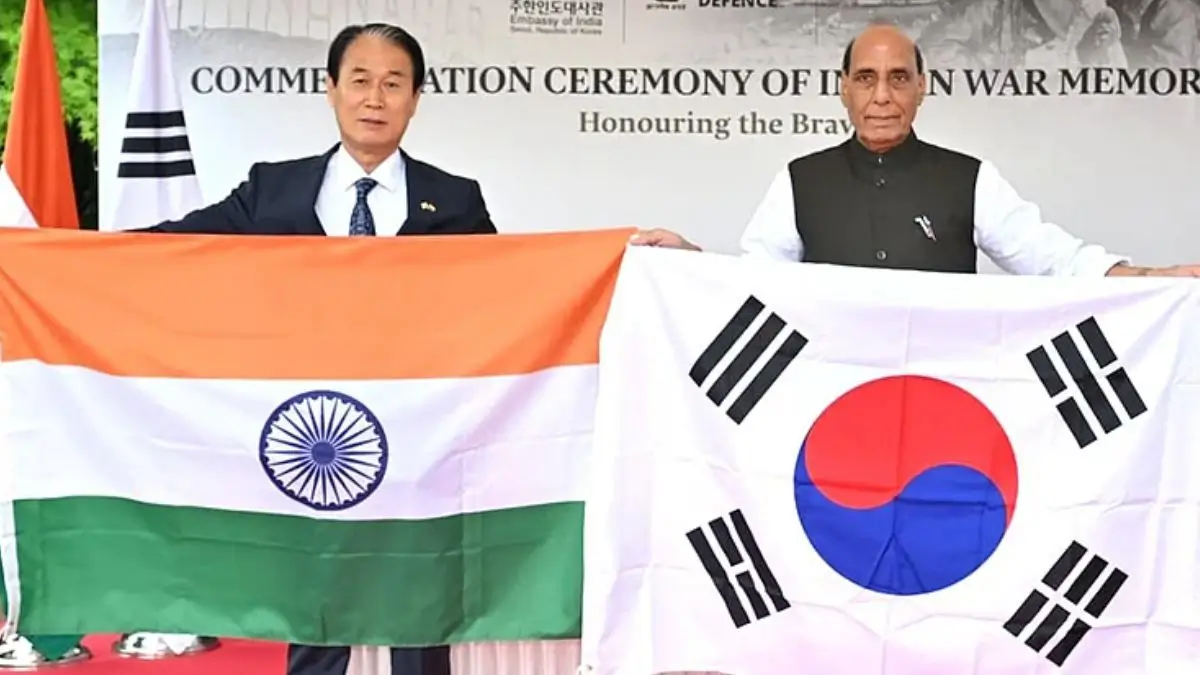
India and South Korea marked an important moment in diplomatic and military history when Defence Minister Rajnath Singh jointly inaugurated the Indian War Memorial in Seoul along with South Korean Minister of Patriots and Veterans Affairs Kwon Oh-eul. The memorial was unveiled at Imjingak Park to honour the contribution of Indian soldiers during the Korean War.
The memorial has been constructed as part of the 75th anniversary commemorations of the Korean War. It recognises the bravery, humanitarian service and sacrifice of the Indian Army’s 60 Para Field Ambulance unit and the Custodian Force of India (CFI), both of which played a major role during and after the war.
Role of India During the Korean War
Although India did not participate as a combatant nation during the Korean War of 1950–1953, it made a remarkable humanitarian contribution. India deployed the 60 Para Field Ambulance unit under the leadership of Lieutenant Colonel A.G. Rangaraj. This medical unit treated thousands of wounded soldiers and civilians under extremely difficult battlefield conditions.
The unit earned the nickname “Maroon Angels” because of its exceptional medical and rescue services. Reports suggest that the Indian medical team treated more than 2,00,000 patients and conducted thousands of surgeries during the conflict.
India also played a major peacekeeping role after the ceasefire. The Custodian Force of India was involved in handling prisoners of war under the Neutral Nations Repatriation Commission led by Lt. Gen. K.S. Thimayya.
Significance of the Memorial
The Indian War Memorial is located at Imjingak Park, a historically important place near the Korean Demilitarized Zone. The area once housed “Hind Nagar,” which accommodated thousands of prisoners of war before their repatriation.
During the ceremony, wreaths were laid to honour Indian soldiers. Rajnath Singh described the memorial as a fitting tribute to Indian troops’ courage, sacrifice and humanitarian values.
The event was attended by senior military officials, diplomats, veterans and representatives from both nations. The two countries also signed an agreement to cooperate in honouring Korean War veterans and promoting cultural and academic exchanges related to the war.
India-South Korea Strategic Partnership
The inauguration ceremony highlighted the growing strategic partnership between India and South Korea. Defence cooperation between the two countries has expanded in recent years through joint defence projects, technology sharing and industrial collaboration.
Rajnath Singh emphasised that the shared sacrifices and historical friendship between the two countries continue to strengthen bilateral ties. The memorial serves as a reminder of India’s long-standing commitment to global peacekeeping and humanitarian missions.

Why this News is Important
Important for International Relations
This development is important because it reflects the strengthening diplomatic and defence relations between India and South Korea. Questions related to bilateral partnerships, strategic cooperation and India’s foreign policy are commonly asked in UPSC, SSC, Banking and Defence examinations.
Important for Defence and Military History
The news highlights India’s contribution during the Korean War through humanitarian and peacekeeping missions. Competitive examinations frequently ask questions about India’s role in international conflicts, United Nations peacekeeping operations and military achievements.
Important for Current Affairs Preparation
The inauguration of the memorial is linked with the 75th anniversary of the Korean War, making it a major international current affairs topic. Aspirants preparing for civil services, CDS, NDA, CAPF and state PCS examinations should remember the names of the leaders, location of the memorial and India’s role in the Korean War.
Important for Questions on Peacekeeping
India is globally recognised for its peacekeeping contributions. The role of the Custodian Force of India and the 60 Para Field Ambulance reflects India’s humanitarian diplomacy and commitment to international peace. Such topics are highly relevant for essay writing and interview rounds in government examinations.
Historical Context
The Korean War (1950–1953)
The Korean War began in 1950 when North Korea invaded South Korea. The conflict soon became an international issue involving the United Nations, the United States, China and several allied nations. The war ended with an armistice agreement in 1953, but no formal peace treaty was signed. As a result, the Korean Peninsula remains divided even today.
India’s Humanitarian Contribution
India did not send combat troops to Korea but contributed one of the largest medical support missions under the United Nations Command. The 60 Para Field Ambulance unit provided emergency treatment, surgeries and medical evacuation services to wounded soldiers and civilians.
Custodian Force of India
After the ceasefire agreement, India led the Neutral Nations Repatriation Commission. The Custodian Force of India supervised prisoners of war and ensured their safe repatriation. This role enhanced India’s global image as a neutral and peace-supporting nation.
Legacy of Lt. Col. A.G. Rangaraj
Lt. Col. A.G. Rangaraj became one of the most respected Indian officers associated with the Korean War. He received the Maha Vir Chakra for his bravery and humanitarian service. South Korea also honoured him for saving countless lives during the war.
Key Takeaways from This News
| S.No. | Key Takeaway |
|---|---|
| 1 | Defence Minister Rajnath Singh inaugurated the Indian War Memorial at Imjingak Park in Seoul, South Korea. |
| 2 | The memorial honours the 60 Para Field Ambulance and Custodian Force of India for their role during the Korean War. |
| 3 | The memorial was unveiled during the 75th anniversary commemorations of the Korean War. |
| 4 | India played a humanitarian and peacekeeping role rather than a combat role in the Korean War. |
| 5 | The event highlighted strengthening India–South Korea defence and strategic relations. |
FAQs Related to Rajnath Singh Unveils Indian War Memorial in South Korea
1. Where was the Indian War Memorial inaugurated in South Korea?
The Indian War Memorial was inaugurated at Imjingak Park in Seoul, South Korea, near the Korean Demilitarized Zone (DMZ).
2. Who inaugurated the Indian War Memorial in South Korea?
The memorial was inaugurated by Indian Defence Minister Rajnath Singh along with South Korean Minister of Patriots and Veterans Affairs Kwon Oh-eul.
3. Why is the Indian War Memorial important?
The memorial honours Indian soldiers and medical personnel who contributed during the Korean War through humanitarian and peacekeeping missions.
4. Which Indian military unit served during the Korean War?
The 60 Para Field Ambulance unit of the Indian Army served during the Korean War.
5. What was the role of the 60 Para Field Ambulance unit?
The unit provided medical treatment, surgeries and evacuation services to wounded soldiers and civilians during the Korean War.
6. What was the Custodian Force of India?
The Custodian Force of India supervised prisoners of war after the Korean War ceasefire agreement under the Neutral Nations Repatriation Commission.
7. Who led the Neutral Nations Repatriation Commission during the Korean War?
Lieutenant General K.S. Thimayya of India led the Neutral Nations Repatriation Commission.
8. When did the Korean War take place?
The Korean War took place between 1950 and 1953.
9. Did India participate as a combatant nation in the Korean War?
No, India did not participate as a combatant nation. It contributed through humanitarian and peacekeeping efforts.
10. Why is this topic important for competitive exams?
This topic is important because it covers international relations, India’s defence diplomacy, peacekeeping missions and historical current affairs frequently asked in UPSC, SSC, Banking, Railways and Defence exams.
Some Important Current Affairs Links