





India joins Pax Silica Partnership to strengthen critical minerals supply chain and semiconductor security. Learn key facts, exam relevance, MCQs, and analysis for UPSC and other competitive exams.
India Joins US-Led Pax Silica Partnership for Critical Minerals and Chip Security
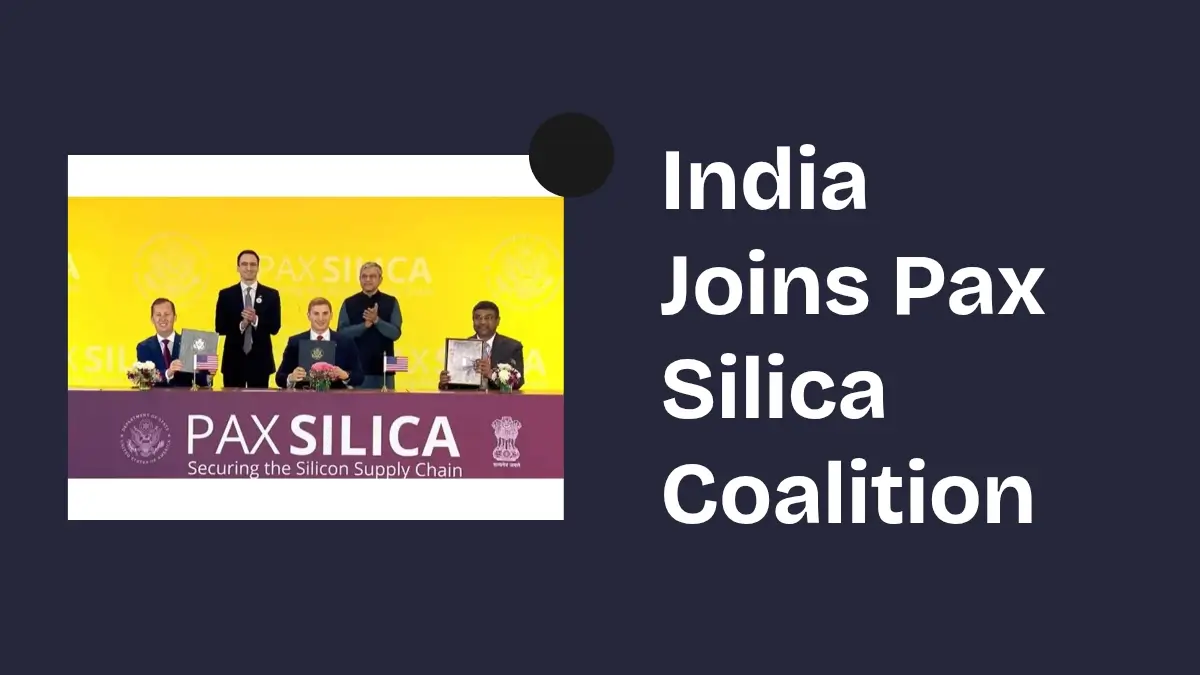
India has formally signed the Pax Silica Declaration, joining a US-led global strategic coalition aimed at building secure, resilient supply chains for critical minerals, semiconductors, artificial intelligence (AI), and advanced manufacturing technologies. The declaration was signed during the India AI Impact Summit 2026 in New Delhi in the presence of Union Minister Ashwini Vaishnaw, U.S. Under Secretary of State for Economic Affairs Jacob Helberg, and U.S. Ambassador Sergio Gor, among other dignitaries.
Strategic Importance of Pax Silica
The Pax Silica initiative is a coalition of like-minded democratic nations that seeks to create reliable, diversified, and innovation-driven global supply chains for technologies foundational to the 21st century — from critical minerals like silica and rare earths to semiconductors and AI systems. Past supply chain disruptions during geopolitical crises highlighted the risks posed by over-dependence on a single nation or region for key technological inputs. Pax Silica aims to reduce this vulnerability by aligning policies, encouraging joint investments, and promoting cooperation among trusted partners.
India’s Role and Strategic Gains
By joining Pax Silica, India aims to strengthen its position in global technology supply chains — particularly in semiconductor design and manufacturing, critical mineral processing, and AI research and deployment. Officials state that India’s vast engineering talent, expanding semiconductor ecosystem, and growing capability in mineral production make it a valuable partner. India is also expected to benefit from greater access to advanced technology, capital, and collaborations in semiconductor fabrication and AI infrastructure development.
Economic and Technological Implications
Economically, this collaboration could accelerate India’s ambitions to develop domestic semiconductor manufacturing facilities and reduce its reliance on imports from dominant players like China. The move is also expected to stimulate job creation in high-tech sectors and attract foreign direct investment into India’s technology ecosystem. Additionally, businesses in the mineral and tech sectors have already reacted positively, with companies such as Gujarat Mineral Development Corporation (GMDC) registering a notable uptick in share prices following the announcement.
Geopolitical Context and Supply Chain Security
Joining Pax Silica is also viewed through the lens of geopolitics. As major powers seek to safeguard technological ecosystems and reduce vulnerabilities to supply chain coercion, India’s participation signals a strengthened strategic alignment with the United States and other democracies. It also reinforces India’s role as a key player in the Indo-Pacific economic and security architecture.

Why This News Is Important for Government Exam Aspirants
Relevance to Economic and Technological Affairs
This development holds significance for competitive exams because it reflects India’s economic diplomacy in the arena of global supply chain security, a topic frequently covered in the International Relations and Economic Development sections of exams like UPSC (IAS), PSCs, Banking, Railways, and Defence Exams. Pax Silica represents a new dimension of global cooperation that goes beyond traditional trade agreements and dives deep into the modern technological ecosystem involving semiconductors, AI, and critical minerals.
Implications for National Security and Policy
The initiative underscores how economic security intersects with national security. Supply chain resilience in semiconductors and critical minerals affects everything from defence manufacturing to information technology infrastructure. For civil services and defence aspirants, understanding such strategies is vital because they illustrate practical applications of national policy in a complex geopolitical environment.
Connection with India’s Growth Trajectory
India’s participation highlights its growing strategic significance in global affairs, especially as it balances relationships with major powers while pursuing self-reliance in key industries. This aligns with government priorities like Atmanirbhar Bharat (Self-Reliant India) and expanding technological capabilities — topics that are directly relevant to questions on current affairs, policy analysis, and international collaborations in competitive exams.
Historical Context: Background of Pax Silica and India’s Entry
The Pax Silica initiative was launched in December 2025, with the United States inviting like-minded nations to form a coalition focused on building robust, trusted supply chains for critical minerals, semiconductors, artificial intelligence, advanced manufacturing, and data infrastructure. Its members include nations such as Australia, Japan, South Korea, the United Kingdom, Singapore, Qatar, the UAE, Israel, and others.
Historically, the global supply chain for semiconductors and critical minerals has been dominated by a few countries, particularly China. The COVID-19 pandemic and subsequent geopolitical tensions underscored vulnerabilities in this system. Many nations realised that over-dependence on single sources for key technologies and components could have severe economic and security repercussions.
Earlier, India was not part of the initial launch of Pax Silica due to its comparatively limited semiconductor fabrication capacity and evolving technology ecosystem. However, ongoing diplomatic engagement and India’s growing technological capabilities led to its inclusion in early 2026, marking a strategic convergence of interests between India and the United States.
The name “Pax Silica” is symbolic — “Pax” refers to peace (from Latin), while “Silica” represents silicon’s foundational role in semiconductor technology. This reflects an overarching aim of fostering stability and cooperation through secure technological ecosystems that drive global economic growth.
Key Takeaways from India Joins Pax Silica Initiative
| S. No. | Key Takeaway |
|---|---|
| 1 | India formally signed the Pax Silica Declaration at the India AI Impact Summit 2026. |
| 2 | The initiative is a US-led coalition aimed at building resilient supply chains for critical minerals, semiconductors, and AI. |
| 3 | India’s participation is expected to strengthen its domestic tech ecosystem and reduce dependency on foreign supply chains. |
| 4 | The collaboration has significant economic, technological, and geopolitical implications for India’s global integration. |
| 5 | Firms in the mineral and tech sectors reacted positively, indicating potential market gains from strategic alliances. |
Frequently Asked Questions (FAQs)
1. What is the Pax Silica Partnership?
The Pax Silica Partnership is a US-led strategic initiative aimed at strengthening global supply chains for critical minerals, semiconductors, artificial intelligence (AI), and advanced technologies. It focuses on reducing over-dependence on single countries for essential tech inputs.
2. Which country leads the Pax Silica initiative?
The initiative is led by the United States as part of its broader strategy to secure supply chains and promote cooperation among trusted partners.
3. Why are critical minerals important?
Critical minerals such as lithium, rare earth elements, and silicon are essential for manufacturing semiconductors, electric vehicles, renewable energy systems, and defence equipment. Their supply security directly impacts economic and national security.
4. How does this partnership benefit India?
India gains access to advanced semiconductor technologies, improved investment opportunities, and stronger integration into global tech supply chains. It also supports India’s goal of becoming a semiconductor manufacturing hub.
5. How is this relevant for UPSC and other competitive exams?
This topic is important for International Relations, Economic Development, Science & Technology, and National Security sections of exams such as UPSC, State PSCs, SSC, Banking, Railways, and Defence.
6. What is the link between Pax Silica and semiconductor security?
Semiconductors power modern electronics, defence systems, and AI applications. By diversifying production and mineral sourcing, Pax Silica aims to prevent disruptions similar to those seen during the COVID-19 pandemic.
7. How does this move align with India’s domestic policies?
It complements India’s Production Linked Incentive (PLI) schemes, semiconductor mission, and broader goal of technological self-reliance under Atmanirbhar Bharat.
8. What geopolitical significance does this partnership hold?
It strengthens India’s strategic alignment with democratic nations and enhances its role in the Indo-Pacific economic framework.
Some Important Current Affairs Links