





GIS platform for rural water and sanitation launched by DDWS and BISAG-N to improve Jal Jeevan Mission monitoring, promote Digital India, and enhance rural development outcomes.
DDWS and BISAG-N Collaborate to Enhance Rural Water and Sanitation Monitoring
Introduction to the Collaboration
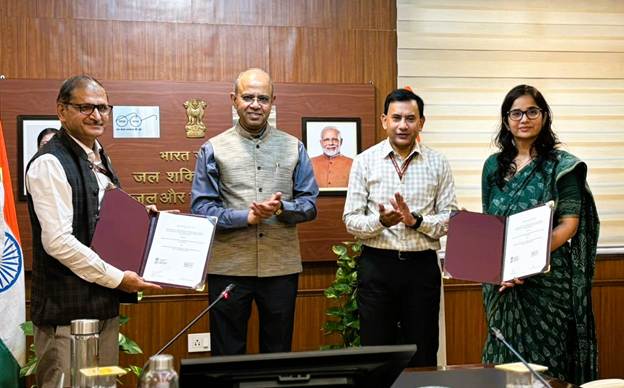
On October 6, 2025, the Department of Drinking Water and Sanitation (DDWS), under the Ministry of Jal Shakti, signed a Memorandum of Agreement (MoA) with the Bhaskaracharya National Institute for Space Applications and Geo-informatics (BISAG-N), an autonomous scientific society under the Ministry of Electronics and Information Technology (MeitY). This partnership aims to develop a Geographic Information System (GIS)-integrated decision-support platform to bolster the monitoring and management of rural water supply and sanitation initiatives.
Objectives of the GIS Platform
The primary objective of this collaboration is to enhance data-driven decision-making, planning, monitoring, and evaluation of rural water supply and sanitation initiatives across the country. The GIS platform will facilitate real-time visualization, analytics, and informed decision support, thereby improving the efficiency and effectiveness of the Jal Jeevan Mission (JJM) and the Swachh Bharat Mission (Grameen) [SBM(G)] portals.
Key Features of the Platform
- Mapping of Rural Piped Water Supply Schemes (RPWSS): The platform will support the creation and mapping of RPWSS, enabling unique scheme-level IDs.
- Granular Monitoring: It will allow for household-level monitoring of water delivery, facilitating convergence with other rural infrastructure initiatives.
- Advanced GIS Capabilities: BISAG-N will provide end-to-end support, including database design, map creation, data migration, software development, and systems integration. The platform will also incorporate advanced features such as ground control surveying, digital photogrammetry, vector data capture, and thematic mapping.
Alignment with PM GatiShakti National Master Plan
The initiative aligns with the PM GatiShakti National Master Plan, enabling seamless integration of water and sanitation infrastructure with other sectoral assets. This convergence will help in optimizing resource allocation, improving service delivery, and accelerating infrastructure development in rural areas.
Support for Digital India Vision
This collaboration supports the Government of India’s Digital India vision by creating a robust digital ecosystem for effective planning and monitoring of rural water and sanitation services. By integrating spatial intelligence with mission data, DDWS and BISAG-N aim to create a robust digital ecosystem that supports effective planning and monitoring of rural water and sanitation services.
Why This News is Important
Enhancing Transparency and Accountability
The integration of GIS technology into rural water and sanitation initiatives will significantly enhance transparency and accountability. Real-time data visualization and monitoring will allow for timely identification of issues and ensure that resources are utilized efficiently.
Supporting Sustainable Development Goals
Access to clean water and sanitation is a fundamental human right and a key component of the Sustainable Development Goals (SDGs). This initiative supports India’s commitment to achieving SDG 6, which aims to ensure availability and sustainable management of water and sanitation for all.
Facilitating Informed Decision-Making
The GIS platform will provide policymakers and implementers with accurate and up-to-date information, enabling informed decision-making. This will lead to more effective planning and implementation of water and sanitation projects.
Promoting Convergence with Other Infrastructure Initiatives
By mapping water and sanitation infrastructure on the same platform as other rural infrastructure initiatives, the project promotes convergence. This holistic approach ensures that all aspects of rural development are considered in planning and implementation.
Aligning with National Digital Initiatives
The initiative aligns with the Government of India’s Digital India vision, leveraging technology to improve public service delivery. It demonstrates the government’s commitment to using digital tools to enhance governance and service delivery in rural areas.
Historical Context
Launch of Jal Jeevan Mission
The Jal Jeevan Mission was launched in 2019 with the aim of providing tap water connections to every rural household by 2024. At that time, out of 17.87 crore rural households in India, about 14.6 crore households (81.67%) lacked tap connections. The mission aimed to provide potable water in adequate quantity (55 liters per capita per day) of prescribed quality (BIS Standard IS: 10500) on a regular basis.
Progress and Extension of the Mission
Since its launch, the Jal Jeevan Mission has approved 6.41 lakh water supply schemes, with an overall cost of Rs 8.29 lakh crore, to provide tap connections to 12.74 crore households. A total expenditure of Rs 3.91 lakh crore has been incurred so far. In the 2025 Budget, Finance Minister Nirmala Sitharaman announced the continuation of the mission with enhanced financial support until 2028.
Key Takeaways from “DDWS and BISAG-N Forge GIS Platform for Rural Water & Sanitation”
| S.No. | Key Takeaway |
|---|---|
| 1. | MoA Signed Between DDWS and BISAG-N: The Department of Drinking Water and Sanitation (DDWS) signed a Memorandum of Agreement (MoA) with the Bhaskaracharya National Institute for Space Applications and Geo-informatics (BISAG-N) to develop a GIS-integrated decision-support platform for rural water and sanitation initiatives. |
| 2. | Enhanced Monitoring Capabilities: The GIS platform will enable real-time visualization, analytics, and informed decision support, improving the monitoring and management of the Jal Jeevan Mission (JJM) and the Swachh Bharat Mission (Grameen) [SBM(G)] portals. |
| 3. | Advanced GIS Features: The platform will incorporate advanced GIS capabilities such as ground control surveying, digital photogrammetry, vector data capture, and thematic mapping, providing comprehensive support for database design, map creation, data migration, software development, and systems integration. |
| 4. | Alignment with PM GatiShakti National Master Plan: The initiative aligns with the PM GatiShakti National Master Plan, enabling seamless integration of water and sanitation infrastructure with other sectoral assets, optimizing resource allocation, and accelerating infrastructure development in rural areas. |
| 5. | Support for Digital India Vision: The collaboration supports the Government of India’s Digital India vision by creating a robust digital ecosystem for effective planning and monitoring of rural water and sanitation services, leveraging technology for inclusive and sustainable development. |
FAQs: Frequently Asked Questions
1. What is the purpose of the DDWS and BISAG-N collaboration?
The collaboration aims to develop a GIS-integrated decision-support platform to monitor and manage rural water supply and sanitation initiatives effectively.
2. Which government missions will benefit from the GIS platform?
The platform will enhance monitoring and management of the Jal Jeevan Mission (JJM) and Swachh Bharat Mission (Grameen) [SBM(G)].
3. What are the key features of the GIS platform?
The platform includes mapping of rural piped water supply schemes, household-level monitoring, database design, map creation, data migration, software development, thematic mapping, and advanced GIS capabilities like digital photogrammetry and vector data capture.
4. How does this initiative align with PM GatiShakti?
It allows integration of water and sanitation infrastructure with other rural infrastructure, optimizing resource allocation and accelerating development.
5. How does the platform support Digital India?
By creating a robust digital ecosystem, it enables accurate planning, real-time monitoring, and efficient governance in rural water and sanitation services.
6. What is the significance of GIS in rural development?
GIS provides spatial data analytics for informed decision-making, improves transparency, ensures efficient resource utilization, and promotes convergence with other development initiatives.
7. When was the Jal Jeevan Mission launched and what is its objective?
Launched in 2019, the Jal Jeevan Mission aims to provide tap water connections to every rural household by 2024.
Some Important Current Affairs Links