




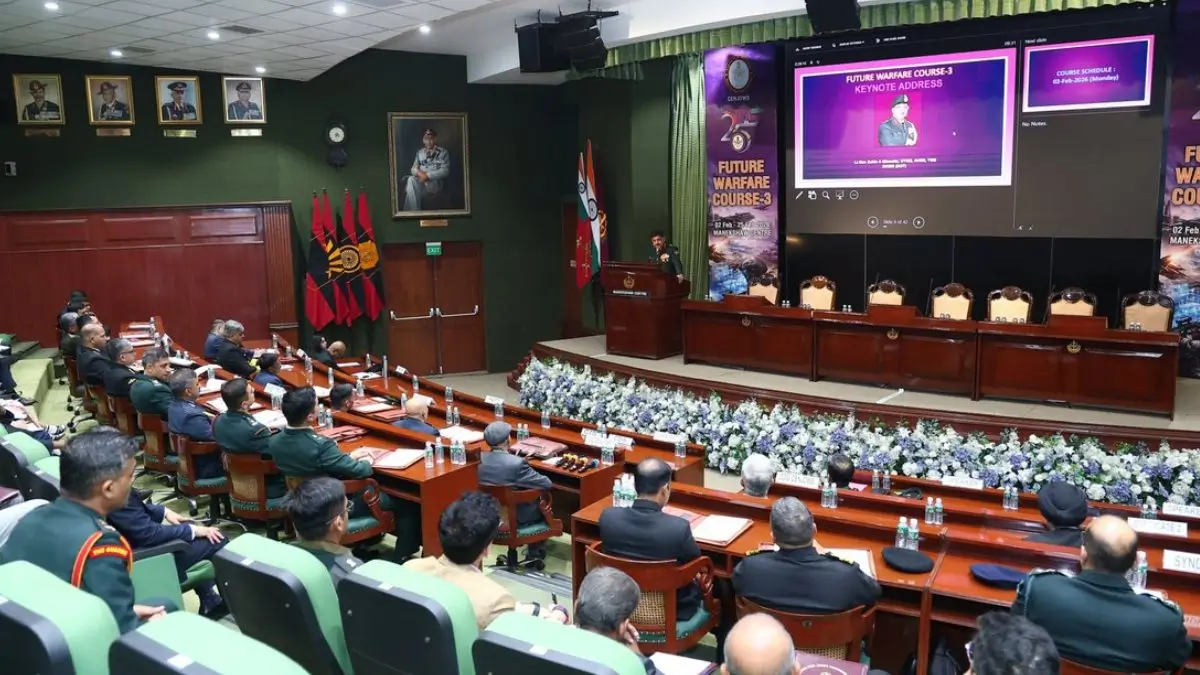
Future Warfare Course India 2026 launched at Manekshaw Centre, New Delhi. Learn about tri-services training, emerging defence technologies, and multi-domain warfare strategies.
India’s Third Edition of Tri‑Services Future Warfare Course Launched in New Delhi
On 2 February 2026, India officially launched the third edition of the Future Warfare Course at the Manekshaw Centre in New Delhi, aimed at equipping its armed forces with critical skills for modern warfare. This high‑level defence programme brings together officers from the Army, Navy, and Air Force, along with experts from the defence industry and strategic sectors, to explore evolving technological and geopolitical challenges shaping the battlefield of tomorrow.
The three‑week programme, running until 25 February 2026, is conducted under the aegis of the Headquarters Integrated Defence Staff (HQ IDS) in partnership with the Centre for Joint Warfare Studies (CENJOWS). Its curriculum is designed to foster a deep understanding of how emerging technology, such as artificial intelligence, cyber capabilities, autonomous systems, and space assets, is transforming military doctrines, strategies, and tactics.
A unique feature of this edition is its expanded and enhanced curriculum, which goes beyond traditional military education to include domain‑specific developments like supply‑chain vulnerabilities, critical and rare earth elements, and regional/global geopolitics that influence future military operations. Participants are taken through practical demonstrations, expert lectures, and visits to institutions critical to India’s defense capabilities, making the learning experience both broad and immersive.
The course also highlights India’s intention to bridge the gap between operational military priorities and indigenous defence industry capabilities. By including representatives from startups, MSMEs, DPSUs, and private industry players, the programme encourages collaborative discussions, empowering military leaders to better integrate homegrown innovations into future combat operations.
In essence, this tri‑services course not only reinforces the strategic vision of future warfare preparedness but also strengthens the jointness among the three services, fostering a holistic approach to national security challenges.

Why This News Is Important for Government Exam Aspirants
Relevance for Defence and General Studies
Understanding developments in India’s defence strategy is crucial for aspirants preparing for exams like UPSC Civil Services (IAS, IPS), SSC GD, CAPF, NDA/CDS, and other competitive government recruitment tests. The Future Warfare Course reflects how India’s armed forces are adapting to the rapid technological shift in modern warfare, which is increasingly focused on cyber, space, AI, robotics, and multi‑domain operations. Such topics are often asked in general studies (GS) papers, particularly under GS Paper‑3 (Defence, Technology & Security).
Strategic and Policy Implications
The launch of this course signals India’s proactive approach in preparing its military leadership to confront future security threats. It also demonstrates India’s focus on joint operational readiness, technological integration, and collaboration with the defence industry, which are key themes in current affairs and national security discussions. Questions may be framed around India’s efforts to build technologically advanced defence capabilities, partnerships between military and industry, and evolving warfare doctrines in the 21st century.
Interdisciplinary Importance
The programme intersects with technology, geopolitics, industry, and defence economics, making it relevant across multiple sections of competitive exams. Aspirants should note how the course incorporates non‑traditional warfare domains and emerging tech topics, as these areas are becoming increasingly significant in both preliminary and mains exams, as well as in interview stages that test candidates’ understanding of India’s strategic direction.
Historical Context: Evolution of the Future Warfare Course
India’s focus on future warfare preparedness stems from the growing complexity of global security landscapes. Traditional battlefield dominance is evolving with innovations in cyber defence, artificial intelligence, unmanned systems, and space capabilities. Recognising this shift, the Indian military launched the first Future Warfare Course in September 2024 under the guidance of Chief of Defence Staff General Anil Chauhan, with the aim of developing a joint, technology‑savvy force capable of addressing multi‑domain challenges.
The Future Warfare Course represents a strategic shift from conventional military training toward holistic and integrated defence education. The curriculum reflects lessons from modern conflicts, where rapid information flow, autonomous weapons, and cyber operations play a dominant role. By bringing together officers of varying ranks and defence industry stakeholders, the programme cultivates critical thinking and collaboration across disciplines—preparing military leaders not just for current challenges, but for future contingencies.
Key Takeaways from “Third Edition of Future Warfare Course Launched in New Delhi”
| S. No. | Key Takeaway |
|---|---|
| 1 | The Third Edition of the Future Warfare Course commenced at the Manekshaw Centre, New Delhi on 2 February 2026 and runs until 25 February 2026. |
| 2 | The course is conducted under Headquarters Integrated Defence Staff (HQ IDS) and the Centre for Joint Warfare Studies (CENJOWS). |
| 3 | It includes officers from the Army, Navy, and Air Force, along with defence industry representatives, startups, MSMEs, and DPSUs. |
| 4 | The curriculum focuses on emerging technologies, multi‑domain warfare, geopolitics, AI, cyber, space, and supply‑chain vulnerabilities. |
| 5 | The programme aligns military operational priorities with indigenous defence innovations, fostering joint preparedness and strategic integration. |
FAQs: Frequently Asked Questions for Exam Preparation
Q1. What is the Future Warfare Course in India?
The Future Warfare Course is a tri-services defence programme designed to train officers of the Army, Navy, and Air Force in modern warfare strategies, emerging technologies, and joint operational planning.
Q2. When and where was the third edition of the Future Warfare Course launched?
It was launched on 2 February 2026 at the Manekshaw Centre, New Delhi, and will run until 25 February 2026.
Q3. Which organizations are conducting the course?
The course is conducted by the Headquarters Integrated Defence Staff (HQ IDS) in collaboration with the Centre for Joint Warfare Studies (CENJOWS).
Q4. What are the main topics covered in this edition of the course?
Topics include emerging technologies, artificial intelligence, cyber warfare, autonomous systems, space operations, supply-chain vulnerabilities, and global geopolitics affecting military strategy.
Q5. Who participates in the Future Warfare Course besides military officers?
Besides military officers, participants include representatives from startups, MSMEs, Defence Public Sector Undertakings (DPSUs), and private defence industry experts to encourage innovation in military applications.
Q6. Why is the Future Warfare Course important for India?
It strengthens jointness among the three services, aligns defence strategies with technological advancements, and prepares India to handle multi-domain threats in future conflicts.
Q7. How does this course benefit students preparing for government exams?
The course provides knowledge on modern defence strategies, military technology, and India’s security policies, which are frequently asked in UPSC, CAPF, CDS, NDA, SSC, and other exams.
Some Important Current Affairs Links




