

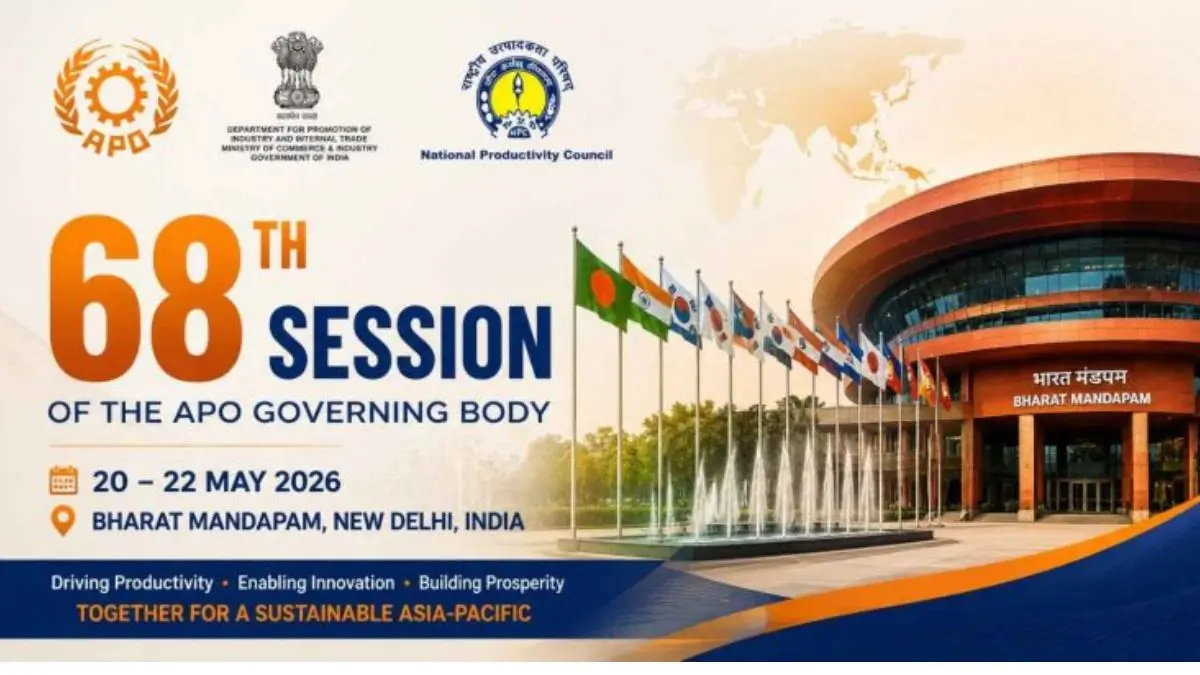
APO Governing Body Meeting 2026 in New Delhi highlights India’s growing regional leadership, APO Vision 2030, governance reforms, important current affairs MCQs, FAQs and key takeaways for UPSC, SSC, Banking and PCS exams.
India has strengthened its position as a major regional economic and productivity partner by hosting the 68th Session of the Asian Productivity Organization (APO) Governing Body Meeting in New Delhi. The high-level international meeting is being held at Bharat Mandapam and has brought together delegates, policymakers, and productivity experts from across the Asia-Pacific region.
India Chairs the APO Governing Body
India is currently serving as the Chair of the APO Governing Body. The three-day summit from May 20 to May 22 witnessed participation from more than 60 senior delegates representing 20 APO member economies. The event highlights India’s growing diplomatic and economic influence in regional cooperation mechanisms.
The meeting is considered one of the most important annual gatherings related to productivity enhancement, economic cooperation, and sustainable growth in the Asia-Pacific region. Union Commerce and Industry Minister Piyush Goyal attended the inaugural session and emphasized the need for innovation-driven growth and institutional collaboration among member countries.
Focus on APO Vision 2030
A major agenda of the meeting is the review of the APO Vision 2030 framework. The framework focuses on improving productivity-led economic transformation among member countries through technology, innovation, skill development, and sustainability initiatives.
Delegates are discussing how member economies can collectively strengthen industrial productivity and adapt to emerging economic challenges. Topics such as digital transformation, green growth, innovation ecosystems, and governance reforms are receiving special attention during the summit.
Budget Planning and Governance Reforms
Another important area of discussion is the APO preliminary budget for the 2027–28 biennium. Financial planning remains central to implementing long-term productivity programs and institutional reforms. Member countries are also reviewing procedures related to the election of the APO Secretary-General and organizational governance mechanisms.
The meeting will also elect the APO Chair and Vice Chairs for the 2026–27 term. These discussions are expected to improve transparency, efficiency, and institutional accountability within the organization.
Participation of International Observers
Apart from APO member economies, observers from Kazakhstan, Uzbekistan, and Bhutan are also participating in the meeting. Representatives from the Global Green Growth Institute have joined the discussions as well.
The participation of observers reflects the growing importance of productivity-led sustainable development and regional cooperation in Asia-Pacific economies.
APO National Awards Programme
One of the major highlights of the summit is the APO National Awards Programme. Awards are being presented in categories such as Productivity Advocates and Productivity Technical Experts. These recognitions aim to encourage institutions and professionals working toward productivity enhancement and innovation.
The awards also strengthen the role of National Productivity Organizations in promoting operational efficiency and best practices among member economies.
About the Asian Productivity Organization
The Asian Productivity Organization was established in 1961 and currently consists of 21 member economies from the Asia-Pacific region. The organization works to improve productivity through policy cooperation, technical assistance, institutional capacity building, and knowledge-sharing initiatives.
Over the decades, the APO has played a significant role in helping member countries improve industrial efficiency, economic competitiveness, and sustainable socioeconomic development.
India’s Expanding Regional Leadership
India’s hosting of the 68th APO Governing Body Meeting reflects its broader ambition to become a leading force in regional economic governance and innovation-driven growth. The summit provides opportunities for bilateral and multilateral engagements among participating nations.
The discussions align with India’s priorities related to manufacturing competitiveness, digital public infrastructure, sustainability, and regional economic integration. The event also demonstrates India’s commitment to strengthening partnerships across the Asia-Pacific region.

Why This News is Important
Important for International Organizations and Governance
This news is highly important for competitive examinations because questions related to international organizations, their headquarters, objectives, and recent meetings are frequently asked in UPSC, SSC, Banking, Railways, Defence, and State PCS examinations.
The Asian Productivity Organization is an important intergovernmental body in the Asia-Pacific region. Candidates preparing for government examinations must remember that the APO was established in 1961 and currently has 21 member economies. The organization focuses on productivity enhancement and sustainable development.
Significance for India’s Foreign Policy
India hosting the 68th APO Governing Body Meeting highlights the country’s growing role in regional diplomacy and economic cooperation. Such international events improve India’s image as a leader in innovation, governance reforms, and sustainable development.
For civil services aspirants, the event is important from the perspective of international relations, economic diplomacy, regional cooperation, and India’s “Act East” policy objectives.
Important for Economy and Sustainable Development
The meeting focuses on productivity-led growth, innovation, digital transformation, and green development strategies. These are key themes in India’s economic policy and global economic discussions.
Competitive exams increasingly ask questions related to sustainability, governance reforms, economic institutions, and productivity enhancement. Therefore, understanding the objectives and outcomes of this summit becomes highly relevant for aspirants.
Historical Context
Establishment of the Asian Productivity Organization
The Asian Productivity Organization was established in 1961 to improve productivity and economic growth among Asia-Pacific economies. It was created during a period when many Asian countries were focusing on industrialization and modernization after independence and post-war reconstruction.
The organization aimed to strengthen cooperation among member nations through knowledge exchange, policy dialogue, training programs, and technical assistance.
India’s Role in APO
India has been an active member of the APO since its early years. Through organizations such as the National Productivity Council, India has participated in multiple APO initiatives related to manufacturing, agriculture, digital transformation, and skill development.
Over time, India’s role within the APO has expanded due to its growing economy and technological advancements. India assumed the chairmanship of the APO Governing Body during the previous session held in 2025.
Evolution of Productivity and Innovation Policies
Initially, the APO mainly focused on industrial productivity and operational efficiency. However, in recent years, the organization has expanded its focus to include digital innovation, sustainability, climate resilience, green growth, and knowledge-based economies.
The APO Vision 2030 framework reflects this transformation and aims to prepare member economies for future technological and economic challenges.
Key Takeaways from This News
| S.No. | Key Takeaway |
|---|---|
| 1 | India hosted the 68th Session of the Asian Productivity Organization Governing Body Meeting in New Delhi from May 20–22, 2026. |
| 2 | More than 60 delegates from 20 APO member economies participated in the summit. |
| 3 | The APO was established in 1961 and currently consists of 21 member economies in the Asia-Pacific region. |
| 4 | Major agenda items included APO Vision 2030, governance reforms, budget planning for 2027–28, and Secretary-General election procedures. |
| 5 | India’s hosting of the summit reflects its growing leadership role in regional economic cooperation, productivity enhancement, and sustainable development. |
FAQs Related to 68th APO Governing Body Meeting
1. What is the Asian Productivity Organization (APO)?
The Asian Productivity Organization (APO) is an intergovernmental organization established in 1961 to improve productivity and economic growth among member economies in the Asia-Pacific region.
2. Where was the 68th APO Governing Body Meeting held?
The 68th APO Governing Body Meeting was held in New Delhi, India, at Bharat Mandapam.
3. How many member economies are part of the APO?
The APO currently has 21 member economies from the Asia-Pacific region.
4. Which country chaired the 68th APO Governing Body Meeting?
India chaired the 68th APO Governing Body Meeting.
5. Which Indian minister attended the APO meeting?
Union Commerce and Industry Minister Piyush Goyal attended the inaugural session of the meeting.
6. What is APO Vision 2030?
APO Vision 2030 is a strategic framework aimed at promoting productivity-driven economic transformation through innovation, digitalization, sustainability, and skill development.
7. Why is the APO important for competitive examinations?
Questions related to international organizations, regional cooperation, sustainable development, and economic governance are frequently asked in UPSC, SSC, Banking, Railways, Defence, and State PCS examinations.
8. In which year was the APO established?
The APO was established in 1961.
9. What are the major focus areas discussed during the APO meeting?
Major focus areas included digital transformation, green growth, governance reforms, innovation ecosystems, and productivity enhancement.
10. Which countries participated as observers in the meeting?
Kazakhstan, Uzbekistan, and Bhutan participated as observer countries during the summit.
Some Important Current Affairs Links