









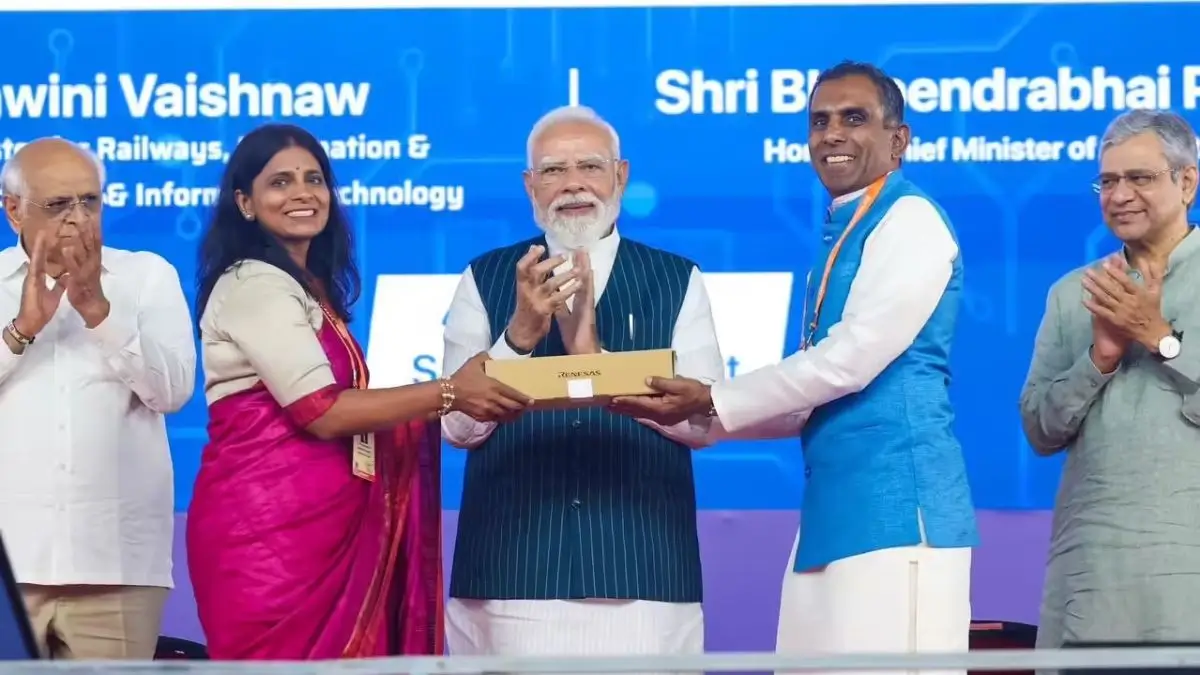
CG Semi OSAT facility in Sanand 2026 marks a major step in India’s semiconductor ecosystem. Learn about the India Semiconductor Mission, OSAT technology, significance, key facts, MCQs, and exam-oriented current affairs for UPSC, SSC, Banking, Railways, Defence, and State PSC exams.
Introduction
Prime Minister Narendra Modi inaugurated the CG Semi Outsourced Semiconductor Assembly and Test (OSAT) facility at Sanand in Gujarat, marking another significant milestone in India’s journey toward becoming a global semiconductor manufacturing hub. The facility represents one of India’s major investments in semiconductor packaging and testing infrastructure and aligns with the government’s long-term vision of building a self-reliant electronics manufacturing ecosystem under initiatives such as Make in India, Digital India, and the India Semiconductor Mission. The project is part of the broader effort to reduce India’s dependence on imported semiconductor chips while attracting global investments into the country’s high-technology manufacturing sector.
CG Semi OSAT Facility: What Has Been Inaugurated?
The newly inaugurated CG Semi facility is an Outsourced Semiconductor Assembly and Test (OSAT) plant located in Sanand, Gujarat. OSAT facilities play a crucial role in the semiconductor value chain by assembling semiconductor chips into finished packages and conducting extensive quality testing before they reach electronic manufacturers.
Unlike semiconductor fabrication plants (fabs), which manufacture silicon wafers, OSAT plants focus on packaging, assembling, and testing chips. These processes ensure that semiconductor devices function reliably before being integrated into smartphones, automobiles, medical devices, industrial equipment, defence systems, and communication technologies.
The Sanand plant has been established with substantial investment and is expected to contribute significantly to India’s semiconductor manufacturing capabilities.
Why Sanand Has Become India’s Semiconductor Hub
Sanand has rapidly emerged as one of India’s most important electronics and semiconductor manufacturing clusters. The region already hosts multiple electronics industries and enjoys strong infrastructure, including highways, logistics facilities, skilled manpower, and industrial parks.
The inauguration of the CG Semi facility further strengthens Gujarat’s position as India’s preferred destination for semiconductor investments. With multiple semiconductor projects already approved or under construction in the state, Sanand is evolving into a complete semiconductor ecosystem rather than merely a manufacturing location.
Importance of OSAT Facilities
Modern semiconductor manufacturing consists of several stages:
- Chip design
- Wafer fabrication
- Assembly
- Packaging
- Testing
- Distribution
OSAT companies specialize in the last three stages. These stages are extremely important because advanced packaging technologies improve chip performance, reduce power consumption, and increase reliability.
Countries such as Taiwan, Malaysia, Singapore, China, and South Korea dominate the OSAT industry. India is now attempting to build similar capabilities through investments under the India Semiconductor Mission.
How the Facility Supports India’s Semiconductor Mission
India launched the India Semiconductor Mission (ISM) to establish a complete semiconductor ecosystem within the country. The mission provides financial incentives for semiconductor fabrication units, assembly facilities, display manufacturing, design companies, and research institutions.
The CG Semi OSAT facility contributes directly to this objective by:
- Reducing dependence on imported semiconductor packaging.
- Creating advanced manufacturing capabilities.
- Strengthening domestic electronics production.
- Supporting electronics exports.
- Developing skilled manpower.
- Encouraging global semiconductor firms to invest in India.
The project demonstrates that India is gradually moving beyond chip design into manufacturing and packaging.
Economic Significance
The semiconductor industry is considered one of the world’s most strategic industries because almost every modern electronic device depends upon chips.
The CG Semi facility is expected to:
- Generate direct and indirect employment.
- Increase investment in Gujarat.
- Promote ancillary industries.
- Boost electronics manufacturing.
- Support India’s export ambitions.
- Improve technological self-reliance.
As semiconductor demand continues to grow globally due to artificial intelligence, electric vehicles, 5G, automation, and Internet of Things (IoT), India’s investments could yield long-term economic benefits.
Applications of Semiconductor Chips
Semiconductors manufactured and tested through such facilities are used in numerous sectors:
- Smartphones
- Computers
- Laptops
- Electric vehicles
- Medical equipment
- Defence electronics
- Space technology
- Consumer appliances
- Artificial Intelligence hardware
- Telecom infrastructure
- Industrial automation
Because semiconductors are used across strategic sectors, countries increasingly view semiconductor manufacturing as an issue of economic and national security.
Government Initiatives Supporting the Sector
The Government of India has introduced several initiatives to strengthen semiconductor manufacturing:
- India Semiconductor Mission (ISM)
- Production Linked Incentive (PLI) Scheme
- Design Linked Incentive (DLI)
- SPECS Scheme
- Modified Electronics Manufacturing Clusters Scheme
- Make in India
- Digital India
These schemes collectively aim to establish India as an attractive destination for semiconductor investment while creating employment and encouraging innovation.
Global Importance of Semiconductor Manufacturing
The COVID-19 pandemic exposed vulnerabilities in global semiconductor supply chains. Shortages affected automobile manufacturing, consumer electronics, defence production, and industrial automation across the world.
Countries including the United States, Japan, South Korea, members of the European Union, and India have therefore increased investments in domestic semiconductor production.
India’s growing semiconductor ecosystem is expected to reduce supply chain risks while integrating the country into global value chains.
Benefits for Government Exam Aspirants
This development is relevant for UPSC, State PSCs, SSC, Banking, Railways, Defence, Police, and Teaching examinations because it covers multiple syllabus areas:
- Science & Technology
- Indian Economy
- Industrial Development
- Government Schemes
- Manufacturing
- Electronics Industry
- Make in India
- Current Affairs
- Infrastructure Development
Students should understand both the technological and economic significance of semiconductor manufacturing.

Why This News Is Important
Strengthening India’s Strategic Technology Sector
Semiconductors are the foundation of the modern digital economy. From mobile phones and electric vehicles to satellites and defence equipment, every advanced technology depends on semiconductor chips. The inauguration of the CG Semi OSAT facility demonstrates India’s commitment to developing indigenous semiconductor capabilities rather than depending heavily on imports.
Reducing Import Dependence
India currently imports a significant proportion of its semiconductor requirements. By expanding domestic assembly, testing, and packaging infrastructure, the country can gradually reduce import dependence and strengthen supply chain resilience.
Boosting Employment and Investment
Large semiconductor projects generate high-skilled employment while attracting additional investment from global technology companies. They also promote ancillary industries such as chemicals, logistics, precision engineering, electronics manufacturing, and research.
Supporting National Security
Semiconductors are critical for defence, communication, aerospace, cybersecurity, and strategic industries. Building domestic capabilities enhances technological sovereignty and reduces vulnerabilities associated with international supply disruptions.
Important for Competitive Examinations
Questions related to India’s semiconductor policy, India Semiconductor Mission, OSAT facilities, electronics manufacturing, industrial corridors, Make in India, and strategic industries frequently appear in UPSC, State PSC, Banking, SSC, Railways, and Defence examinations. Therefore, candidates should understand the significance of this development from both technological and economic perspectives.
Historical Context
India’s Long Journey Towards Semiconductor Manufacturing
For many years, India excelled in semiconductor chip design but lacked large-scale commercial manufacturing facilities. The country depended primarily on imports from Taiwan, South Korea, China, and other semiconductor-producing nations.
Recognizing the strategic importance of semiconductors, the Government of India launched the India Semiconductor Mission with financial incentives for chip manufacturing, assembly, testing, packaging, and design. Since then, several major semiconductor projects have been approved across Gujarat and Assam, gradually building a complete semiconductor ecosystem. The inauguration of the CG Semi OSAT facility represents another milestone in this broader national strategy aimed at making India a trusted global semiconductor destination.
Key Takeaways from CG Semi OSAT Facility Inauguration
| S. No. | Key Takeaway |
|---|---|
| 1 | Prime Minister Narendra Modi inaugurated the CG Semi OSAT facility at Sanand, Gujarat. |
| 2 | OSAT stands for Outsourced Semiconductor Assembly and Test, an essential stage in semiconductor manufacturing. |
| 3 | The project strengthens India’s semiconductor ecosystem under the India Semiconductor Mission. |
| 4 | The facility will support electronics manufacturing, employment generation, and technological self-reliance. |
| 5 | The development is important for UPSC, PSC, SSC, Banking, Railways, Defence, and other government examinations because it relates to Science & Technology, Economy, and Government Schemes. |
FAQs: Frequently Asked Questions
1. What is the CG Semi OSAT facility inaugurated by Prime Minister Narendra Modi?
The CG Semi OSAT facility is an Outsourced Semiconductor Assembly and Test (OSAT) plant established in Sanand, Gujarat. It performs semiconductor chip packaging, assembly, and testing before chips are supplied to electronics manufacturers.
2. What does OSAT stand for?
OSAT stands for Outsourced Semiconductor Assembly and Test, which is the final stage in the semiconductor manufacturing process involving chip packaging, assembly, and quality testing.
3. Where is the newly inaugurated CG Semi OSAT facility located?
The facility is located in Sanand, Gujarat, which is emerging as one of India’s major semiconductor and electronics manufacturing hubs.
4. Why is the CG Semi OSAT facility important for India?
The facility strengthens India’s semiconductor ecosystem, reduces dependence on imported semiconductor packaging services, promotes domestic manufacturing, creates employment opportunities, and supports technological self-reliance.
5. What is the India Semiconductor Mission (ISM)?
The India Semiconductor Mission (ISM) is a Government of India initiative launched to establish a complete semiconductor manufacturing ecosystem by providing financial incentives for semiconductor fabrication, packaging, testing, display manufacturing, and chip design.
6. What is the difference between a Semiconductor Fab and an OSAT facility?
A semiconductor Fab manufactures silicon wafers and integrated circuits, while an OSAT facility assembles, packages, and tests semiconductor chips after fabrication.
7. Which government initiatives support semiconductor manufacturing in India?
Major initiatives include:
- India Semiconductor Mission (ISM)
- Production Linked Incentive (PLI) Scheme
- Design Linked Incentive (DLI)
- Make in India
- Digital India
- SPECS Scheme
8. Why are semiconductors strategically important?
Semiconductors are essential for smartphones, computers, electric vehicles, defence equipment, medical devices, satellites, AI systems, telecommunications, and industrial automation. They are considered critical for both economic growth and national security.
9. Why is Sanand becoming a semiconductor hub?
Sanand offers excellent industrial infrastructure, logistics connectivity, skilled workforce, and supportive government policies, making it attractive for semiconductor and electronics manufacturing investments.
10. Why is this topic important for government examinations?
The topic is relevant for UPSC, State PSC, SSC, Banking, Railways, Defence, Police, and Teaching examinations under Science & Technology, Economy, Government Schemes, Industrial Development, and Current Affairs.
Some Important Current Affairs Links