









C.P. Radhakrishnan Vice President sworn in as India’s 15th Vice-President on 12 September 2025, defeating B. Sudershan Reddy. Learn election details, constitutional significance, and key facts for government exams.
C.P. Radhakrishnan Sworn In as India’s 15th Vice-President
Oath of Office and Ceremonial Details
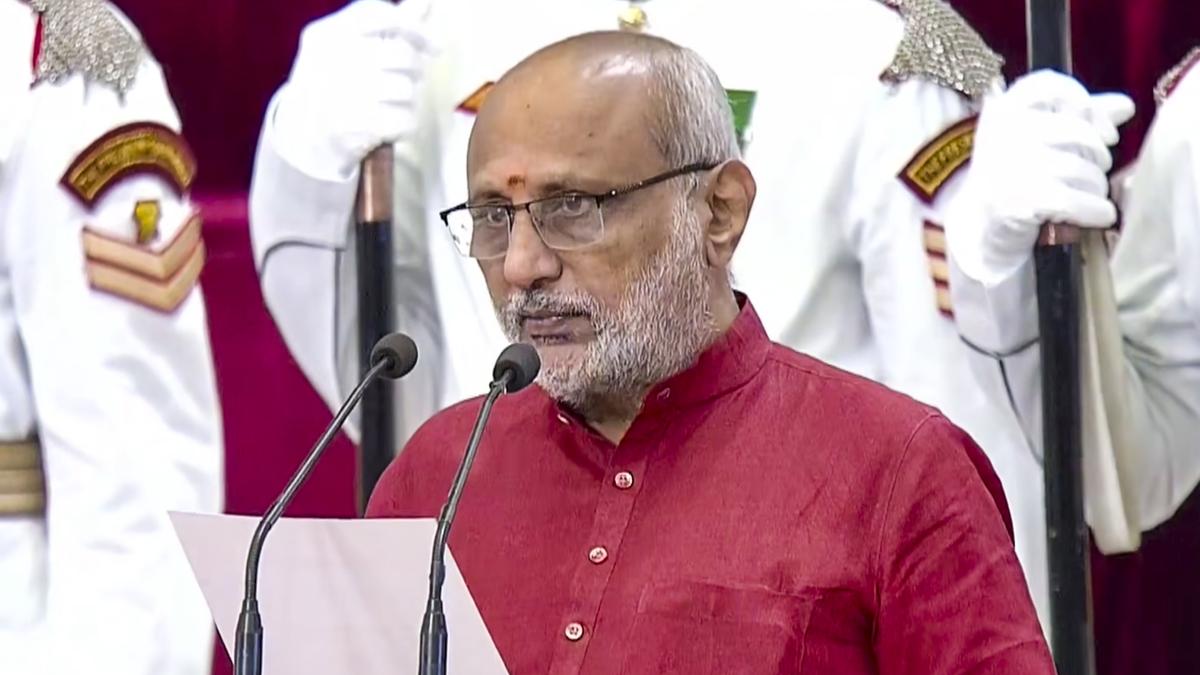
On 12 September 2025, Chandrapuram Ponnusamy Radhakrishnan took the oath as the 15th Vice-President of India and automatically became the Chairman of the Rajya Sabha. The oath was administered by President Droupadi Murmu at a brief ceremony held at Rashtrapati Bhavan in New Delhi—an event marked by dignitaries from across the political spectrum.
Electoral Victory and Vote Margin
Radhakrishnan, the nominee of the National Democratic Alliance (NDA), won the vice-presidential election held on 9 September 2025, defeating former Supreme Court Judge B. Sudershan Reddy, the candidate from the opposition INDIA bloc. He secured 452 votes while Reddy got 300 votes. The margin of victory was 152 votes.
Voter Turnout & Valid Votes
Of the 781 eligible members of Parliament, 767 MPs voted. Out of these, 752 ballots were valid and 15 were invalid. This resulted in a voter turnout of approximately 98.2%.
Profile of C.P. Radhakrishnan
Born on 4 May 1957 in Tiruppur, Tamil Nadu, Radhakrishnan holds a Bachelor’s degree in Business Administration. He began his political journey as an RSS Swayamsevak, and later became active with the Bharatiya Janasangh. Before being elected Vice-President, he served as Governor of Maharashtra, Governor of Jharkhand, and briefly held additional charge in Telangana and as Lieutenant Governor of Puducherry. He was earlier elected twice to the Lok Sabha from Coimbatore (1998 and 1999), among other roles.
After Taking Office: Symbolic Gestures and First Steps
After being sworn in, Radhakrishnan paid homage at several national memorials: he visited Rajghat to honour Mahatma Gandhi; then offered tributes to former Prime Minister Atal Bihari Vajpayee, Deendayal Upadhyaya, and Chaudhary Charan Singh. These acts underscored continuity and respect for India’s political and governance heritage.
Why This News is Important
Constitutional Significance
The Vice-President of India is the second-highest constitutional post in the country. The office is key, not only because the Vice-President acts as Chairman of the Rajya Sabha (the Upper House of Parliament), but also because in the absence, resignation, removal, or death of the President, the Vice-President performs the President’s duties. Radhakrishnan’s election thus holds weight both in legislative proceedings and in constitutional protocols.
Political Context & Balance of Power
His election reflects the strength of the ruling coalition (NDA), and suggests that the opposition (INDIA bloc) was unable to muster sufficient votes despite high turnout. Margins and cross-voting also become a lens to evaluate internal coherence or fragmentation in opposition ranks. For students of polity and current affairs, it shows how parliamentary numbers, alliances, and party discipline affect high‐office elections.
Role in Federal Relations & Parliamentary Democracy
Since Radhakrishnan has emphasized the need for “Centre-State harmony” and cooperative federalism, his tenure could impact how legislative debates unfold, how states perceive the central government, and how governance gets shaped in terms of inter-governmental coordination. Given his background across multiple states (Tamil Nadu, Maharashtra, Jharkhand, etc.), this could signal a period of bridged differences.
Relevance for Exam Preparations
This event is high yield for government exams (CSE, PSC, State Exams) under sections covering Indian Polity, Constitution, current affairs, and governance. Students are expected to know about major constitutional posts, election processes, profiles of office-holders, and the implication of such shifts. It’s also crucial for essay topics or short answer questions on recent political developments.
Historical Context
Evolution of the Vice-President’s Office
The Vice-President’s role is defined in the Indian Constitution (Articles 63-71). Since India’s independence, the post has usually been held by senior political figures. The Vice-President has duties such as presiding over Rajya Sabha sessions, casting tie votes in the Rajya Sabha, and stepping in as acting President when needed.
Recent Predecessor & Early Election Trigger
Jagdeep Dhankhar, the previous Vice-President, resigned in July 2025, ahead of his term’s scheduled expiry (which was to end in August 2027), citing health concerns. This resignation triggered an early election. Article 68 of the Constitution requires that in case of a vacancy due to death, removal, resignation or otherwise, a new election should be held “as soon as possible”.
Past Vice-Presidents & Party Affiliations
In India’s past, Vice-Presidents have come from varied backgrounds: judicial (e.g. Venkaiah Naidu), politics, administration. The involvement of political party affiliations, particularly in recent decades, has become more pronounced. Also, the condition of cross-voting and alliance support has, at times, determined margins in such elections.
Significance of Cross-Voting in Indian Elections
Cross-voting (where members vote against their party line or implied preference) has been a recurring phenomenon in high-stakes votes. It often indicates either internal dissent, ideological alignment across party lines, or leverage used by parties or individuals. In this election, the margin over expected votes suggested some cross-voting, making it of interest to those studying party systems and voting behavior.
Key Takeaways from C.P. Radhakrishnan’s Vice-Presidential Swearing-In
| S. No | Key Takeaway |
|---|---|
| 1 | Election Result: C.P. Radhakrishnan won the Vice-Presidential election on 9 September 2025 with 452 votes vs. 300 for B. Sudershan Reddy. |
| 2 | Oath Date: He was sworn in as the 15th Vice-President on 12 September 2025, with President Droupadi Murmu administering the oath. |
| 3 | High Parliamentary Turnout: Out of 781 eligible MPs, 767 voted; 752 votes were valid, resulting in a turnout of about 98.2%. |
| 4 | Profile & Background: Born 1957 in Tamil Nadu, BBA degree, early affiliation with RSS, roles include MP, Governor of states, party leadership, business background. |
| 5 | Constitutional Implication & Predecessor’s Resignation: The need for the election arose after Jagdeep Dhankhar’s resignation in July 2025; constitutional provisions (Articles 67 & 68) mandate filling the vacancy as soon as possible. |
FAQs: Frequently Asked Questions
1. Who is the 15th Vice-President of India?
C.P. Radhakrishnan was sworn in as India’s 15th Vice-President on 12 September 2025.
2. When was the Vice-President election held?
The election took place on 9 September 2025.
3. Who did C.P. Radhakrishnan defeat in the Vice-President election?
He defeated former Supreme Court Judge B. Sudershan Reddy.
4. How many votes did Radhakrishnan secure?
He secured 452 votes while Reddy got 300 votes.
5. What is the voter turnout in this election?
Out of 781 eligible MPs, 767 voted, resulting in a turnout of approximately 98.2%.
6. What are the constitutional roles of the Vice-President of India?
The Vice-President acts as Chairman of the Rajya Sabha and assumes the President’s responsibilities if the President is unable to perform duties.
7. What was the reason for this early Vice-President election?
Jagdeep Dhankhar resigned in July 2025, triggering an early election as per constitutional provisions.
8. What is C.P. Radhakrishnan’s political background?
He has served as MP, Governor of Maharashtra and Jharkhand, RSS Swayamsevak, and has been active in BJP and its earlier formations.
9. Where was C.P. Radhakrishnan born?
He was born in Tiruppur, Tamil Nadu on 4 May 1957.
10. Why is this news important for exams?
It is relevant for current affairs, Indian Polity, constitutional posts, governance, and parliamentary affairs sections in government exams.
Some Important Current Affairs Links