


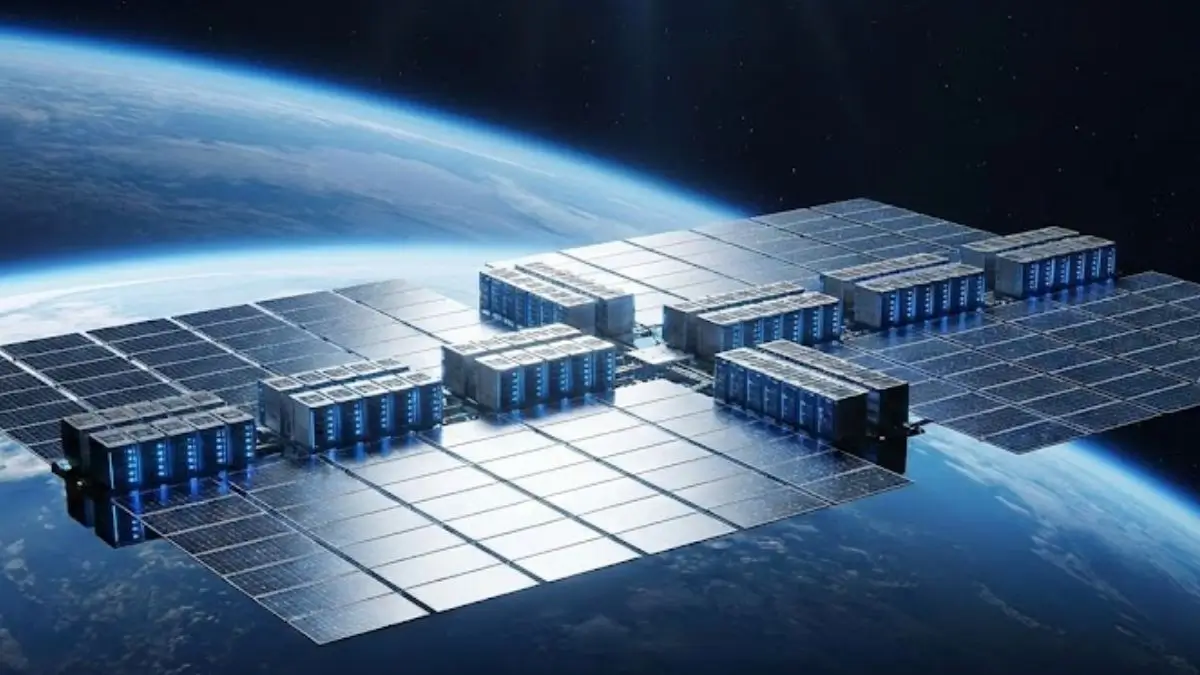
Solar-powered space data centres by Google Project Suncatcher aim to revolutionize AI computing in orbit. Learn about launch timelines, TPUs, challenges, and global impact.
Google’s Project Suncatcher: Solar‑Powered AI Data Centres in Space
Introduction: A Space‑Age Data Revolution
Google has unveiled an ambitious research initiative called Project Suncatcher, aiming to build solar‑powered data centres in space — a breakthrough concept that could redefine how computing for artificial intelligence (AI) is done globally.
In response to rapidly rising demand for energy‑intensive AI workloads and limitations of terrestrial data centres, Google’s plan proposes deploying constellations of satellites equipped with Tensor Processing Units (TPUs) — custom AI chips — powered almost entirely by solar energy collected in orbit
These orbiting nodes would communicate with one another using high‑speed free‑space optical links, forming a distributed processing network akin to a data centre floating above Earth. Initial prototype satellites are expected to be launched by early 2027.
How Project Suncatcher Works
Google’s proposal for Project Suncatcher envisions a constellation of satellites in a dawn‑dusk sun‑synchronous low Earth orbit (LEO) where solar panels can receive nearly continuous sunlight — up to eight times more energy than on Earth.
Each satellite would:
- Carry AI‑focused TPUs to handle machine learning tasks.
- Use solar panels for power generation without reliance on Earth‑based electricity grids.
- Communicate with neighbouring satellites through optical (laser) links capable of transferring tens of terabits per second — similar in purpose to fibre‑optic cables on the ground.
This networked system could potentially function like a scalable, space‑based data centre, harnessing abundant solar energy with minimal need for cooling infrastructure or water, which are major constraints for Earth‑based facilities
Engineering and Operational Challenges
Despite its futuristic promise, Project Suncatcher faces significant engineering challenges:
- High‑Speed Satellite Communication: Achieving reliable, ultra‑fast connections between satellites at tens of terabits per second is technically complex.
- Radiation and Harsh Space Conditions: AI hardware must withstand intense radiation and extreme temperatures — tests show promising TPU resilience but long‑term durability remains uncertain.
- Maintaining Satellite Formation: Precise positioning (within hundreds of meters) is required to enable efficient optical communication.
- Cost and Logistics: Launching space infrastructure is expensive, though projected reductions in launch costs by the 2030s could improve feasibility.
Strategic Impact and Future Prospects
Google’s Project Suncatcher is part of the company’s broader “moonshot” philosophy — tackling enormous scientific and technical challenges with long‑term payoff potential.
If successful, it could:
- Reduce environmental impacts associated with traditional data centres, such as high electricity consumption and water use.
- Offer a scalable computing platform for increasingly AI‑driven services worldwide.
- Potentially inspire global competition in space‑based infrastructure from other tech and aerospace players.
However, experts note that operational space data centres remain years away from reality and extensive testing — including the planned 2027 prototype launch — will determine the project’s viability.

Why This Project Matters for Government Exam Aspirants
Relevance to Current Affairs and Technology Trends
Project Suncatcher is a prime example of how cutting‑edge technology intersects with global challenges such as energy demand, environmental sustainability, and the future of computing — topics frequently covered in government exam syllabi. Aspirants should understand not only the technical aspects but also the policy, economic, and ethical implications of space infrastructure and AI.
Technological innovations like this also reflect broader themes in science and technology sections of exams like UPSC, SSC, IBPS, and other competitive tests where space tech, renewable energy, and AI are key areas.
Historical Context: Evolution of Data Centres and the Leap to Space
The idea of data centres emerged as early as the 1940s with mainframe computers, but modern data centres accelerated in the 2000s with cloud computing. As AI demands grew exponentially in the last decade, traditional data centres faced challenges such as high energy consumption, water use for cooling, and environmental concerns.
To address these issues, companies began exploring renewable energy solutions — wind, solar, and hydro power on Earth. Project Suncatcher takes this paradigm further by moving the compute infrastructure into space, a concept once limited to science fiction.
The notion of space‑based infrastructure has parallels in projects like Starlink for internet, but applying it to data centres represents an entirely new frontier. This highlights how technological evolution often shifts from terrestrial solutions to orbital engineering as human needs expand.
Key Takeaways from Google’s Project Suncatcher
| S. No. | Key Takeaway |
|---|---|
| 1 | Project Suncatcher aims to develop solar‑powered data centres in space using satellites. |
| 2 | The initiative plans to launch prototype satellites by early 2027. |
| 3 | Satellites will use Google TPUs (AI chips) and free‑space optical links. |
| 4 | Operating in sun‑synchronous low Earth orbit allows nearly continuous solar power. |
| 5 | Major challenges include communication, radiation, formation control, and costs. |
Frequently Asked Questions (FAQs)
1. What is Google’s Project Suncatcher?
Project Suncatcher is a research initiative by Google to develop solar-powered data centres in space. The satellites will carry AI-focused processors and communicate through optical links, aiming to reduce energy consumption and environmental impact.
2. When will the prototype satellites of Project Suncatcher be launched?
Google plans to launch the first prototype satellites by early 2027 to test the feasibility of space-based AI data centres.
3. How will Project Suncatcher satellites be powered?
The satellites will use solar panels in sun-synchronous low Earth orbit (LEO), receiving nearly continuous sunlight for energy.
4. What are the main components of the space-based data centres?
Each satellite will have Google’s TPUs (Tensor Processing Units) for AI computations, solar panels for power, and optical communication links for high-speed data transfer.
5. What challenges does Project Suncatcher face?
The project faces challenges like satellite communication reliability, radiation exposure, maintaining satellite formation, and high launch costs.
6. How is Project Suncatcher relevant to government exam aspirants?
The project is relevant for sections on science and technology, renewable energy, AI, and space research, often included in exams like UPSC, SSC, IBPS, and Railway recruitment.
7. How does Project Suncatcher help the environment?
By relying on solar energy in space and minimizing reliance on terrestrial electricity grids, the project reduces carbon footprint and water usage needed for traditional data centres.
8. How fast will satellites communicate in Project Suncatcher?
The satellites are designed to communicate at tens of terabits per second through free-space optical links, similar to high-speed fiber-optic connections.
9. What historical developments led to Project Suncatcher?
From early terrestrial mainframes to cloud computing and renewable energy-powered data centres, the evolution of energy-efficient AI computation laid the foundation for exploring space-based infrastructure.
10. Are there any similar global initiatives?
Projects like Starlink for internet distribution show growing interest in orbital infrastructure, but space-based AI data centres are largely a pioneering effort by Google.
Some Important Current Affairs Links