






NASA’s discovery of asteroid 2025 PN7 — Earth’s temporary second moon — offers new insights into quasi-satellites, near-Earth orbits, and planetary defense. Learn the key facts, history, and exam-relevant details here.
Discovery and What It Means
In August 2025, astronomers working with the NASA and the University of Hawaii’s Pan-STARRS telescope at Haleakalā Observatory in Hawaii detected a small asteroid designated 2025 PN7.
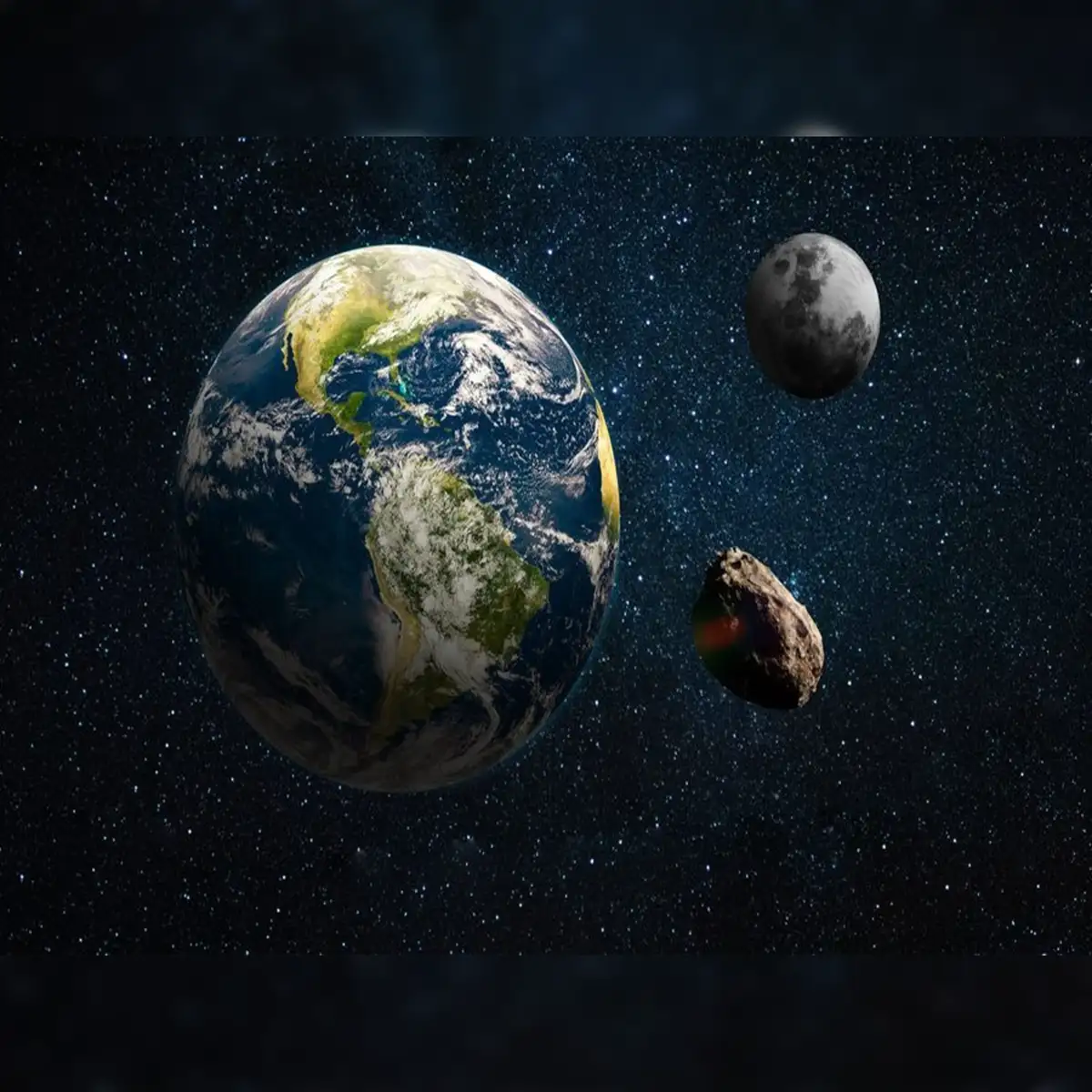
Subsequent orbital analysis revealed that 2025 PN7 is in a unique co-orbital configuration with Earth: while it orbits the Sun, its orbit closely resembles Earth’s, making it appear—when viewed from our vantage point—as though it is a “second moon.”
Measuring roughly 19 metres in diameter (some estimates between 18 m and 36 m), this object is far smaller and dimmer than the familiar Moon.
According to simulations, 2025 PN7 has likely been travelling in this quasi-satellite arrangement for several decades (possibly since the 1960s) and is expected to remain in a similar configuration until approximately 2083, before gradually drifting away.
How It Orbits and Why It’s Not a True Moon
Unlike the permanent natural satellite Moon, which is gravitationally bound to Earth, 2025 PN7 is not captured in Earth’s gravity in the same way. Instead, it shares Earth’s orbital period around the Sun, following a path that keeps pace with Earth, making it look like it is circling Earth.
From Earth’s perspective, the object appears to loop around, but physically it remains in a heliocentric orbit (orbiting the Sun). This type of object is termed a “quasi-moon” or quasi-satellite.
Because of its small size and very faint brightness (magnitude around 26), 2025 PN7 eluded detection for so long—regular telescopes cannot easily pick it up.
What Scientists Are Focusing On
Researchers are excited because 2025 PN7 offers a natural laboratory to study near-Earth objects (NEOs) with Earth-like orbits. Understanding its trajectory, composition, and dynamical behaviour helps in planetary-defence planning, asteroid-mining considerations and our understanding of how such co-orbital configurations evolve.
Additionally, the discovery hints at the possibility of many small asteroids subtly sharing similar orbits with Earth, waiting to be detected with the next generation of survey telescopes.
Why This News Is Important
Relevance for Competitive Exams
For aspirants of teacher, police, banking, railways, defence and civil services (like PSCS to IAS), awareness of current affairs from science and space domains is invaluable. The discovery of 2025 PN7 underscores India’s and the world’s focus on space science—an area increasingly prominent in exam syllabi under “Science & Technology” and “Environment & Space Technology”.
Implications for Science & Society
The identification of a quasi-moon, though small and harmless, highlights human capability to monitor and analyse celestial bodies with precision. It emphasises that our understanding of the Earth’s immediate cosmic neighbourhood is evolving. For civil services, this speaks to themes of scientific literacy, international cooperation (NASA + global observatories), and long-term planning in space safety.
Strategic and Educational Significance
From a strategic standpoint, being aware of near-Earth objects supports frameworks of planetary defence—relevant for national security and science policy statements that may surface in exam questions. From an educational angle, the event can be used in teaching modules on orbital mechanics, Earth-Sun relationships, and space exploration. Thus, the story is doubly relevant: as a factual current-affair item and as a concept-rich scientific phenomenon.
Historical Context
Humanity has long regarded Earth as having one natural moon. Over recent decades, however, astronomers have identified small asteroids that share Earth’s orbit in various quasi-satellite or “mini-moon” states.
For example, in late 2024, an asteroid known as 2024 PT5 temporarily accompanied Earth for about two months before moving on.
The concept of quasi-satellites emerged with advances in survey telescopes and orbital simulations: these are objects that, while orbiting the Sun, are locked in resonant motion with Earth—hence appearing as companions. Some examples include 469219 Kamoʻoalewa (an earlier known quasi-moon) and others.
The pathway of 2025 PN7 is part of this scientific lineage: discovered via Pan-STARRS, confirmed through archival data, then subjected to orbit-integration simulations that estimate its residence time within Earth’s co-orbital zone until about 2083. This builds on decades of asteroid-detection work and represents a step forward in monitoring Earth’s immediate cosmic environment.
Key Takeaways from 2025 PN7 Discovery
| # | Key Takeaway |
|---|---|
| 1 | 2025 PN7 is a small asteroid (~19 m diameter) discovered in August 2025 that shares Earth’s orbit, making it appear as a “second moon.” |
| 2 | It is not a true moon—rather a quasi-moon (co-orbital object) that orbits the Sun while keeping up with Earth’s path. |
| 3 | 2025 PN7 has likely been in this quasi-satellite configuration for decades and is expected to remain so until around 2083. |
| 4 | It is extremely faint (magnitude ~26), making it undetectable with regular telescopes—a fact that shows how much of our near-Earth environment is still undiscovered. |
| 5 | The discovery has significance for exam-relevant topics: near-Earth object monitoring, space threat assessment, orbit dynamics and India’s wider interest in space science. |
FAQs: Frequently Asked Questions
1. What is 2025 PN7?
2025 PN7 is a small asteroid approximately 19 metres in diameter, discovered by NASA and the University of Hawaii’s Pan-STARRS telescope. It shares Earth’s orbit around the Sun, making it appear as a temporary “second moon.”
2. Is 2025 PN7 a real second moon of Earth?
No, it is not a true moon. 2025 PN7 is a quasi-satellite — a type of asteroid that follows a similar orbit as Earth around the Sun but is not gravitationally bound to it like our natural Moon.
3. How long will 2025 PN7 remain near Earth?
Scientists estimate that 2025 PN7 has been in a quasi-satellite configuration since the 1960s and will continue in this orbit until around 2083 before drifting away.
4. Why is this discovery significant for science?
The discovery enhances our understanding of near-Earth objects (NEOs) and provides insights into planetary defense, asteroid movement, and Earth’s orbital environment. It also showcases advancements in global space monitoring technologies.
5. Can 2025 PN7 be seen with the naked eye?
No, it cannot. The asteroid is extremely small and faint, with a magnitude of around 26, making it invisible without the aid of powerful telescopes.
6. What does the term “quasi-moon” mean?
A quasi-moon, or quasi-satellite, is an object that orbits the Sun along with Earth and appears to orbit Earth due to its synchronized orbital pattern.
7. Which telescope discovered 2025 PN7?
The discovery was made using the Pan-STARRS telescope located at Haleakalā Observatory in Hawaii, operated by NASA and the University of Hawaii.
8. How is this news relevant for competitive exams?
It falls under Science and Technology (Space Research), an important section in exams like UPSC, State PCS, SSC, CDS, and Defence exams. Questions can be asked about the discovery, terminology, and space mission details.
9. Are there any other known quasi-moons of Earth?
Yes, previous quasi-moons include 469219 Kamoʻoalewa and 2024 PT5, both of which shared similar orbital dynamics with Earth for limited durations.
10. What can students learn from this discovery?
Students can learn about Earth’s co-orbital asteroids, the concept of quasi-satellites, orbital resonance, and the importance of global cooperation in astronomical research.
Some Important Current Affairs Links