








Global Gender Gap Index 2025: India slips to 131st rank out of 146 countries, reflecting persistent gender disparity in economic, educational, and health sectors. Read detailed analysis for exam prep.
Overview of the Global Gender Gap Index 2025
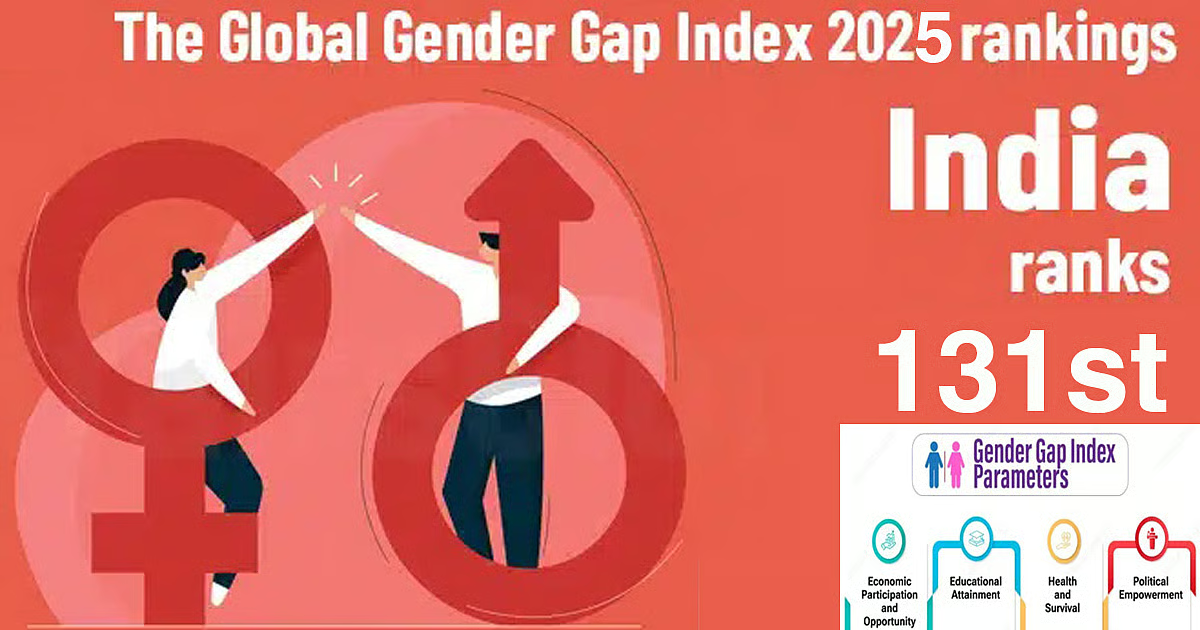
The World Economic Forum (WEF) released its Global Gender Gap Index 2025, evaluating 146 countries on the basis of gender parity across four key dimensions: Economic Participation and Opportunity, Educational Attainment, Health and Survival, and Political Empowerment. The report aims to provide insights into gender-based disparities and track progress toward equality over time.
India’s Overall Ranking and Performance
In the 2025 index, India ranked 131st out of 146 countries, slipping from its 127th position in 2024. This decline indicates a regression in gender parity, particularly in areas like political empowerment and health. Although the country witnessed minor improvements in economic and educational indicators, these were insufficient to maintain or boost its global position.
Detailed Sub-index Performance
- Economic Participation and Opportunity: India improved slightly in this area with a score of 40.7%, moving up due to increased female labor force participation.
- Educational Attainment: India reached approximately 97.1% parity, showcasing progress in access to education for girls and women.
- Health and Survival: Despite some efforts, India still ranks poorly at 142nd, with gender-based health disparities continuing to persist.
- Political Empowerment: A significant drop was observed here. India ranks 65th, with only 13.8% representation of women in Parliament and 5.6% in ministerial positions, marking a decline from previous years.
India’s Position in South Asia
Among South Asian countries, India’s performance is modest. It ranks below Bangladesh (24th), Bhutan (119th), Nepal (125th), and Sri Lanka (130th). However, it ranks higher than Maldives (138th) and Pakistan (148th). This reflects broader regional challenges in gender equity, but also emphasizes the need for targeted reforms in India.

Why This News is Important
Relevant for Competitive Exam Syllabus
This topic is directly relevant to general studies, current affairs, and social issues sections of government exams such as UPSC, SSC, Banking, Railways, and State PSCs. The Global Gender Gap Index is frequently cited in exam questions due to its global relevance and India’s performance.
Indicators of Social and Economic Development
The Index helps students understand broader issues like gender inequality, women’s participation in governance, access to education, and health indicators. Such topics are important for essay writing, interviews, and policy analysis in exams and beyond.
Reflects Government Policy Impact
India’s drop in the ranking serves as a reflection of how government initiatives are (or are not) impacting gender parity. Programs like Beti Bachao Beti Padhao, women’s reservation, and skill development schemes need more effective implementation to show measurable results.
Historical Context
The Global Gender Gap Index was introduced by the World Economic Forum in 2006 to assess gender disparities worldwide. Since its inception, India’s ranking has fluctuated. India’s best rank was 87th in 2006, and its lowest rank was 140th in 2021.
Over the years, India has made considerable progress in education and economic inclusion, but areas like political empowerment and healthcare access have remained weak spots. Efforts to bridge these gaps have seen limited success due to societal, cultural, and structural barriers.
In 2023 and 2024, India ranked 135th and 127th, respectively. The rise in 2024 offered hope, but the slip in 2025 shows the fragility of gender equity progress without sustained policy and cultural change.
Key Takeaways from “India’s Rank in Gender Gap Index 2025”
| S.No | Key Takeaway |
|---|---|
| 1 | India slipped to 131st position in the WEF Global Gender Gap Index 2025. |
| 2 | India’s overall parity score stands at approximately 64.1%. |
| 3 | India ranked 65th in Political Empowerment, a major drop from last year. |
| 4 | Health and Survival remains a critical concern, ranking 142nd globally. |
| 5 | India lags behind neighbours like Bangladesh, Bhutan, and Nepal in ranking. |
FAQs: Frequently Asked Questions
Q1: What is the Global Gender Gap Index?
It is an annual report by the World Economic Forum measuring gender parity across four dimensions: Economic Participation & Opportunity, Educational Attainment, Health & Survival, and Political Empowerment
Q2: How many countries were ranked in the 2025 index?
The Global Gender Gap Report 2025 evaluated 148 countries
Q3: What is India’s overall gender parity score?
India scored 64.1% (or 64.4% per some sources), slightly improving by about 0.3 points from the previous year
Q4: In which sub-index did India gain ground?
India improved in Economic Participation & Opportunity (+0.9 pp to 40.7 %) and in Educational Attainment (~97.1 %), along with marginal gains in Health & Survival
Q5: Where did India fall behind?
Performance declined in Political Empowerment—women’s representation in Parliament dropped to 13.8%, and ministerial positions reduced to 5.6%
Q6: How does India compare regionally?
Among South Asian nations, India ranks low—behind Bangladesh (24), Nepal (125), Bhutan (119), and Sri Lanka (130), but ahead of Maldives (138) and Pakistan (148)
Q7: When will global gender parity be achieved?
The WEF estimates at current pace, full global parity is ~123 years away
Some Important Current Affairs Links