







G7 Summit 2025 Canada: Learn about India’s role, key global issues, AI governance, and climate initiatives discussed at the 51st G7 meeting, crucial for UPSC and other competitive exams.
51st G7 Summit 2025: Key Highlights, India’s Role & Global Stakes
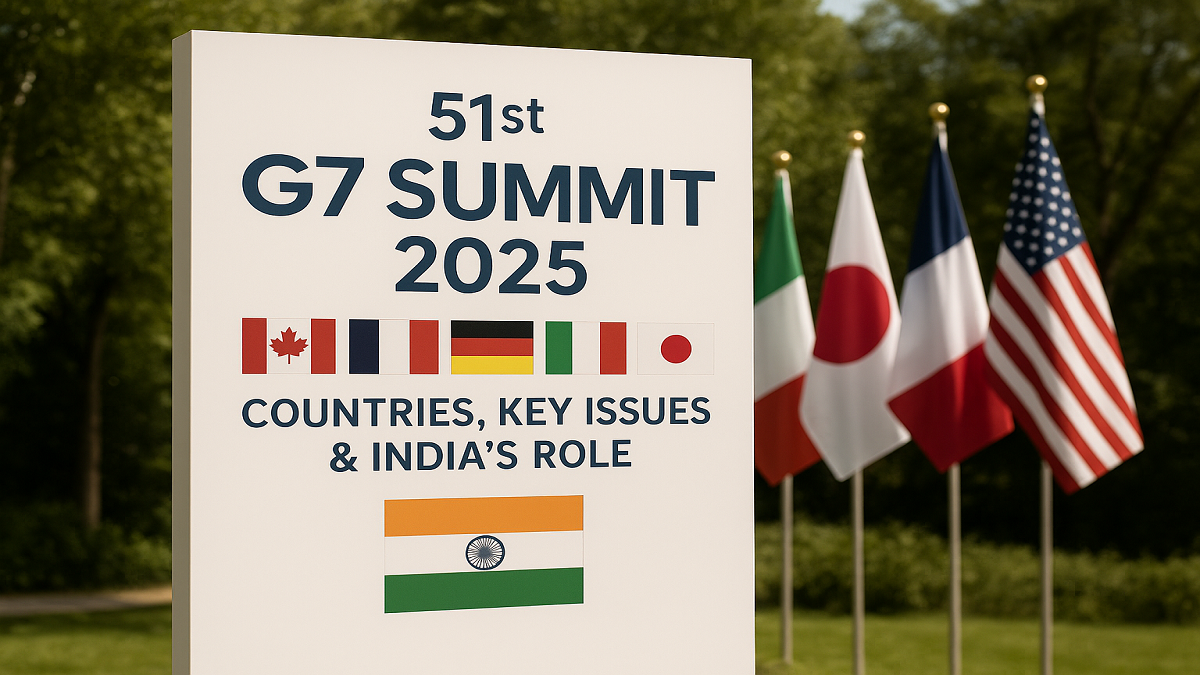
The 51st G7 Summit, held on June 16–17, 2025, in Kananaskis, Alberta (Canada), gathered leaders from the world’s seven most advanced economies—Canada, France, Germany, Italy, Japan, the UK, and the US—along with key invitees like India’s Prime Minister Narendra Modi and Ukraine’s President Volodymyr Zelenskiy Hosted by Canadian PM Mark Carney, the summit focused on three central pillars: protecting communities, building energy resilience and digital transition, and securing future partnerships
Global Geopolitical Tensions: Iran–Israel & Russia–Ukraine
The summit unfolded amid rising global tensions. G7 leaders issued a statement affirming Israel’s right to self-defense and identifying Iran as a principal source of regional instability Meanwhile, Ukrainian President Zelenskiy secured C$2 billion in aid from Canada but received no commitment from the U.S., as President Trump abstained from Ukraine-focused discussions
Deepening Tech & AI Governance
Digital innovation was a top agenda priority. Canada highlighted digital ethics and cybersecurity frameworks, while India advocated for responsible AI, watermarking deepfakes, and promoting its Aadhaar-UPI digital public infrastructure as a global model
Trade Talks & Economic Resilience
A notable outcome was the new US–UK trade pact, involving tariff reductions on autos and aerospace goods However, Canada’s pivot to defense spending and global partnerships also marked a significant shift in trade diplomacy
Climate & Energy Security
Discussions also centered on energy security, wildfire preparedness, and renewable transitions. Canada introduced the Wildfire Charter, and India underscored its achievements under the Paris Agreement and within the International Solar Alliance
India’s Strategic Outreach Role
India participated as an “Outreach Partner”, invited after strong backing from G6 members amid Canada-India diplomatic tension PM Modi’s presence was seen as both a diplomatic confidence-building move and a strategic engagement to push Global South concerns—like technology fairness, debt relief, counter-terrorism, and democratic values
Why This News Is Important
Multilateral Diplomacy Under Strain
In the wake of geopolitical crises—Israel–Iran strikes and Russia–Ukraine conflict—the G7 summit’s attempt to project unity reflects both the strength and limitations of collective diplomacy. U.S. non-commitment on Ukraine demonstrates fractures in global leadership
Reinforcement of Global Tech & Climate Frameworks
The summit underscored the need for stronger international cooperation on AI governance and climate resilience, especially as tech innovation accelerates faster than regulation—a central theme for aspirants in GS‑III (Science & Technology; Environment).
India’s Evolving Global Profile
By being invited and actively participating, India is signaling its emergent strategic importance on the world stage. This aligns with UPSC and other exam syllabi, emphasizing how India positions itself within global frameworks like G7, G20, and BRICS
Historical Context: Evolution of India‑G7 Ties
Since 2003, India has been regularly invited as an “Outreach Partner”—attending every summit since 2019—to reflect its growing role in global governance The G7 itself began as an economic forum in 1975 (originally as G6), expanding to seven members and then eight before becoming G7 again in 2014 after Russia’s exclusion Canada, the G7 chair in 2025 under Mark Carney, emphasized substance over form amid historical instability, opting for thematic statements instead of a rigid joint communiqué to avoid discord
Key Takeaways from “51st G7 Summit 2025”
| # | Key Takeaway |
|---|---|
| 1 | Summit held on June 16–17, 2025 in Kananaskis, Canada |
| 2 | G7 focus: Iran–Israel crisis, Russia–Ukraine war, AI & digital governance, energy & climate security |
| 3 | PM Modi attended as Outreach Partner, reaffirming India’s status as a rising global player |
| 4 | U.S.–UK trade deal struck; Canada committed to defense spending and global energy resilience |
| 5 | India advocated for responsible AI, Global South priorities, digital public infrastructure, and multilateral counter-terror cooperation |
FAQs: Frequently Asked Questions
Q1. What is the G7 Summit?
The G7 Summit is an annual meeting of leaders from seven of the world’s most advanced economies—Canada, France, Germany, Italy, Japan, the UK, and the US—to discuss global economic governance, international security, and energy policies.
Q2. Why was India invited to the G7 Summit 2025?
India was invited as an “Outreach Partner” due to its growing global economic influence and leadership role in areas like digital infrastructure, climate action, and multilateral diplomacy.
Q3. What were the top issues discussed at the 51st G7 Summit 2025?
The summit focused on the Iran–Israel conflict, the Russia–Ukraine war, responsible AI and digital governance, energy resilience, climate change mitigation, and trade partnerships.
Q4. What was India’s contribution to the summit?
India highlighted the importance of AI ethics, watermarking deepfakes, promoting digital public infrastructure like Aadhaar and UPI, and representing the concerns of the Global South.
Q5. What is the significance of the G7 Summit for competitive exam aspirants?
The G7 Summit reflects India’s foreign policy priorities and global positioning, making it a key topic for General Studies (GS-II & GS-III), International Relations, Science & Tech, and Current Affairs sections of various competitive exams.
Some Important Current Affairs Links