









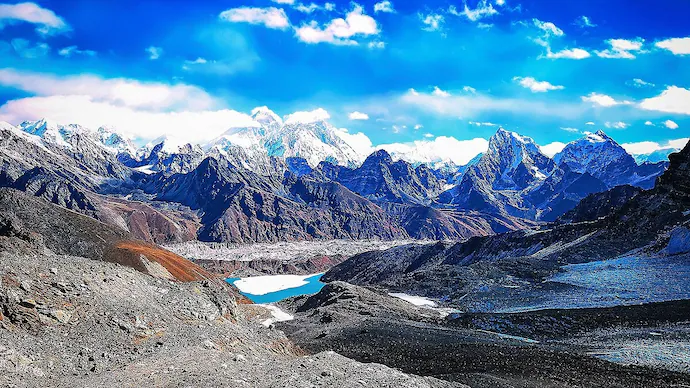
Asia Warming WMO Report highlights that the continent is heating at nearly double the global rate, triggering glacier loss, marine heatwaves, and extreme weather across India, Myanmar, and more.
Asia Is Warming at Nearly Twice the Global Rate: WMO Report
Asia is heating up at an alarming rate—almost double the global average. In 2024, the continent’s mean temperature was 1.04 °C above the 1991–2020 benchmark, making it the warmest or second-warmest year on record, depending on the dataset
Extreme Heatwaves Spread Across the Continent
Multiple regions—including South, East, Southeast, and Central Asia—faced intense and prolonged heatwaves. India experienced its hottest year since 1901, with the longest heatwave since 2010, resulting in over 44,000 heatstroke cases and 450+ deaths Myanmar recorded a scorching 48.2 °C, setting a national high
Rapid Ocean Warming & Marine Heatwaves
Asia’s ocean waters are warming fast—about 0.24 °C per decade, nearly double the global average of 0.13 °C In 2024, marine heatwaves engulfed nearly 15 million km² of ocean—roughly 10% of Earth’s surface
Glacier Melting in High-Mountain Asia
Out of 24 monitored glaciers across the Himalayas and Tian Shan, 23 continued to lose mass in 2024. This accelerates glacial lake floods and heightens water security threats for downstream communities
Rising Sea Levels & Coastal Risks
Sea level rise along Asia’s coasts of the Indian and Pacific Oceans surpassed the global average. Low-lying areas now face elevated threats from storms, tidal surges, and progressive flooding
Surge in Extreme Weather Events
From Tropical Cyclone Yagi ravaging Vietnam, the Philippines, Myanmar, and China, to historic floods in Central Asia and a deadly monsoon-triggered landslide in Kerala (350+ deaths), Asia endured a series of extreme weather shocks in 2024
Early Warning Saves Lives
Despite the devastation, some nations enhanced disaster resilience. In Nepal, strengthened early warning systems and preemptive action shielded over 130,000 people from climate impacts

Why This News Matters for Exams
Exam relevance:
- Geography & Environment: Reflects real-time climate trends—rising temperatures, sea-level changes, glacier retreat.
- Disaster Management & Planning: Highlights extreme events (heatwaves, floods, cyclones) and early warning systems—key for UPSC, SSC, State PSC, Railway exams.
- Policy & Governance: Encourages discussion on adaptation, mitigation, and climate diplomacy—essential for Civil Services and other administrative roles.
- Science & Technology: Underlines the significance of meteorological data, early warning, and climate modeling in national planning.
Understanding these interlinked areas will help candidates craft informed answers in GS, Essay, and Interview stages, covering both environmental and governance dimensions.
Historical Context: Why Asia Is Heating Up Faster
Polar Amplification & Land-Sea Contrast
Land masses heat faster than oceans, and expansive continental Asia is especially prone to these anomalies. Similar to polar regions, this land-sea warming gap accelerates temperature increases
Industrialization & Urban Heat
Asia’s rapid industrial and urban growth has raised greenhouse gas emissions. While global, Asia’s scale magnifies regional warming, making its heatwaves more frequent and intense.
Glacial Decline in the Third Pole
Glaciers across the Himalayas and nearby ranges act as freshwater reservoirs. Recent trends of diminishing snow and glacial mass have accelerated, exposing communities to water variability and flood risks .
Marine Heatwaves & Ocean Currents
The Indo–Pacific Warm Pool is expanding and warming, driving frequent marine heatwaves. This heightens the risks for fisheries, coastal economies, and biodiversity .
Escalating Extreme Weather
Changes in monsoon dynamics, cyclone frequency, and precipitation are direct outcomes of rising land and sea temperatures. Data shows both flooding and drought occurrences are increasing region-wide
Key Takeaways from Asia Warming at Twice the Global Rate
| # | Key Takeaway |
|---|---|
| 1 | Asia’s average temperature rose ~1.04 °C above the 1991–2020 baseline in 2024—double the global warming rate |
| 2 | The region’s oceans warmed at 0.24 °C/decade, nearly twice the global ocean warming rate of 0.13 °C/decade . |
| 3 | 23 of 24 monitored glaciers in Asia lost mass in 2024, worsening risks of glacial lake flooding . |
| 4 | Marine heatwaves impacted about 15 million km², and sea levels in Asia rose faster than the global average . |
| 5 | Numerous extreme weather events—heatwaves, cyclones (like Yagi), floods, droughts—highlight the urgent need for climate preparedness . |
FAQs: Frequently Asked Questions
Q1. What does the WMO report say about Asia’s temperature trends?
A: The WMO states that Asia’s average temperature in 2024 was 1.04 °C above the 1991–2020 average, warming almost twice as fast as the global average.
Q2. Which countries in Asia experienced extreme weather in 2024?
A: Countries like India, Myanmar, China, Vietnam, and Nepal faced extreme heatwaves, floods, cyclones, and glacial changes.
Q3. How are Asia’s oceans being impacted by climate change?
A: Ocean temperatures are rising at 0.24 °C per decade—almost twice the global average—causing widespread marine heatwaves.
Q4. Why is glacier loss in Asia a serious concern?
A: Glacial melting in the Himalayas and other high-mountain areas increases the risk of glacial lake outburst floods (GLOFs) and endangers water security for millions downstream.
Q5. How has early warning infrastructure helped?
A: Countries like Nepal used improved early warning systems to protect over 130,000 people from extreme climate events in 2024.
Q6. What is the significance of this report for competitive exams?
A: It is relevant for topics under Geography, Environment & Ecology, Climate Change, Disaster Management, and Current Affairs in exams like UPSC, State PSCs, SSC, Railways, and Defence services.
Some Important Current Affairs Links