









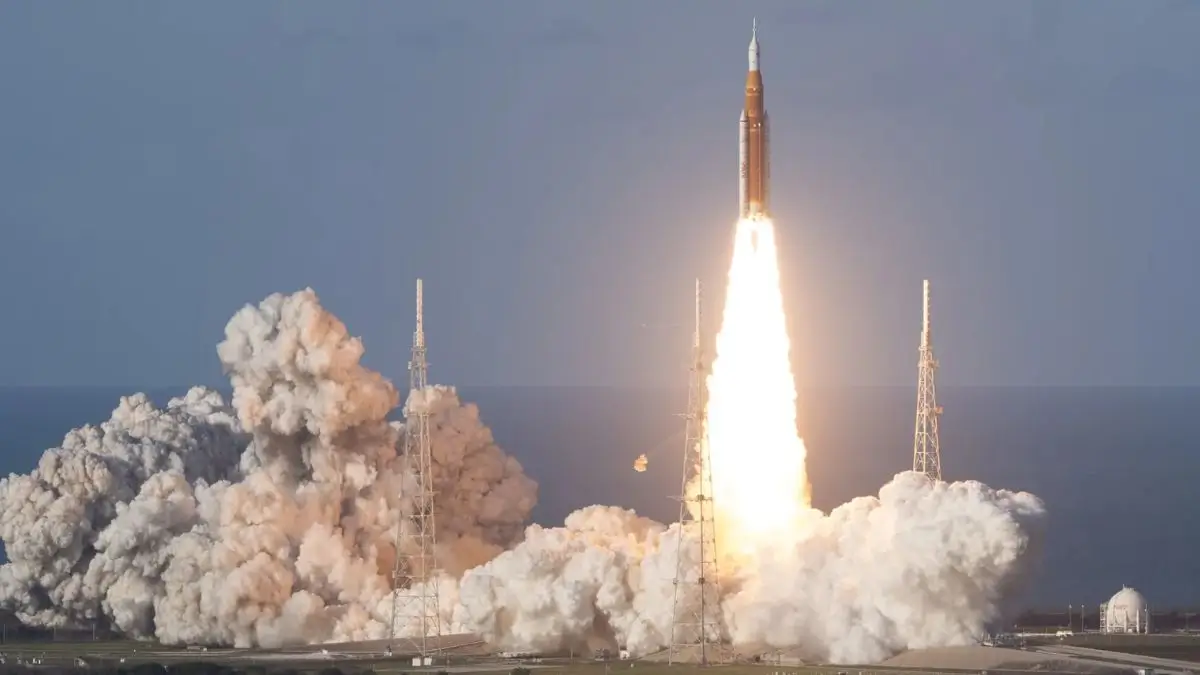
Artemis II mission details 2026 explain NASA’s first crewed lunar flyby in 50 years, key objectives, astronauts, and its importance for competitive exams.
NASA’s Artemis II Mission Begins: First Crewed Moon Journey in Over 50 Years
🌌 Introduction to Artemis II Mission
The NASA has successfully launched its historic Artemis II mission, marking the first crewed journey toward the Moon in more than five decades. This mission represents a significant milestone in human space exploration, as it is the first time astronauts are traveling beyond low Earth orbit since the Apollo era ended in 1972.
Artemis II is part of NASA’s broader Artemis program, aimed at returning humans to the Moon and eventually enabling missions to Mars.
🚀 Mission Details and Objectives
Artemis II is a 10-day crewed mission that involves four astronauts traveling around the Moon aboard the Orion spacecraft using the Space Launch System (SLS) rocket.
The primary objective of the mission is to test critical systems such as life support, communication, and navigation in deep space. Unlike Apollo missions, Artemis II will not land on the Moon but will perform a lunar flyby to validate technology for future landings.
👨🚀 Crew Members and Diversity Milestones
The Artemis II mission includes four astronauts: Reid Wiseman, Victor Glover, Christina Koch, and Jeremy Hansen.
This mission is historic not only for its technological achievements but also for its diversity:
- First woman astronaut to travel to lunar space
- First Black astronaut on a lunar mission
- First non-American astronaut (Canadian) to participate
These milestones reflect the evolving global and inclusive nature of space exploration.
🌍 Mission Trajectory and Achievements
The spacecraft follows a free-return trajectory, meaning it will naturally return to Earth using the Moon’s gravity without requiring major propulsion adjustments.
During the mission, astronauts will:
- Travel farther than any human has before
- Capture images of Earth and the Moon
- Conduct system tests for future missions
The spacecraft is expected to travel thousands of kilometers beyond the Moon, setting new records in human spaceflight.
🔭 Future Implications of Artemis Program
Artemis II is a crucial stepping stone toward future missions:
- Artemis III (planned) aims to land humans on the Moon
- Long-term goal includes establishing a sustainable lunar base
- Future missions may lead to human exploration of Mars
The mission demonstrates international cooperation and technological advancement, shaping the future of deep space exploration.

📌 Why This News is Important
🛰️ Revival of Human Lunar Exploration
The Artemis II mission marks the return of humans to deep space after more than 50 years. This is a major development in global space exploration, signaling a renewed interest in lunar missions and beyond.
🌍 Technological Advancement
This mission tests advanced systems such as life support, radiation shielding, and communication technologies required for long-duration space missions. These innovations are essential for future missions to the Moon and Mars.
🌐 Global Collaboration
Artemis II includes international participation, reflecting growing global cooperation in space exploration. This sets a precedent for future multinational missions.
🎯 Strategic Importance for Future Missions
The success of Artemis II will directly influence upcoming missions, especially Artemis III, which aims to achieve a human landing on the Moon.
📚 Exam Relevance
For competitive exams like UPSC, SSC, Banking, Defence, and Railways, this topic is crucial under:
- Science & Technology
- Space Missions
- International Collaboration
📜 Historical Context
🌕 Apollo Missions Legacy
The last human mission to the Moon was Apollo 17 in 1972. After that, human space exploration focused mainly on low Earth orbit, including missions to the International Space Station.
🚀 Transition to Artemis Program
NASA initiated the Artemis program to revive lunar exploration. Artemis I (2022) was an uncrewed test mission that validated the Orion spacecraft and SLS rocket.
🌌 Shift in Space Strategy
Unlike the Cold War-driven Apollo missions, Artemis emphasizes:
- Sustainability
- International cooperation
- Long-term human presence on the Moon
This marks a new era of collaborative and scientific exploration rather than competition.
📊 Key Takeaways from This News
| S.No | Key Takeaway |
|---|---|
| 1 | Artemis II is the first crewed Moon mission in over 50 years |
| 2 | The mission involves a 10-day lunar flyby without landing |
| 3 | It includes historic diversity milestones in astronaut selection |
| 4 | The mission tests critical systems for future Moon and Mars missions |
| 5 | Artemis program aims for sustainable lunar presence and future Mars exploration |
FAQs on Artemis II Mission
1. What is Artemis II mission?
The NASA Artemis II mission is the first crewed lunar mission in over 50 years, designed to send astronauts around the Moon without landing.
2. How is Artemis II different from Artemis I?
Artemis I was an uncrewed test flight, while Artemis II carries astronauts to test systems in real space conditions.
3. Who are the astronauts in Artemis II?
The crew includes Reid Wiseman, Victor Glover, Christina Koch, and Jeremy Hansen.
4. Will Artemis II land on the Moon?
No, it will only perform a lunar flyby to test spacecraft systems for future landing missions.
5. What is the Artemis program?
The Artemis Program aims to return humans to the Moon and prepare for Mars exploration.
6. What is the Space Launch System (SLS)?
The Space Launch System is the most powerful rocket developed by NASA for deep-space missions.
7. Why is Artemis II important for exams?
It is crucial under Science & Technology, especially topics like space missions, international collaboration, and future exploration plans.
8. What is a free-return trajectory?
It is a path where the spacecraft uses the Moon’s gravity to return safely to Earth without major engine burns.
Some Important Current Affairs Links