




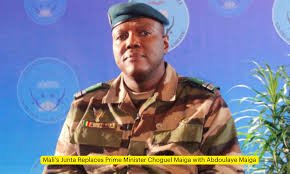
Mali’s Junta Replaces Prime Minister Choguel Maïga with Abdoulaye Maïga
On May 26, 2024, Mali’s ruling military junta made a significant change in its government structure by replacing Prime Minister Choguel Kokalla Maïga with Abdoulaye Maïga, a key figure in the transitional government. This move comes amid ongoing efforts by the junta to consolidate its power and strengthen its leadership amidst growing domestic and international pressures.
New Leadership in Mali’s Government
Abdoulaye Maïga, who previously held the role of Minister of Territorial Administration, was appointed to lead the government after the abrupt dismissal of Choguel Maïga. This change marks a pivotal shift in Mali’s leadership under the junta, which has been in power since a coup in 2021. Abdoulaye Maïga’s appointment is expected to enhance the junta’s control over Mali’s political landscape and further stabilize the current government structure.
Mali’s Political Landscape and the Role of the Junta
The Malian military junta, led by Colonel Assimi Goïta, has been facing growing international criticism and sanctions, particularly from the Economic Community of West African States (ECOWAS) and the United Nations. Despite this, the junta has continued to push forward with its political agenda, emphasizing national sovereignty and resistance to foreign influence. The reshuffling of leadership is seen as a strategic move to solidify the junta’s internal cohesion and reaffirm its control over the country’s governance.
Implications for Mali’s Future
The change in leadership reflects the junta’s desire to streamline governance and address the country’s political instability. Mali has been grappling with severe security challenges due to the presence of extremist groups in the region. The new prime minister’s appointment is expected to usher in more focused efforts on national security, economic recovery, and improving Mali’s relations with its neighbors.
Why This News is Important
Political Stability and Governance in Mali
This news is crucial for understanding the evolving political landscape in Mali. The military junta’s decision to replace Prime Minister Choguel Maïga with Abdoulaye Maïga signals a shift in governance aimed at strengthening the junta’s grip on power. This change will have far-reaching implications for the political and economic stability of Mali. The appointment highlights the junta’s commitment to controlling political developments within the country, despite international condemnation and economic sanctions.
Impact on Regional and Global Relations
Mali’s military junta has faced significant pressure from international organizations, including ECOWAS and the United Nations, for delaying a return to civilian rule. The reshuffling of leadership could have a direct impact on the country’s diplomatic relations. The new prime minister’s ability to manage Mali’s internal affairs and negotiate with international bodies will be crucial in determining the future of Mali’s foreign relations, particularly with its regional neighbors in West Africa and former colonial powers.
Security and Economic Recovery
Mali has been struggling with significant security challenges, particularly in the northern regions, where extremist groups are active. The leadership change could influence the government’s strategy in combating these threats. Additionally, economic recovery remains a major priority for the junta. With international sanctions impacting the economy, the new prime minister’s approach to governance could play a key role in Mali’s efforts to rebuild its economy and secure foreign investments.
Historical Context
Mali’s Political History
Mali has experienced a tumultuous political history, including several military coups. The country, once a stable democracy in West Africa, saw a significant shift in 2012 when a military coup ousted then-President Amadou Toumani Touré. Since then, the political landscape has been marked by instability and frequent military involvement in governance. In August 2020, another military coup ousted President Ibrahim Boubacar Keïta, and the junta took control, promising a return to civilian rule after a transition period. However, this has not yet materialized, and the junta has increasingly consolidated power.
The Role of the Junta
The junta, led by Colonel Assimi Goïta, has faced pressure from both local and international entities to establish a clear timetable for returning to democratic governance. Despite this, the junta has been adamant about maintaining control over Mali’s political future. The replacement of Prime Minister Choguel Maïga signals a commitment to internal cohesion within the junta and a response to ongoing challenges in both governance and security.
Key Takeaways from “Mali’s Junta Replaces Prime Minister Choguel Maïga”
| Serial No. | Key Takeaway |
|---|---|
| 1 | Abdoulaye Maïga has been appointed as Mali’s new prime minister, replacing Choguel Maïga. |
| 2 | The military junta, led by Colonel Assimi Goïta, continues to consolidate power in Mali. |
| 3 | The change in leadership reflects the junta’s efforts to stabilize governance amidst political and security challenges. |
| 4 | Mali faces severe security threats from extremist groups in the northern regions, which will likely influence the new prime minister’s approach. |
| 5 | International criticism and sanctions from ECOWAS and the UN are ongoing, impacting Mali’s diplomatic relations and economic recovery. |
Important FAQs for Students from this News
What led to the replacement of Prime Minister Choguel Maïga in Mali?
The replacement of Prime Minister Choguel Maïga was part of a political reshuffling by Mali’s military junta, aimed at strengthening governance and consolidating power amidst internal and international pressures.
Who is Abdoulaye Maïga, the new Prime Minister of Mali?
Abdoulaye Maïga is a former Minister of Territorial Administration in Mali’s transitional government. He was appointed as the new prime minister after the removal of Choguel Maïga, with a focus on stabilizing the country’s political and security situation.
What is the significance of the military junta’s role in Mali’s government?
The military junta, led by Colonel Assimi Goïta, took control of Mali after a coup in 2021. Despite facing international criticism and sanctions, the junta has maintained its hold on power, signaling a slow transition back to civilian rule.
How has the international community responded to Mali’s junta-led government?
The international community, including organizations like ECOWAS and the United Nations, has criticized the junta for delaying the return to civilian rule. This has led to sanctions and strained relations, particularly with countries in the West African region.
What security challenges does Mali face under the junta’s leadership?
Mali faces severe security threats from extremist groups, particularly in its northern regions. The government, under the junta’s leadership, has focused on combating these groups while attempting to stabilize the country politically and economically.
Some Important Current Affairs Links