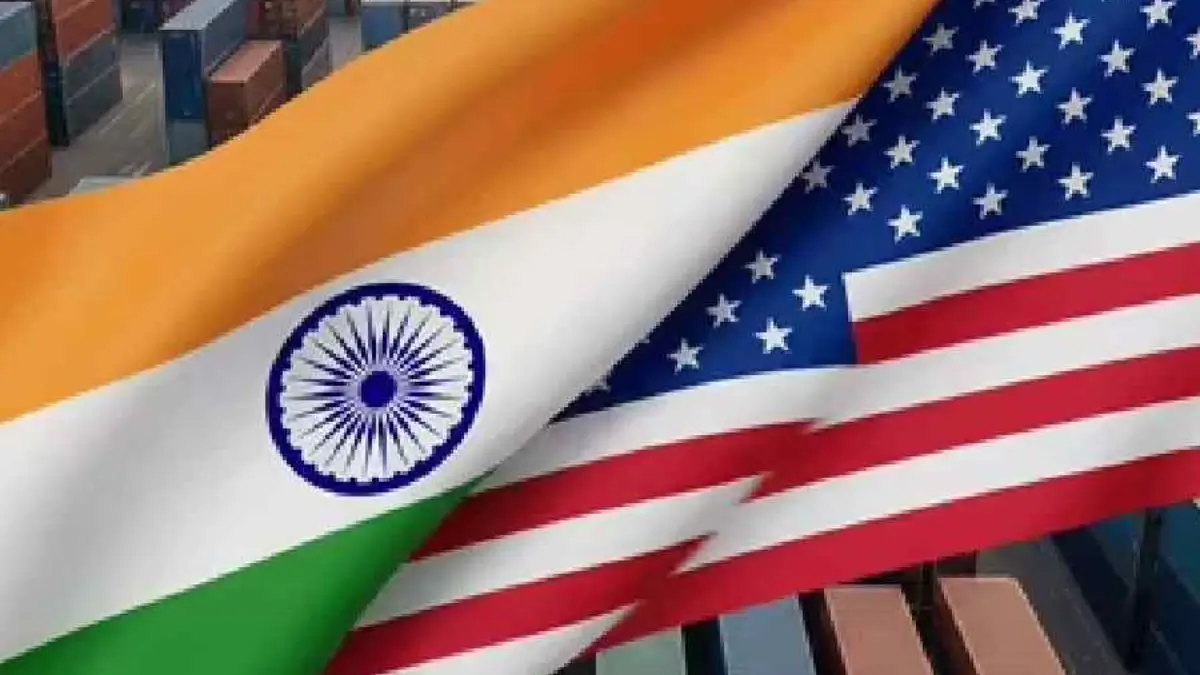









India U.S. 10-Year Defence Pact 2025 establishes a long-term framework to enhance military cooperation, defence manufacturing, and Indo-Pacific security — a key topic for UPSC, CDS, and SSC exams.
India & U.S. Sign 10-Year Defence Framework Pact
Overview of the Agreement
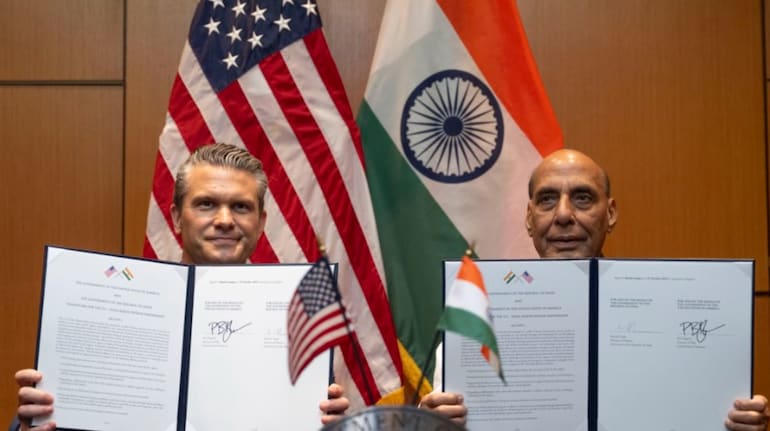
On October 31, 2025, the Republic of India and the United States of America formalised a landmark defence cooperation arrangement: a 10-year “Framework for the U.S.–India Major Defence Partnership”. The pact was signed during a meeting between India’s Defence Minister Rajnath Singh and U.S. Defence Secretary Peter Hegseth on the sidelines of the ASEAN-India Defence Ministers’ Informal Meeting in Kuala Lumpur, Malaysia.
Key Highlights of the 10-Year Framework
The agreement is designed to guide defence cooperation between India and the U.S. over the coming decade. Some of its core components include:
- Enhanced military coordination and joint exercises.
- Defence technology sharing and innovation, enabling deeper collaboration in research and development.
- Expanded information and intelligence exchange to support strategic operations and situational awareness.
- Increased defence industry collaboration, spanning manufacturing, supply chains, and co-development.
- A focus on maritime security in the Indo-Pacific region, recognising the strategic significance of sea-lanes and regional stability.
According to Defence Minister Rajnath Singh, this framework “will provide policy direction to the entire spectrum of the India-U.S. Defence Relationship.” On the U.S. side, Secretary Peter Hegseth described the deal as a major step toward regional security and global cooperation, calling the current level of defence ties “the strongest ever.”
Significance for India-U.S. Strategic Partnership
This 10-year pact marks a shift from ad-hoc cooperation toward a long-term institutionalised defence architecture between India and the U.S. It signals both parties’ recognition of the changing geopolitical landscape—particularly in the Indo-Pacific region—and the need for coordinated responses. For India, it offers access to advanced technology, deeper industry linkages, and a stronger role in shaping regional security architecture. For the U.S., it reinforces India as a key strategic partner in Asia and contributes to a rules-based order in the Indo-Pacific.
Implications for Defence & Industry in India
From India’s perspective, the pact aligns with its “Make in India – Defence” push and broader strive for defence self-reliance. Closer collaboration in technology and industry means Indian defence manufacturers may gain from U.S. know-how, joint ventures, and export potential. Operationally, increased joint exercises and intelligence sharing will enhance India’s readiness and interoperability with a major global power.
Link to Exam Preparation
For students preparing for teaching, police, banking, railways, defence, and civil service exams, this news intersects several themes: international relations, defence policy, strategic partnerships, and industrial policy. Questions may involve the objectives of the pact, its significance for India’s security strategy, or the aspects of cooperation under the framework. Knowing such high-level agreements and how they reflect India’s foreign-policy priorities is valuable for general studies and current affairs sections.
Why This News Is Important
Strategic Relevance
The signing of the 10-year defence framework between India and the U.S. is important because it institutionalises a key bilateral partnership at a strategic level—beyond isolated deals or annual exercises. By providing a roadmap for cooperation over a decade, the agreement reflects long-term alignment in defence and security interests. For India, which is seeking to assert its role in the Indo-Pacific, this pact adds substance to its strategic posture.
Defence Industrial & Technological Impact
From an industrial and technological viewpoint, the framework elevates the defence industry dimension of India-U.S. relations. It opens new avenues for co-development, technology transfer, and supply-chain integration. For India’s “Make in India – Defence” ambition and drive for self-reliance (Atmanirbhar Bharat), such partnerships are instrumental in bridging capability gaps and upgrading indigenous ecosystems.
Exam-Relevant Dimensions
For aspirants of government jobs (teachers, police, banking, railways, defence, civil services), this news touches upon multiple domains: international relations (IR), defence studies, economy/industry policy, and national security. Understanding the broad contours of the pact helps answer questions on foreign-policy alignments, India’s strategic aims, and the evolving global order. Additionally, it offers a concrete example to illustrate India’s defence diplomacy for essay or descriptive sections.
Historical Context
India and the U.S. have steadily deepened their defence ties over the past two decades. In 2005, they designated each other “Major Defence Partners”. In 2016, a foundational Joint Strategic Vision for the Asia-Pacific and Indian Ocean Region was adopted. In 2020, the two countries signed mutual logistics agreements (LEMOA, COMCASA, BECA) to facilitate interoperability and access. The current 10-year framework builds upon this evolution, shifting from individual pacts and dialogues to a time-bound, structured partnership. Moreover, the Indo-Pacific region has become a major theatre of geostrategic competition—making India’s enhanced collaboration with the U.S. especially pertinent. This development must also be viewed against India’s push for a “free, open, and inclusive” Indo-Pacific and its emphasis on defence readiness and diplomatic outreach to counter emerging threats and secure maritime interests.
Key Takeaways from “India-U.S. 10-Year Defence Framework Pact”
| S. No | Key Takeaway |
|---|---|
| 1 | India and the United States signed a 10-year defence framework agreement on October 31, 2025. |
| 2 | The framework aims to deepen cooperation in joint exercises, technology sharing, intelligence exchange, and maritime security. |
| 3 | The agreement was signed on the sidelines of the ASEAN-India Defence Ministers’ Informal Meeting in Kuala Lumpur. |
| 4 | It supports India’s strategic goals of defence modernisation, Atmanirbhar Bharat in defence manufacturing, and stronger Indo-Pacific posture. |
| 5 | The pact marks a shift toward long-term institutionalisation of India-U.S. defence partnership, enhancing regional stability and global cooperation. |
Frequently Asked Questions (FAQs)
1. What is the India-U.S. 10-year Defence Framework Pact?
The India-U.S. 10-year Defence Framework Pact is a long-term strategic agreement that outlines defence cooperation between the two countries for the next decade. It covers technology sharing, joint military exercises, intelligence exchange, and maritime security collaboration.
2. When and where was the 10-year Defence Framework Pact signed?
The pact was signed on October 31, 2025, during the ASEAN-India Defence Ministers’ Informal Meeting held in Kuala Lumpur, Malaysia.
3. Who represented India and the U.S. at the signing of the pact?
The agreement was signed between Defence Minister Rajnath Singh of India and U.S. Defence Secretary Peter Hegseth.
4. What is the main goal of this defence framework?
The main goal is to provide a structured, long-term roadmap for defence cooperation that enhances interoperability, supports India’s self-reliance in defence manufacturing, and strengthens Indo-Pacific regional security.
5. How does this pact benefit India’s defence industry?
The pact will promote co-development and co-production of advanced defence technologies, creating opportunities for Indian industries to collaborate with U.S. firms under the Make in India – Defence initiative.
6. How does this pact impact India’s foreign policy?
It reinforces India’s position as a strategic partner in the Indo-Pacific, deepening ties with the U.S. while maintaining balanced relations with other global powers.
7. How is this pact relevant to competitive exams?
This topic connects with current affairs, defence policy, international relations, and India’s foreign policy — all commonly covered in exams like UPSC, SSC, CDS, CAPF, and State PSCs.
8. What earlier defence agreements paved the way for this pact?
Earlier foundational agreements include LEMOA (2016), COMCASA (2018), and BECA (2020), all of which enhanced logistics, communication, and intelligence sharing between the two nations.
9. What is the Indo-Pacific region’s significance in this pact?
The Indo-Pacific is a key strategic area for trade and security. This pact enhances maritime domain awareness and naval collaboration, ensuring a free and open Indo-Pacific.
10. How will this agreement influence India’s defence modernization?
It will accelerate access to cutting-edge technologies, training, and operational coordination, helping India strengthen its defence capabilities and global defence partnerships.
Some Important Current Affairs Links