







Mobile Phone Manufacturing Scheme with ₹62,500 crore outlay explained: know its five-year tenure, incentives, domestic sourcing, employment target and exam-important facts.
Government Launches a Major Push for Mobile Manufacturing
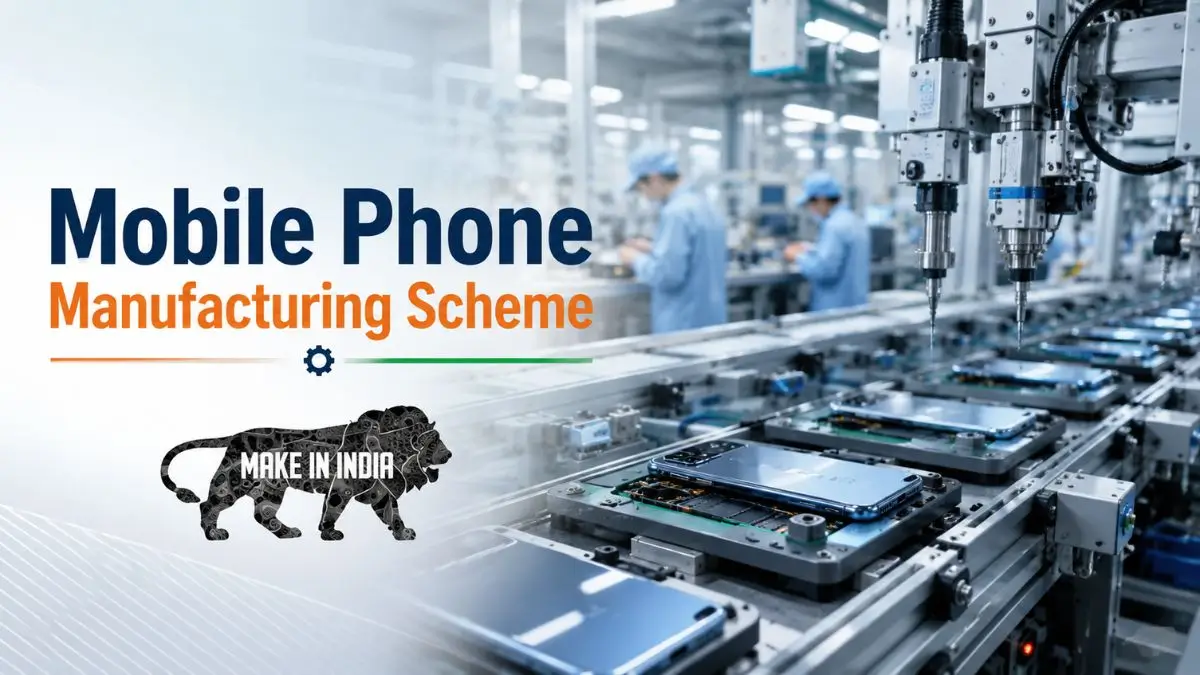
The Centre has notified the ₹62,500 crore Mobile Phone Manufacturing Scheme (MPMS) to strengthen India’s position as a major global hub for electronics and smartphone manufacturing. The five-year scheme will support the expansion of mobile phone production, encourage domestic value addition, strengthen supply chains and promote the growth of Indian mobile phone brands.
The scheme is expected to play an important role in advancing the objectives of Make in India and Atmanirbhar Bharat. It comes as India continues to expand its electronics manufacturing ecosystem and seeks to move beyond the assembly of finished products towards greater domestic production of components, sub-assemblies, design capabilities and intellectual property.
Mobile Phone Manufacturing Scheme to Run for Five Years
The Mobile Phone Manufacturing Scheme will operate from FY 2026-27 to FY 2030-31. The scheme provides incentive support on eligible sales for mobile phones manufactured in India.
The scheme covers two major target segments. The first segment focuses on large-scale mobile phone manufacturing, including eligible companies involved in electronics manufacturing services. The second segment is aimed at supporting Indian mobile phone brands.
According to the scheme framework, eligible incentives will be provided at differentiated rates. The policy also includes additional support for domestic sourcing of important components and sub-assemblies, thereby encouraging companies to deepen localisation in the manufacturing process.
Incentives to Encourage Domestic Component Sourcing
One of the major features of the new scheme is the focus on domestic value addition. Companies can receive an additional incentive of up to 1.5% for sourcing key components and sub-assemblies from domestic sources.
The localisation initiative covers important components such as camera modules, display assemblies, mechanical components and battery cells. This provision is intended to reduce dependence on imported components and encourage the development of a stronger domestic electronics supply chain.
For India, greater local sourcing can help retain more economic value within the country. It can also encourage investment in component manufacturing, research, technology and skilled employment.
Support for Indian Mobile Phone Brands
The MPMS also aims to promote Indian mobile phone brands and strengthen their ability to compete in domestic and international markets. Eligible Indian-owned companies with 51% Indian ownership and a turnover of at least ₹1,000 crore in FY 2025-26 may qualify under specified conditions.
Indian brands have also been given special policy support to encourage investment in research and development, product design and intellectual property. The scheme seeks to help Indian companies move towards technological sovereignty and create greater value through innovation and patents.
Applicants under the Indian mobile phone brand segment will receive a one-year gestation period. The selection of eligible Indian brands will be carried out by the Empowered Committee according to the prescribed criteria.
Large Manufacturers and EMS Companies Can Benefit
The scheme provides eligibility for mobile phone manufacturers, including Electronics Manufacturing Services (EMS) companies registered in India. Under the notified framework, companies with a turnover of at least ₹10,000 crore in FY 2025-26 can become eligible under specified conditions.
The participation of large manufacturers is expected to help India scale up production and strengthen its role in global value chains. The policy aims to create an ecosystem in which mobile phone production is supported by domestic suppliers, component manufacturers, designers and research institutions.
Production and Employment Expected to Rise
The government expects cumulative mobile phone production in India to reach approximately ₹39 lakh crore during the policy period. The scheme is also expected to generate around 60,000 new direct employment opportunities.
Employment generation is particularly significant because electronics manufacturing has emerged as an important source of jobs in India. The expansion of the sector can create opportunities in production, engineering, supply-chain management, research, design, quality control and related services.
India is already the world’s second-largest mobile phone manufacturer by volume. The new policy seeks to consolidate this position and further increase India’s competitiveness in international electronics manufacturing.
MPMS Builds on India’s Previous PLI Success
The new Mobile Phone Manufacturing Scheme follows the Production Linked Incentive Scheme for Large Scale Electronics Manufacturing, commonly known as PLI-LSEM. The earlier scheme played an important role in expanding mobile manufacturing and smartphone exports from India.
The tenure of the PLI-LSEM ended on March 31, 2026. The MPMS represents the next stage of India’s policy strategy for the sector, with a stronger emphasis on domestic value addition, supply-chain resilience, Indian brands and component localisation.
Why This News Matters for Government Exam Aspirants
The Mobile Phone Manufacturing Scheme is important for candidates preparing for UPSC, State PCS, SSC, Banking, Railways and other government examinations because it connects several important areas of the syllabus. These include government schemes, industrial policy, electronics manufacturing, employment generation, exports, Make in India, Atmanirbhar Bharat and Production Linked Incentives.
Aspirants should remember the scheme name, total outlay, tenure, target segments, additional domestic sourcing incentive and expected employment generation. The transition from the earlier PLI-LSEM to MPMS can also be important for questions related to recent government initiatives in the electronics sector.

Why this News is Important
Strengthens India’s Electronics Manufacturing Strategy
The notification of the Mobile Phone Manufacturing Scheme is significant because electronics manufacturing has become an important pillar of India’s industrial and export strategy. The scheme aims to increase production while encouraging companies to manufacture more components within India. This can reduce import dependence and improve the resilience of domestic supply chains.
Supports Make in India and Atmanirbhar Bharat
The scheme directly supports the broader objectives of Make in India and Atmanirbhar Bharat. Instead of focusing only on the assembly of finished mobile phones, the policy encourages greater domestic value addition through the local production and sourcing of components. This approach can help India develop a more complete electronics manufacturing ecosystem.
Promotes Employment and Industrial Growth
The government expects the scheme to generate around 60,000 direct jobs. The expansion of manufacturing can also create additional opportunities across related industries such as logistics, engineering, components, design and technology services. Therefore, the scheme has wider significance for employment and industrial development.
Important for India’s Export Competitiveness
Mobile phones have become an important category in India’s export basket. By increasing production capacity and improving supply-chain capabilities, the scheme can strengthen India’s position in global electronics markets. It also aims to help domestic companies become more competitive internationally.
Relevant for Competitive Examinations
For government exam aspirants, this development is important because questions can be asked on the scheme’s budgetary outlay, duration, objectives, incentive structure, employment target and relationship with the earlier PLI-LSEM. The MPMS also provides an example of how government policy uses financial incentives to promote manufacturing, exports and technological development.
Historical Context
Growth of Mobile Manufacturing in India
India’s mobile phone manufacturing sector has expanded significantly over the last decade. Government initiatives under Make in India encouraged global and domestic companies to establish or expand manufacturing operations in the country.
Role of Production Linked Incentives
The Production Linked Incentive Scheme for Large Scale Electronics Manufacturing was an important policy intervention in the growth of India’s electronics sector. The scheme provided incentives linked to incremental sales and helped attract large investments into mobile phone manufacturing.
The PLI-LSEM played a major role in increasing domestic production and supporting the growth of smartphone exports. Its tenure ended on March 31, 2026, creating the need for a new policy framework to support the next stage of industry development.
Shift Towards Domestic Value Addition
India’s policy focus has gradually shifted from the assembly of finished products towards deeper manufacturing capabilities. The new MPMS reflects this transition by offering additional incentives for the domestic sourcing of critical components and sub-assemblies.
Next Phase of Electronics Manufacturing
The MPMS represents the next phase of India’s electronics manufacturing strategy. Along with increasing production volumes, the policy focuses on supply-chain resilience, Indian brands, research and development, product design, patents and technological sovereignty. This broader approach aims to help India capture a larger share of the economic value generated by the global electronics industry.
Key Takeaways from Mobile Phone Manufacturing Scheme
| S. No. | Key Takeaway |
|---|---|
| 1 | The Centre has notified the Mobile Phone Manufacturing Scheme (MPMS) with a total outlay of ₹62,500 crore. |
| 2 | The scheme will operate for five years, from FY 2026-27 to FY 2030-31. |
| 3 | MPMS focuses on scaling up mobile phone manufacturing, increasing domestic value addition and strengthening supply chains. |
| 4 | An additional incentive of up to 1.5% is available for domestic sourcing of key components and sub-assemblies. |
| 5 | The scheme is expected to support cumulative mobile phone production of about ₹39 lakh crore and generate around 60,000 direct jobs. |
Frequently Asked Questions (FAQs)
1. What is the Mobile Phone Manufacturing Scheme (MPMS)?
The Mobile Phone Manufacturing Scheme (MPMS) is a Central Government initiative designed to expand mobile phone manufacturing in India, increase domestic value addition, strengthen supply chains and promote Indian mobile phone brands.
2. What is the total outlay of the Mobile Phone Manufacturing Scheme?
The scheme has a total financial outlay of ₹62,500 crore.
3. What is the duration of the MPMS?
The scheme will operate for five years, from FY 2026-27 to FY 2030-31.
4. What is the main objective of the MPMS?
Its key objectives are to scale up mobile phone manufacturing, encourage domestic sourcing of components, strengthen India’s electronics ecosystem and improve India’s competitiveness in global electronics value chains.
5. What additional incentive is available for domestic sourcing?
Eligible manufacturers can receive an additional incentive of up to 1.5% for sourcing specified key components and sub-assemblies domestically.
6. Which components are covered under the domestic sourcing focus?
The localisation focus includes important components and sub-assemblies such as camera modules, display assemblies, mechanical components and battery cells.
7. Does the scheme support Indian mobile phone brands?
Yes. The scheme includes a dedicated segment for eligible Indian-owned mobile phone brands, with the objective of strengthening domestic brands and encouraging innovation, product design and intellectual property development.
8. What is the expected employment generation under the scheme?
The scheme is expected to generate approximately 60,000 direct employment opportunities.
9. What is the expected cumulative mobile phone production under the MPMS?
The government expects cumulative mobile phone production of approximately ₹39 lakh crore during the scheme period.
10. Which earlier scheme preceded the MPMS?
The MPMS follows the Production Linked Incentive Scheme for Large Scale Electronics Manufacturing (PLI-LSEM), whose tenure ended on March 31, 2026.
Some Important Current Affairs Links