







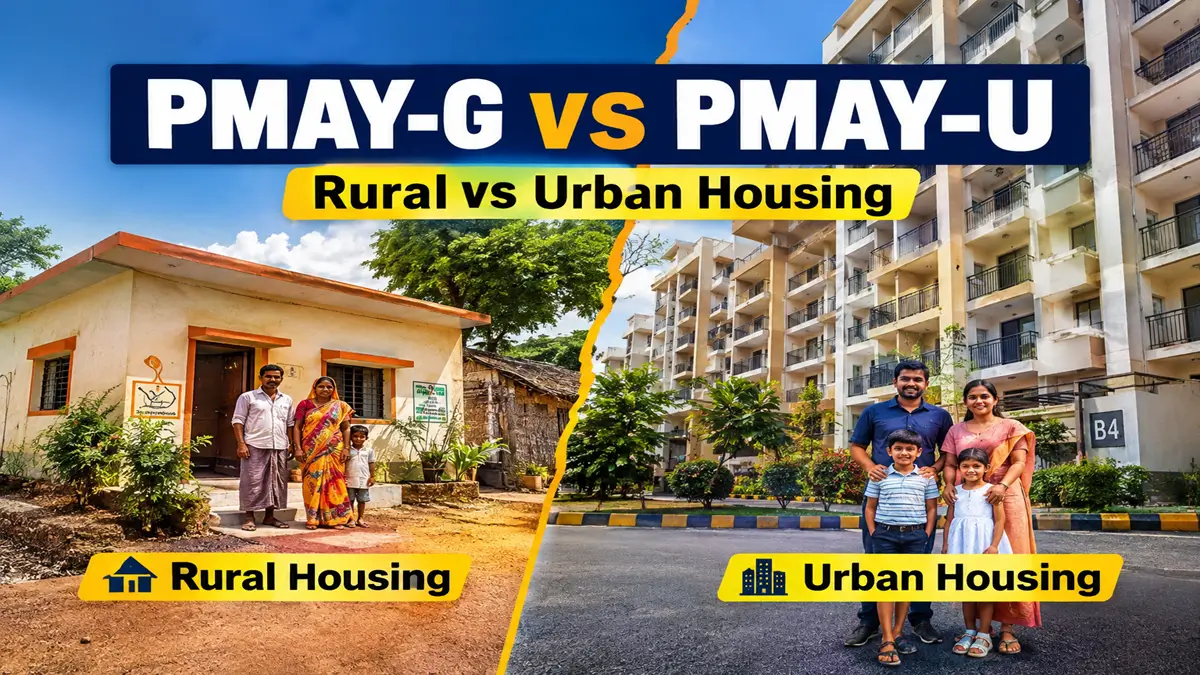
PMAY-G vs PMAY-U difference explained with ministries, launch dates, eligibility, financial assistance, PMAY-U 2.0 verticals and key exam facts.
Introduction to PMAY-G and PMAY-U
The Pradhan Mantri Awas Yojana (PMAY) is one of the Government of India’s major initiatives for improving access to affordable and pucca housing. The programme is divided into two major components based on the location of beneficiaries: Pradhan Mantri Awaas Yojana-Gramin (PMAY-G) for rural households and Pradhan Mantri Awas Yojana-Urban (PMAY-U) for urban households. Understanding the distinction between PMAY-G and PMAY-U is important for government-exam aspirants because questions related to ministries, welfare schemes, eligibility, financial assistance and implementation frequently appear in competitive examinations.
PMAY-G: Housing Support for Rural India
PMAY-G is implemented by the Ministry of Rural Development and came into effect on 1 April 2016 after restructuring the earlier Indira Awaas Yojana. Its objective is to provide pucca houses with basic amenities to eligible rural households, particularly families that are houseless or living in inadequate kutcha houses. The scheme uses housing-deprivation criteria and relevant survey data for identifying beneficiaries.
Financial Assistance Under PMAY-G
Under PMAY-G, the standard central assistance is ₹1.20 lakh per unit in plain areas and ₹1.30 lakh in hilly and difficult areas. The programme also converges with other government initiatives for facilities such as sanitation, employment-related wage support and basic household amenities. The minimum house size under the scheme is 25 square metres, including space for hygienic cooking.
PMAY-U: Affordable Housing in Urban Areas
PMAY-U is administered by the Ministry of Housing and Urban Affairs (MoHUA) and was launched on 25 June 2015. Its objective is to provide all-weather pucca houses with basic civic amenities to eligible urban beneficiaries. The scheme covers urban areas and has addressed housing requirements among economically weaker sections and other eligible income groups.
PMAY-U 2.0 and Its Four Verticals
PMAY-U has been revamped as PMAY-U 2.0, which took effect from 1 September 2024. The renewed mission seeks to support one crore additional eligible urban beneficiaries over five years. It operates through four verticals: Beneficiary Led Construction (BLC), Affordable Housing in Partnership (AHP), Affordable Rental Housing (ARH), and Interest Subsidy Scheme (ISS).
Major Difference Between PMAY-G and PMAY-U
The principal difference between the two schemes is their geographical and administrative focus. PMAY-G addresses housing deprivation in rural areas and is implemented by the Ministry of Rural Development, whereas PMAY-U addresses affordable housing requirements in urban areas under the Ministry of Housing and Urban Affairs. Their beneficiary identification systems, implementation mechanisms and housing interventions are consequently different.
Women’s Ownership and Social Inclusion
Women’s ownership is an important feature associated with government housing programmes. Under PMAY-U, houses are generally required to be in the name of an adult female member or jointly in the name of the husband and wife, subject to scheme provisions. PMAY-G has also recorded substantial participation of women as owners or joint owners of sanctioned houses. These provisions promote asset ownership among women and strengthen the social impact of housing programmes.
Current Relevance of PMAY-G
PMAY-G continues to be an important rural-development programme. In 2025, the government stated that the overall rural target had been raised to 4.95 crore pucca houses with basic amenities by 2029, including two crore additional rural houses approved for the period from FY 2024-25 to FY 2028-29.
Current Relevance of PMAY-U
PMAY-U 2.0 is the current urban housing framework and reflects the government’s shift towards multiple forms of affordable housing, including construction, partnership-based housing, rental housing and interest-subsidy support. As of 2026, the government has continued to emphasise implementation of the scheme and completion of eligible housing projects.
Why the Comparison Matters for Government Exams
PMAY-G vs PMAY-U is an important topic for examinations such as UPSC, State PSC, SSC, banking, railways, defence and police recruitment examinations. Aspirants should remember the launch dates, implementing ministries, geographical coverage, financial assistance under PMAY-G and the four verticals of PMAY-U 2.0. These details can help candidates answer both direct factual questions and questions involving government welfare policies.

Why This News Is Important
Importance for Government-Exam Aspirants
The comparison between PMAY-G and PMAY-U is important because both programmes represent major components of the government’s housing policy, but they operate in different geographical and administrative settings. Competitive examinations frequently test candidates on the distinction between similar government schemes, especially their ministries, target beneficiaries, launch dates and objectives.
Importance for Rural Development
PMAY-G is closely connected with rural development, poverty reduction and improvement of living conditions. It aims to move eligible rural households from inadequate housing towards pucca homes with basic amenities. The scheme also uses convergence with other government programmes, making it relevant to questions on integrated welfare delivery.
Importance for Urban Development
PMAY-U is significant for understanding India’s urbanisation and affordable-housing policy. Its updated PMAY-U 2.0 framework includes construction, affordable housing partnerships, rental housing and interest-subsidy support. This broader structure reflects the different housing challenges faced by urban populations.
Importance for Social Inclusion
Housing schemes also have an important gender and social-inclusion dimension. PMAY-U provisions promote ownership or joint ownership by women, while PMAY-G has resulted in a substantial share of houses being owned or jointly owned by women. Therefore, PMAY is relevant not only to housing policy but also to questions concerning women’s empowerment and inclusive development.
Importance for Policy-Based Questions
For examinations, students should avoid treating PMAY as a single identical scheme across India. PMAY-G and PMAY-U have separate ministries, implementation structures and target areas. PMAY-U 2.0 has further introduced a revised framework for urban housing. Remembering these distinctions can help aspirants solve questions on welfare schemes, ministries and government initiatives accurately.
Historical Context: Evolution of Government Housing Schemes
Indira Awaas Yojana as the Earlier Rural Housing Programme
India’s rural housing policy predates PMAY-G. The earlier Indira Awaas Yojana (IAY) was the principal rural housing programme before it was restructured into PMAY-G. The government subsequently adopted a more comprehensive approach that linked housing assistance with basic amenities and improved beneficiary identification.
Launch of PMAY-U in 2015
The urban component of PMAY was launched on 25 June 2015 as part of the government’s broader Housing for All approach. It was designed to address housing requirements in urban areas through different intervention models and beneficiary categories.
Launch of PMAY-G in 2016
PMAY-G came into effect on 1 April 2016, with the programme formally launched on 20 November 2016. It replaced the earlier rural housing framework with an emphasis on better-quality pucca houses, beneficiary participation and convergence with other schemes.
Transition to PMAY-U 2.0
Based on implementation experience under the original urban mission, the government revamped the urban programme. PMAY-U 2.0 came into effect on 1 September 2024 and seeks to assist one crore additional eligible urban beneficiaries through four major verticals.
Continuing Housing Mission
The evolution from IAY to PMAY-G and from PMAY-U to PMAY-U 2.0 shows how India’s housing policy has expanded from basic construction assistance towards a broader housing ecosystem involving sanitation, infrastructure, rental housing, partnerships and financial support. This evolution is particularly relevant for civil-service and other government examinations.
Key Takeaways from PMAY-G vs PMAY-U: Rural and Urban Housing Schemes
| S. No. | Key Takeaway |
|---|---|
| 1 | PMAY-G is the rural housing component and is implemented by the Ministry of Rural Development. |
| 2 | PMAY-U is the urban housing component and is implemented by the Ministry of Housing and Urban Affairs. |
| 3 | PMAY-G came into effect on 1 April 2016, while PMAY-U was launched on 25 June 2015. |
| 4 | PMAY-G provides standard central assistance of ₹1.20 lakh in plain areas and ₹1.30 lakh in hilly/difficult areas. |
| 5 | PMAY-U 2.0, effective from 1 September 2024, operates through BLC, AHP, ARH and ISS to support affordable urban housing. |
FAQs: PMAY-G vs PMAY-U
1. What is PMAY?
Pradhan Mantri Awas Yojana (PMAY) is a major Government of India housing initiative aimed at improving access to affordable and pucca housing for eligible households in rural and urban areas.
2. What is PMAY-G?
PMAY-G (Pradhan Mantri Awaas Yojana-Gramin) is the rural housing component of the programme. It focuses on providing pucca houses with basic amenities to eligible rural households.
3. Which ministry implements PMAY-G?
PMAY-G is implemented by the Ministry of Rural Development.
4. When did PMAY-G come into effect?
PMAY-G came into effect on 1 April 2016. It replaced the earlier Indira Awaas Yojana (IAY) framework.
5. What is PMAY-U?
PMAY-U (Pradhan Mantri Awas Yojana-Urban) is the urban housing component designed to address the housing requirements of eligible beneficiaries in urban areas.
6. Which ministry implements PMAY-U?
PMAY-U is implemented under the Ministry of Housing and Urban Affairs (MoHUA).
7. When was PMAY-U launched?
PMAY-U was launched on 25 June 2015.
8. What is the difference between PMAY-G and PMAY-U?
The primary difference is their geographical focus. PMAY-G focuses on rural housing, whereas PMAY-U focuses on urban housing. They are also administered by different ministries and have different implementation frameworks.
9. What is the standard financial assistance under PMAY-G?
PMAY-G provides central assistance of ₹1.20 lakh per unit in plain areas and ₹1.30 lakh per unit in hilly and difficult areas.
10. What is PMAY-U 2.0?
PMAY-U 2.0 is the revamped urban housing mission that came into effect on 1 September 2024. It aims to support eligible urban beneficiaries through multiple affordable-housing interventions.
Some Important Current Affairs Links