






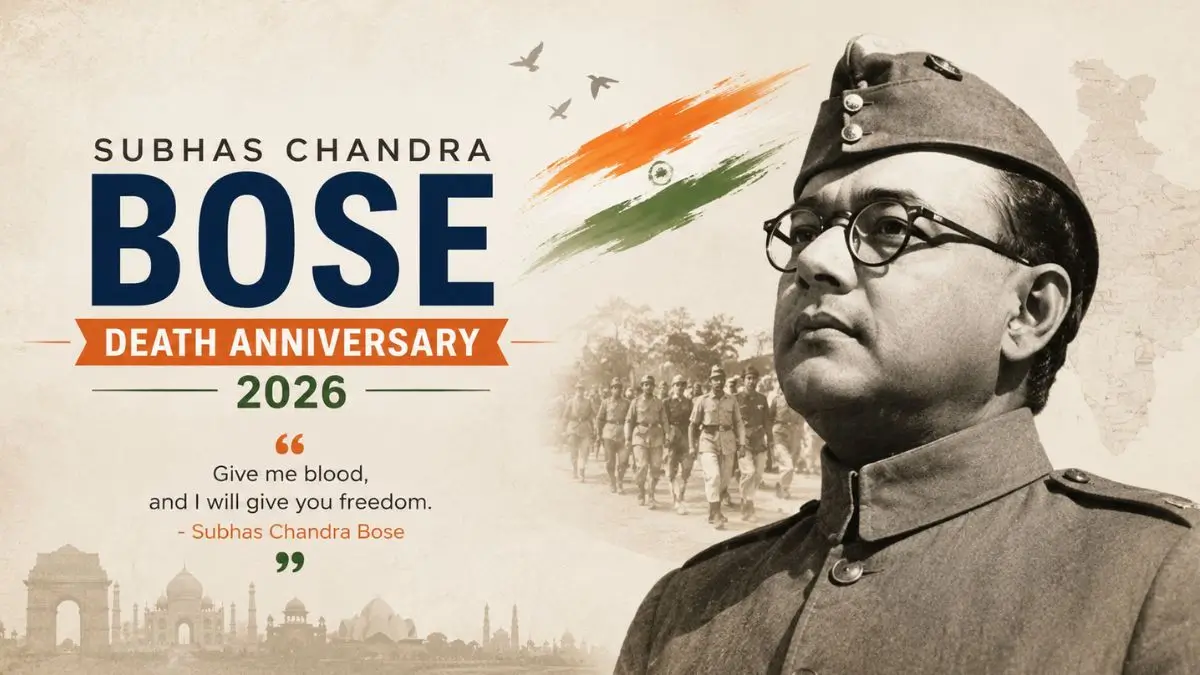
Subhas Chandra Bose death anniversary 2026 highlights Netaji’s biography, INA leadership, Azad Hind Government, freedom struggle and death controversy.
Subhas Chandra Bose Death Anniversary 2026
Subhas Chandra Bose Death Anniversary 2026 is observed on August 18, 2026, marking 81 years since his reported death. Popularly known as Netaji, Bose remains one of the most prominent figures of India’s freedom struggle. His approach differed from the mainstream Congress strategy because he strongly advocated complete independence from British rule and supported an armed struggle when he believed it could accelerate India’s liberation. His association with the Indian National Army (INA) and the establishment of the Azad Hind Government are central to his political and military legacy.
Early Life and Education of Subhas Chandra Bose
Subhas Chandra Bose was born on January 23, 1897, in Cuttack, then part of the Bengal Province, to Janakinath Bose and Prabhavati Dutt Bose. He studied at Presidency College in Calcutta, where his involvement in nationalist activities resulted in his expulsion. He later completed his education at Scottish Church College in 1919 and subsequently studied at the University of Cambridge. Bose passed the Indian Civil Service (ICS) examination in 1920, but chose to give up his candidature in 1921 because he wanted to devote himself to India’s freedom movement.
Subhas Chandra Bose and the Indian National Congress
Bose became an important leader of the Indian National Congress and was elected its president in 1938. During his presidency, he established the National Planning Committee, reflecting his emphasis on industrialisation and economic planning for a future independent India. He was re-elected Congress president in 1939, defeating Pattabhi Sitaramayya. However, ideological differences with Mahatma Gandhi and other senior Congress leaders led to his resignation. Bose subsequently established the Forward Bloc to bring together left-oriented political forces.
Bose’s Escape from India and International Activities
While under house arrest, Bose made a dramatic escape from Calcutta on January 26, 1941. He travelled through Kabul and Moscow before reaching Germany in April 1941. In Germany, he used Azad Hind Radio to communicate messages supporting India’s freedom struggle in several Indian languages. His international activities were aimed at securing foreign assistance for the struggle against British colonial rule.
Leadership of the Indian National Army
In 1943, Bose reached Japanese-controlled Southeast Asia and assumed leadership of the Indian National Army, also known as the Azad Hind Fauj. Under his leadership, the INA became an important symbol of armed resistance against British rule. Bose popularised the slogan “Delhi Chalo”, calling upon Indians to support the struggle for independence. The INA, together with Japanese forces, advanced towards the northeastern regions of India and reached areas near Imphal and Kohima in 1944, although the campaign ultimately failed and the forces retreated.
Establishment of the Azad Hind Government
A major milestone in Bose’s career came on October 21, 1943, when he announced the establishment of the Provisional Government of Free India, commonly known as the Azad Hind Government. The government represented Bose’s attempt to create an alternative political authority for a free India. His leadership gave a distinct international and military dimension to the Indian independence movement.
Subhas Chandra Bose Death Anniversary and the Mystery of His Death
The circumstances surrounding Bose’s death remain one of the most debated subjects in modern Indian history. The officially reported account states that he suffered severe injuries in a plane crash on August 18, 1945, near Taihoku in Formosa, now Taipei, Taiwan, and subsequently died in a Japanese hospital. Questions have nevertheless continued regarding the circumstances of the crash and the identity of the ashes preserved at Renkōji Temple in Tokyo.
Mukherjee Commission and Controversy
Several investigations examined the circumstances of Bose’s disappearance and reported death. The Justice Mukherjee Commission of Inquiry, whose findings were presented in 2005, concluded that although Bose was dead, he had not died in the reported plane crash and that the ashes at Renkōji Temple were not his. However, the Government of India did not accept the commission’s conclusions as reliable. Therefore, Bose’s death continues to attract historical and public interest.
Legacy of Netaji Subhas Chandra Bose
Subhas Chandra Bose is remembered for his uncompromising demand for complete independence, his leadership of the INA and his establishment of the Azad Hind Government. His methods and political outlook differed significantly from those of other major nationalist leaders, making him an important subject for modern Indian history and competitive examinations. His slogans, leadership and military-oriented approach continue to occupy an important place in discussions about India’s freedom movement.

Why This News Is Important
Importance for Government Exams
Subhas Chandra Bose Death Anniversary 2026 is important for government-exam aspirants because Bose is frequently associated with questions on the Indian freedom movement, the Indian National Congress, the Indian National Army and the political developments of the 1930s and 1940s. Important examinations such as UPSC, State PCS, SSC, Railways, banking examinations and police recruitment tests may ask factual or conceptual questions related to his life and political activities.
Important Historical Facts to Remember
Candidates should remember that Bose was born on January 23, 1897, in Cuttack, passed the ICS examination in 1920 and resigned from the ICS candidature in 1921. He served as Congress president in 1938 and was re-elected in 1939. His differences with the Congress leadership resulted in his resignation, after which he formed the Forward Bloc.
INA and Azad Hind Government
The INA and Azad Hind Government are among the most important examination topics connected with Bose. He assumed leadership of the INA in Southeast Asia in 1943 and announced the Provisional Government of Free India on October 21, 1943. The INA’s campaign towards Imphal and Kohima in 1944 is also significant for understanding the military dimension of India’s independence struggle.
Understanding the Death Controversy
The circumstances of Bose’s death are important because they demonstrate the distinction between an officially reported historical account and later investigations. The reported plane crash occurred on August 18, 1945, while the Justice Mukherjee Commission later reached different conclusions. Understanding both accounts helps candidates answer history questions accurately without confusing established facts with unresolved controversies.
Historical Context: Subhas Chandra Bose and India’s Freedom Struggle
Rise of Revolutionary Nationalism
The Indian freedom movement included several political approaches, ranging from constitutional methods and mass movements to revolutionary and militant strategies. Subhas Chandra Bose emerged as a prominent leader who believed that India should achieve complete independence rather than settle for dominion status within the British Empire.
Bose’s Congress Presidency
Bose’s election as Congress president in 1938 reflected his growing influence among nationalist leaders. His emphasis on industrial development and economic planning was reflected in the formation of the National Planning Committee. His re-election in 1939, followed by differences with the Congress leadership, marked an important political turning point.
Formation of the Forward Bloc
After resigning from the Congress presidency, Bose founded the Forward Bloc to consolidate left-oriented political forces. His political activities increasingly focused on achieving independence through more aggressive means, eventually leading to his escape from India and international efforts to build support for the anti-British struggle.
INA and the Final Phase of the Freedom Struggle
Bose’s leadership of the INA gave the independence movement an organised military dimension. The INA’s operations in Southeast Asia and its advance towards northeastern India became an important part of the history of the final years of British rule. Although its military campaign did not succeed, the INA became an enduring symbol of resistance.
Bose’s Historical Legacy
Bose’s life and political career remain significant because they represent an alternative strand of Indian nationalism. His emphasis on sacrifice, discipline, military organisation and complete independence contributed to the diversity of strategies within the broader freedom movement. His reported death in 1945 and the subsequent controversy have further contributed to his lasting place in Indian historical memory.
Key Takeaways from Subhas Chandra Bose Death Anniversary 2026
| Serial Number | Key Takeaway |
|---|---|
| 1 | Subhas Chandra Bose Death Anniversary 2026 is observed on August 18 and marks 81 years since his reported death. |
| 2 | Subhas Chandra Bose was born on January 23, 1897, in Cuttack and is popularly known as Netaji. |
| 3 | Bose led the Indian National Army (INA) and announced the Provisional Government of Free India/Azad Hind Government on October 21, 1943. |
| 4 | Bose served as Congress president in 1938 and was re-elected in 1939 before resigning amid ideological differences with the Congress leadership. |
| 5 | His reported death in a plane crash on August 18, 1945, remains controversial, with later investigations producing differing conclusions. |
FAQs: Subhas Chandra Bose Death Anniversary 2026
1. When is Subhas Chandra Bose Death Anniversary observed?
Subhas Chandra Bose Death Anniversary is observed on August 18 every year, commemorating the date of his reported death in 1945.
2. When and where was Subhas Chandra Bose born?
Subhas Chandra Bose was born on January 23, 1897, in Cuttack, then part of the Bengal Presidency.
3. What is Subhas Chandra Bose popularly known as?
Subhas Chandra Bose is popularly known as Netaji.
4. When did Subhas Chandra Bose clear the Indian Civil Service examination?
Bose cleared the Indian Civil Service (ICS) examination in 1920 but later resigned from the service in 1921 to participate in India’s freedom struggle.
5. When did Subhas Chandra Bose become Congress president?
Bose became president of the Indian National Congress in 1938. He was re-elected in 1939 but subsequently resigned because of differences with the Congress leadership.
6. Which organisation was founded by Subhas Chandra Bose after his resignation from the Congress presidency?
Bose established the Forward Bloc in 1939 to consolidate left-wing forces within the nationalist movement.
7. What was the Indian National Army?
The Indian National Army (INA), also called the Azad Hind Fauj, was a military force formed to fight British rule in India. Subhas Chandra Bose assumed its leadership in Southeast Asia in 1943.
8. When was the Provisional Government of Free India established?
The Provisional Government of Free India, commonly known as the Azad Hind Government, was proclaimed by Bose on October 21, 1943.
9. What was the famous slogan associated with Subhas Chandra Bose?
One of the most famous slogans associated with Bose was “Delhi Chalo”, which was used to inspire the INA’s advance towards India.
10. When did the INA campaign reach the Imphal and Kohima region?
The INA, alongside Japanese forces, advanced towards northeastern India during 1944, with the campaign reaching the Imphal and Kohima region.
Some Important Current Affairs Links