


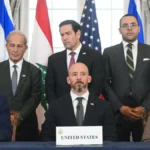




Israel Lebanon Trilateral Framework Agreement 2026 explained with key provisions, objectives, historical background, U.S. role, Hezbollah’s response, important facts, MCQs, FAQs, and exam-oriented notes for UPSC, SSC, Banking, Railways, Defence, and State PSC aspirants.
Introduction
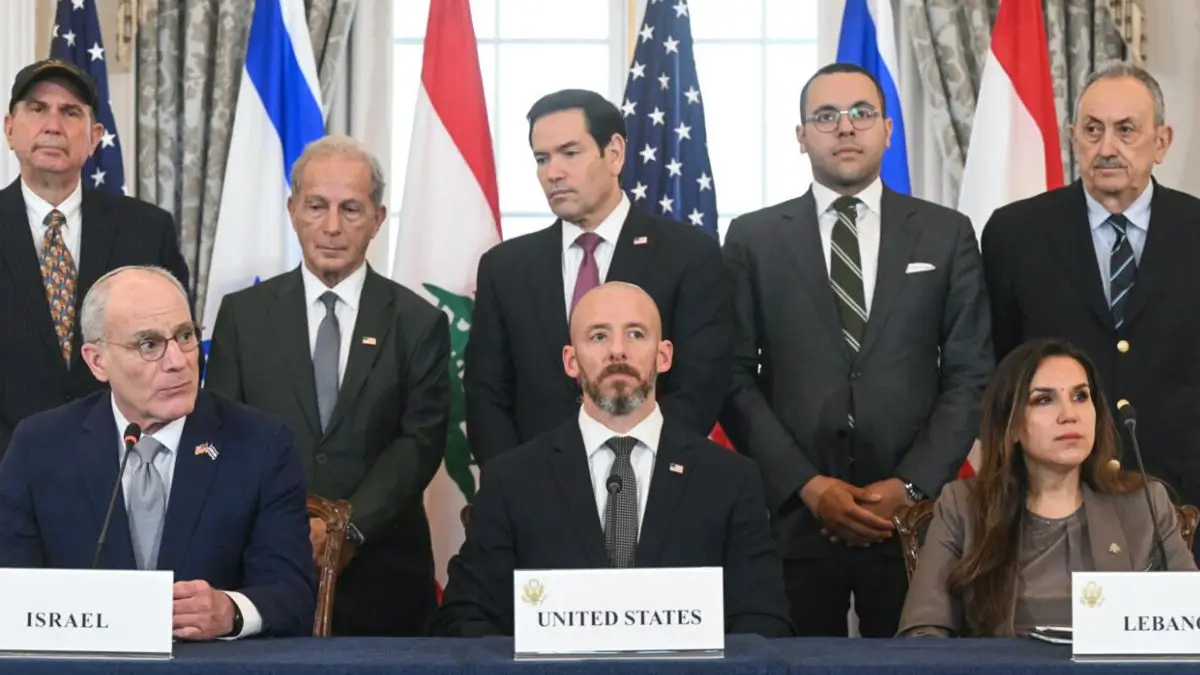
The United States has brokered a new Israel–Lebanon Trilateral Framework Agreement, signed in Washington on 26 June 2026, with the objective of reducing border tensions, restoring Lebanese state authority, and creating a roadmap for long-term peace between Israel and Lebanon. Rather than functioning as a final peace treaty, the agreement establishes a phased political and security framework that aims to reduce violence while addressing long-standing security concerns along the Israel–Lebanon border.
The agreement has attracted global attention because it comes after months of intense conflict involving Israel and Hezbollah, which resulted in thousands of casualties, large-scale displacement, and severe damage to infrastructure. Although welcomed by the United States and the Lebanese government, the framework has also received criticism from Hezbollah and several political analysts, making it an important topic for competitive examinations.
What Is the Israel–Lebanon Trilateral Framework?
The Israel–Lebanon Trilateral Framework is a political and security agreement mediated by the United States between Israel and Lebanon. Its primary objective is to gradually restore peace in southern Lebanon while reducing military confrontations along the international border.
Unlike a conventional peace treaty, the framework introduces a step-by-step mechanism under which both countries are expected to fulfil specific obligations before moving to the next stage. This phased approach seeks to build confidence while preventing further escalation of conflict.
Why Was the Agreement Needed?
The security situation along the Israel–Lebanon border deteriorated sharply after renewed clashes between Israel and Hezbollah during 2026. Continuous cross-border attacks increased fears of a wider regional conflict involving multiple Middle Eastern actors.
According to available reports:
- More than 4,000 people reportedly lost their lives.
- Thousands of civilians were displaced.
- Critical infrastructure suffered extensive destruction.
- Border communities faced prolonged insecurity.
The humanitarian crisis and growing international concern prompted diplomatic intervention led by the United States.
Major Features of the Framework
Phased Israeli Military Redeployment
Israel has agreed to gradually redeploy its military forces from Lebanese territory. However, every stage of withdrawal depends upon security conditions being fulfilled rather than following a fixed timeline.
This conditional approach is intended to ensure that security risks do not re-emerge after troop withdrawal.
Expansion of Lebanese Armed Forces’ Authority
The agreement proposes a stronger role for the Lebanese Armed Forces (LAF). As Israeli troops withdraw, the Lebanese military will gradually assume responsibility for maintaining law and order in southern Lebanon.
The objective is to strengthen Lebanese sovereignty and reduce the influence of non-state armed groups.
Disarmament of Non-State Armed Groups
One of the most debated provisions requires the verified disarmament of Hezbollah and other non-state armed organisations operating in Lebanon.
Israel considers this condition essential before completing its military withdrawal. However, Hezbollah has categorically rejected the proposal, making implementation highly uncertain.
Pilot Security Zones
The framework establishes pilot security zones along sensitive border regions.
These zones are expected to reduce accidental military confrontations while allowing monitoring by designated authorities under an internationally coordinated mechanism.
United States Coordination Mechanism
A U.S.-supported coordination mechanism has been created to supervise implementation, facilitate communication, verify compliance, and resolve disputes arising during different phases of the agreement.
This mechanism reflects Washington’s continued diplomatic engagement in Middle Eastern security affairs.
Humanitarian Assistance
Alongside the security framework, the United States announced approximately 100 million US dollars in humanitarian assistance for Lebanon.
The aid is intended to support reconstruction, rehabilitation of affected communities, and restoration of essential public services.
Reactions from Different Stakeholders
United States
The United States described the framework as the “beginning of the beginning” toward regional peace. American officials believe the agreement could create conditions for long-term stability if successfully implemented.
Israel
Israel welcomed the framework but maintained that complete troop withdrawal would occur only after Hezbollah’s verified disarmament.
Israeli leaders argue that border security remains their highest priority.
Lebanon
Lebanese President Joseph Aoun viewed the agreement as an opportunity to restore national sovereignty and rebuild conflict-affected regions.
However, political leaders within Lebanon remain divided regarding implementation.
Hezbollah
Hezbollah rejected the framework outright and declared it unacceptable.
The organisation stated that it would neither surrender its weapons nor accept conditions imposed through external mediation.
Challenges Before Implementation
Despite diplomatic optimism, the agreement faces several practical obstacles.
Many analysts believe Lebanon lacks the political and military capacity to forcibly disarm Hezbollah.
Critics also argue that linking Israeli withdrawal to Hezbollah’s disarmament could prolong Israeli military presence in southern Lebanon, potentially increasing domestic tensions within Lebanon rather than resolving them.
Importance for International Relations
The framework demonstrates how international mediation remains a key tool for conflict management.
It also illustrates the complexity of modern security negotiations where state actors, non-state armed groups, humanitarian concerns, and regional geopolitics intersect simultaneously.
For students preparing for civil services and other government examinations, this agreement highlights important concepts such as diplomacy, peacebuilding, border security, regional conflicts, international organizations, and conflict resolution.

Why This News Is Important
Important for International Relations
The Israel–Lebanon Trilateral Framework represents one of the most significant diplomatic initiatives in the Middle East during 2026. It demonstrates how third-party mediation by major powers such as the United States continues to influence regional security arrangements.
Important for Competitive Examinations
Questions related to this agreement may appear in UPSC, State PSC, SSC, Banking, Defence, Railways, Police, and Teaching examinations under International Relations, Current Affairs, World Geography, and General Studies.
Students should remember:
- Date of signing
- Countries involved
- Main objectives
- Role of the United States
- Hezbollah’s response
- Humanitarian assistance
- Key provisions
Important from a Geopolitical Perspective
The agreement reflects continuing instability in West Asia and highlights the challenges of balancing national sovereignty with regional security concerns.
It also demonstrates how unresolved disputes involving armed non-state groups continue to complicate peace negotiations.
Importance for Future Peace Efforts
Even though implementation remains uncertain, the framework provides a diplomatic structure that could support future negotiations between Israel and Lebanon.
Its success or failure may influence future conflict-resolution strategies elsewhere in the region.
Historical Context
Long History of Israel–Lebanon Conflict
Israel and Lebanon have experienced decades of political and military tensions, particularly in southern Lebanon.
The emergence of Hezbollah during the 1980s significantly altered regional security dynamics, leading to repeated conflicts between Israel and the armed group.
The 2006 Lebanon War
The 2006 war between Israel and Hezbollah caused widespread destruction and led to the adoption of a United Nations ceasefire under Security Council Resolution 1701.
Despite the ceasefire, periodic border clashes continued over the following years.
Renewed Escalation in 2026
Following months of renewed hostilities during 2026, rising casualties and humanitarian concerns prompted renewed diplomatic intervention by the United States.
The Trilateral Framework represents the latest attempt to stabilize one of the Middle East’s most volatile border regions.
Key Takeaways from This News
| S.No. | Key Takeaway |
|---|---|
| 1 | The Israel–Lebanon Trilateral Framework Agreement was signed on 26 June 2026 with U.S. mediation. |
| 2 | The agreement aims to reduce border tensions, restore Lebanese sovereignty, and promote long-term regional stability. |
| 3 | Israeli troop withdrawal will occur in phases and is linked to verified security conditions, including the proposed disarmament of Hezbollah. |
| 4 | The framework strengthens the role of the Lebanese Armed Forces and establishes a U.S.-backed coordination mechanism, along with US$100 million in humanitarian aid. |
| 5 | While supported by the United States and the Lebanese government, Hezbollah has rejected the agreement, raising doubts about its implementation. |
FAQs: Frequently Asked Questions (Exam-Oriented)
1. What is the Israel–Lebanon Trilateral Framework Agreement?
The Israel–Lebanon Trilateral Framework Agreement is a U.S.-mediated diplomatic and security framework signed on 26 June 2026 to reduce border tensions, strengthen Lebanese state authority, and promote long-term regional stability.
2. Which countries are involved in the Trilateral Framework?
The agreement involves Israel, Lebanon, and the United States, with the U.S. acting as the mediator and coordinator.
3. Why was the Israel–Lebanon Trilateral Framework introduced?
The framework was introduced to address escalating border violence, reduce military confrontations, facilitate Israeli troop redeployment, and strengthen the role of the Lebanese Armed Forces.
4. Is the Trilateral Framework a formal peace treaty?
No. It is not a peace treaty but a phased political and security framework intended to build confidence and reduce conflict.
5. What role does the United States play in the agreement?
The United States serves as the mediator, monitors implementation, facilitates dialogue between the parties, and has also announced humanitarian assistance for Lebanon.
6. What is the role of the Lebanese Armed Forces (LAF) under the framework?
The Lebanese Armed Forces are expected to gradually assume security responsibilities in southern Lebanon as Israeli forces redeploy.
7. Why has Hezbollah opposed the agreement?
Hezbollah has rejected the agreement because it opposes provisions related to the disarmament of non-state armed groups and views them as unacceptable.
8. Which United Nations resolution is closely associated with the Israel–Lebanon border issue?
UN Security Council Resolution 1701, adopted after the 2006 Lebanon War, remains a key international framework governing the ceasefire and border security.
9. Why is this news important for competitive examinations?
This topic is important for UPSC, State PSCs, SSC, Banking, Railways, Defence, CAPF, CDS, NDA, Police, and Teaching examinations under International Relations, Current Affairs, Defence, and General Studies.
10. Which topics should aspirants prepare from this news?
Students should prepare:
Middle East geopolitics
Israel–Lebanon relations
Hezbollah
U.S. role in West Asia
UN Security Council Resolution 1701
Border security
International diplomacy
Humanitarian assistance
Some Important Current Affairs Links