


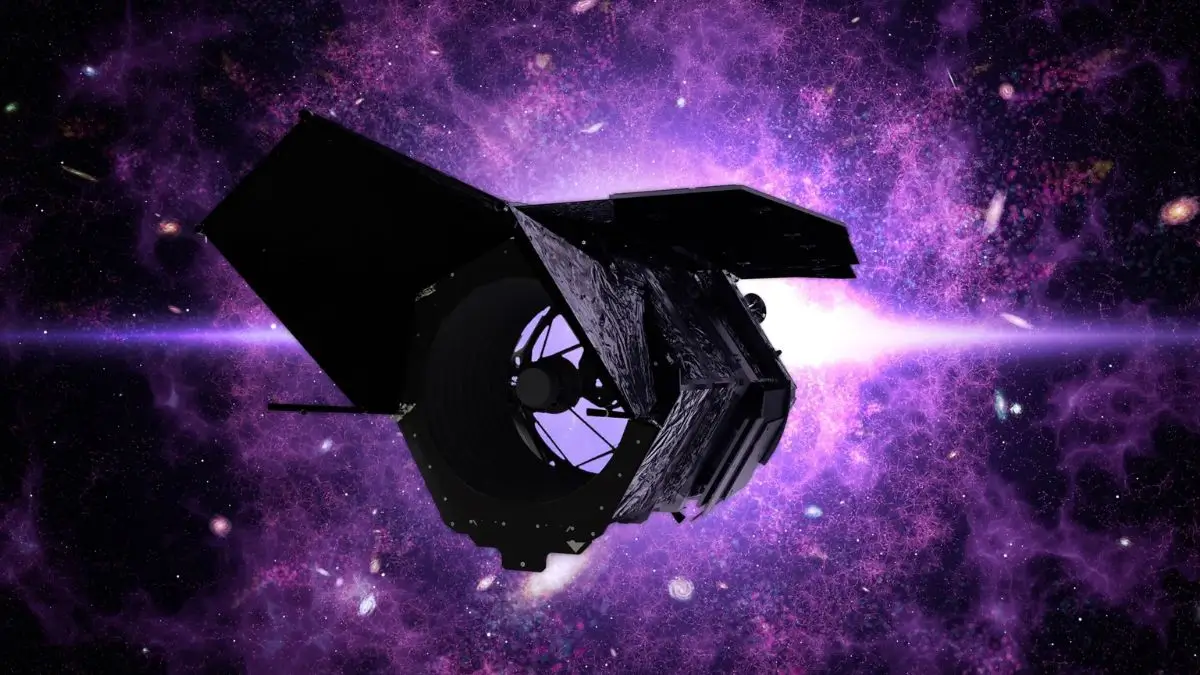
Nancy Grace Roman Space Telescope final testing phase 2026 explained with key facts, objectives, and exam-relevant insights on NASA’s next-generation space mission.
Nancy Grace Roman Space Telescope Enters Final Testing Phase After Assembly Completion
Introduction to the Mission
The Nancy Grace Roman Space Telescope, developed by NASA, has successfully completed its assembly and has now entered the crucial final testing phase. This milestone marks a significant advancement in space exploration, as the telescope is expected to revolutionize our understanding of the universe.
Assembly Completion and Testing Phase
The telescope was assembled at NASA’s Goddard Space Flight Center, where engineers integrated its key components. With assembly complete, the observatory is undergoing rigorous environmental and performance testing to ensure it can withstand the harsh conditions of space. These tests include vibration, thermal vacuum, and optical alignment checks before launch.
Advanced Capabilities of the Telescope
The Roman Space Telescope is designed with a wide-field instrument capable of capturing images 100 times larger than those of the Hubble Space Telescope. It can scan the sky up to 1,000 times faster, enabling astronomers to study vast areas of space efficiently.
Scientific Objectives
The primary aim of the mission is to study dark energy and dark matter, which together make up most of the universe. Additionally, the telescope will help discover thousands of exoplanets using advanced techniques like gravitational microlensing.
Expected Launch Timeline
NASA is targeting a launch window as early as September 2026. The telescope will be placed in a Sun–Earth Lagrange Point 2 orbit, allowing it to observe deep space with minimal interference.

Why This News is Important
Boost to Space Research and Technology
The completion of this telescope represents a major leap in space technology. Its advanced imaging capabilities will allow scientists to map the universe on an unprecedented scale, significantly enhancing astronomical research.
Understanding Dark Energy and Dark Matter
Dark energy and dark matter remain some of the biggest mysteries in physics. The Roman Telescope’s observations will help scientists understand the expansion of the universe and the forces shaping cosmic evolution, which is crucial for theoretical physics and cosmology.
Contribution to Exoplanet Discovery
The telescope is expected to detect thousands of new exoplanets, including potentially habitable worlds. This will expand knowledge about planetary systems and the possibility of life beyond Earth.
Importance for Competitive Exams
For aspirants of UPSC, SSC, Banking, Defence, and other government exams, this news is important under science and technology sections. It highlights advancements in global space missions, international collaborations, and cutting-edge research.
Historical Context
Evolution of Space Telescopes
The journey of space telescopes began with the Hubble Space Telescope, launched in 1990, which provided deep-space images and transformed astronomy. Later, the James Webb Space Telescope expanded capabilities with infrared observations.
Development of the Roman Telescope
Originally proposed as the Wide-Field Infrared Survey Telescope (WFIRST), the mission was approved in 2016 and later renamed in honor of Nancy Grace Roman, known as the “Mother of Hubble.”
Advancements Over Previous Missions
Unlike its predecessors, the Roman Telescope combines wide-field imaging with high resolution, enabling it to survey large portions of the universe quickly while maintaining precision. This marks a shift toward large-scale cosmic mapping missions.
Key Takeaways from This News
| S.No. | Key Takeaway |
|---|---|
| 1 | Nancy Grace Roman Space Telescope has completed assembly and entered final testing phase |
| 2 | It will study dark energy, dark matter, and exoplanets |
| 3 | The telescope can scan space 1,000 times faster than Hubble |
| 4 | Expected launch timeline is September 2026 |
| 5 | It represents a major advancement in next-generation space telescopes |
FAQs: Nancy Grace Roman Space Telescope
1. What is the Nancy Grace Roman Space Telescope?
It is a next-generation space telescope developed by NASA to study dark energy, dark matter, and exoplanets using wide-field infrared observations.
2. Why is it important for competitive exams?
It is relevant under Science & Technology, Space Missions, and International Developments—frequently asked in UPSC, SSC, Banking, and Defence exams.
3. What makes the Roman Telescope unique?
It can capture images 100 times larger than the Hubble Space Telescope and survey space nearly 1,000 times faster.
4. What is the expected launch timeline?
NASA is targeting a launch around 2026.
5. Where will the telescope be positioned in space?
It will be placed at the Sun–Earth Lagrange Point 2 (L2), a stable orbit ideal for deep space observation.
6. What are its main scientific objectives?
To study dark energy, map the structure of the universe, and detect exoplanets through microlensing.
7. What was the telescope previously called?
It was earlier known as the Wide-Field Infrared Survey Telescope (WFIRST).
8. Who was Nancy Grace Roman?
She was NASA’s first Chief of Astronomy and is known as the “Mother of Hubble.”
Some Important Current Affairs Links




