






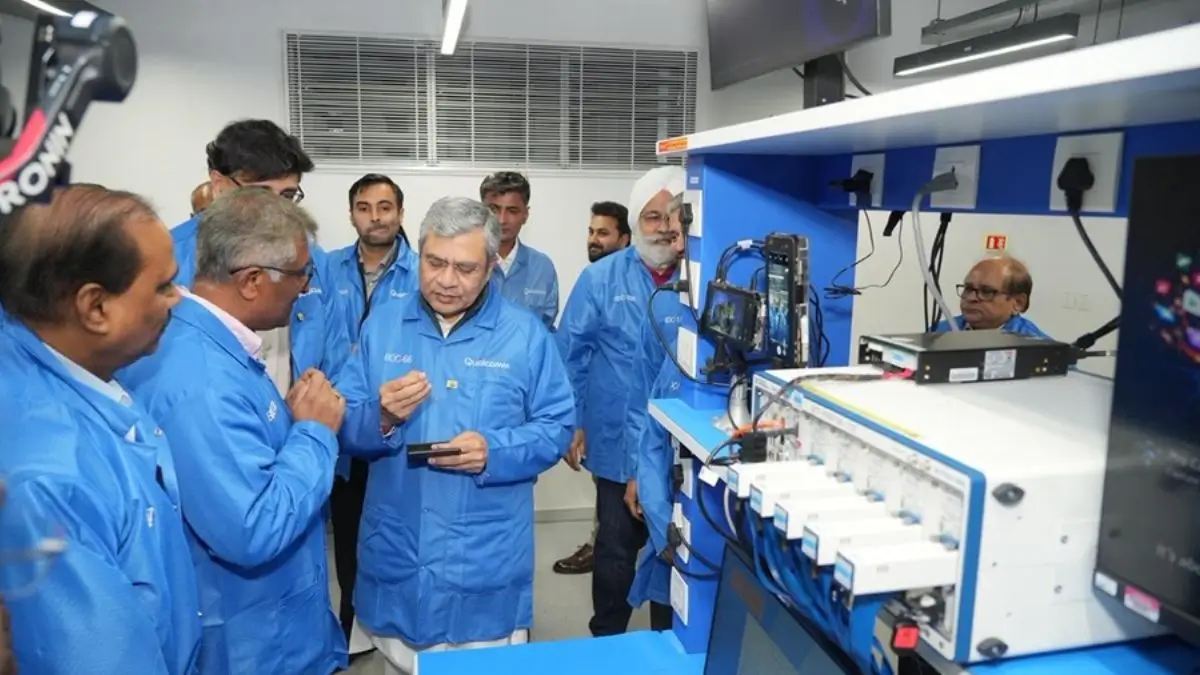
Qualcomm 2 nm chip launch in Bengaluru marks a major boost to India’s semiconductor mission as Ashwini Vaishnaw highlights India’s growing role in advanced chip technology and innovation.
📌 Ashwini Vaishnaw Launches Qualcomm’s 2 nm Advanced Semiconductor Chip in Bengaluru
On 7 February 2026, Union Minister Ashwini Vaishnaw launched Qualcomm’s state-of-the-art 2 nanometre (nm) semiconductor chip at the company’s Bengaluru facility, marking a significant milestone in India’s rapidly evolving semiconductor ecosystem.
The 2 nm chip technology represents the cutting edge in semiconductor design, offering higher processing speeds, lower power consumption, and enhanced capabilities for advanced applications such as artificial intelligence (AI), mobile devices, high-performance computing, and telecommunications.
🇮🇳 India’s Growing Role in Global Semiconductor Engineering
During the event, Minister Vaishnaw highlighted that India’s role has moved beyond traditional “back-office” support to frontier-level design and engineering work, underscoring the nation’s growing contribution to global technology innovation.
Qualcomm’s engineering centres in Bengaluru, Chennai, and Hyderabad have collaborated on this achievement, with India playing a crucial part in design implementation, system integration and AI optimization — showcasing the deep technical talent available in the country.
🧠 Strategic Vision: India Semiconductor Mission & ISM 2.0
This launch aligns with India’s broader India Semiconductor Mission (ISM) which aims to develop a full-stack semiconductor ecosystem — from research and design to manufacturing and validation. Minister Vaishnaw emphasized that the next phase, ISM 2.0, will focus heavily on product design and ecosystem development, leveraging India’s large pool of engineers and deep expertise in technology services.
The Minister also reiterated India’s strategic intentions to not just participate in global tech supply chains but to lead in advanced semiconductor innovation, boosting talent development and strengthening collaborations between government, industry, and academia.
🚀 Impacts on Innovation & Future Technologies
The deployment of 2 nm technology is expected to accelerate India’s technological capabilities across sectors including AI computing, telecommunications, defence systems, and next-generation devices. It further reinforces India’s position as a preferred destination for semiconductor design and R&D by major global players.
This development comes as several semiconductor units under the India Semiconductor Mission are in various stages of construction, indicating robust progress towards self-reliance in this critical sector.

📌 Why This News Is Important
Understanding the launch of Qualcomm’s 2 nm semiconductor chip is crucial for aspirants because it reflects India’s strategic push into high-tech manufacturing and global innovation leadership. The semiconductor industry forms the backbone of modern technology — powering everything from smartphones and computers to defence systems and AI infrastructure.
For government exam preparation, this news illustrates how India is transforming from a consumer of advanced technology into a developer and designer of cutting-edge tech products. The involvement of India in frontier semiconductor design signals a shift in the global tech landscape and underscores the importance of national initiatives like the India Semiconductor Mission. This mission not only offers economic growth but also creates opportunities in engineering, research, and manufacturing fields.
Moreover, this news is relevant for various competitive exams (e.g., UPSC, SSC, banking, railways) because it highlights government policy in technology, innovation, international cooperation, and economic self-reliance. Aspirants must note this development as part of India’s National Technology Agenda, which will increasingly influence future questions in General Studies, Economy & Science & Tech sections.
📌 Historical Context
India has historically been a major player in global information technology services and software development, but was not prominently engaged in cutting-edge semiconductor design or fabrication. However, with the government’s launch of the India Semiconductor Mission (ISM) a few years ago, India began investing strategically in building a semiconductor ecosystem supported by policy incentives, R&D infrastructure, and partnerships with global firms.
Earlier milestones included the opening of advanced design centres by companies like AMD and ARM in India, and agreements to develop local chip fabrication facilities. These developments built a foundation that enabled India to contribute significantly to complex semiconductor projects like the 2 nm chip by Qualcomm.
This evolution reflects a long-term goal: reducing dependency on imports for critical technology, nurturing indigenous innovation, and integrating India firmly into the global high-tech value chain.
📌 Key Takeaways from Qualcomm’s 2 nm Chip Launch
| Sl. No. | Key Takeaway |
|---|---|
| 1 | The 2 nm semiconductor chip was launched by Ashwini Vaishnaw in Bengaluru. |
| 2 | This chip represents one of the most advanced design nodes globally. |
| 3 | India’s semiconductor ecosystem now includes frontier design capabilities. |
| 4 | The launch aligns with the India Semiconductor Mission and future ISM 2.0. |
| 5 | The development boosts India’s strategic role in global tech and innovation. |
📌 FAQs: Frequently Asked Questions
1. Who launched Qualcomm’s advanced semiconductor chip in Bengaluru?
Union Minister for Electronics and IT Ashwini Vaishnaw launched Qualcomm’s advanced semiconductor chip in Bengaluru, highlighting India’s growing strength in semiconductor design and innovation.
2. What is the significance of the 2 nm semiconductor chip?
The 2 nanometre chip is one of the most advanced semiconductor technologies in the world. It offers faster processing speeds, improved energy efficiency, and enhanced performance for AI, mobile devices, and high-performance computing.
3. Which Indian cities contributed to Qualcomm’s chip development?
Qualcomm’s engineering teams in Bengaluru, Chennai, and Hyderabad played a key role in the development and design of the advanced chip.
4. What is the India Semiconductor Mission (ISM)?
The India Semiconductor Mission (ISM) is a government initiative aimed at building a strong semiconductor ecosystem in India, including chip design, manufacturing, and research infrastructure.
5. Why is the semiconductor industry important for India?
Semiconductors are essential for modern electronics, defence systems, telecommunications, and AI. Strengthening this sector helps India achieve technological self-reliance and economic growth.
6. How is this news relevant for competitive exams?
This development is important for exams because it relates to science & technology, government initiatives, economic development, and Make in India policies, which are common topics in UPSC, SSC, banking, and state PSC exams.
7. What role does Bengaluru play in India’s tech ecosystem?
Bengaluru is known as India’s technology hub and hosts several global R&D centres, making it a major center for semiconductor and software innovation.
Some Important Current Affairs Links