







INS Sindhughosh Decommissioned 2025 in 2025 after 40 years of service. Explore its history, role in Indian Navy, and significance in naval modernization and maritime security.
INS Sindhughosh Decommissioned After Four Decades of Service to the Nation
Introduction: End of a Historic Naval Era
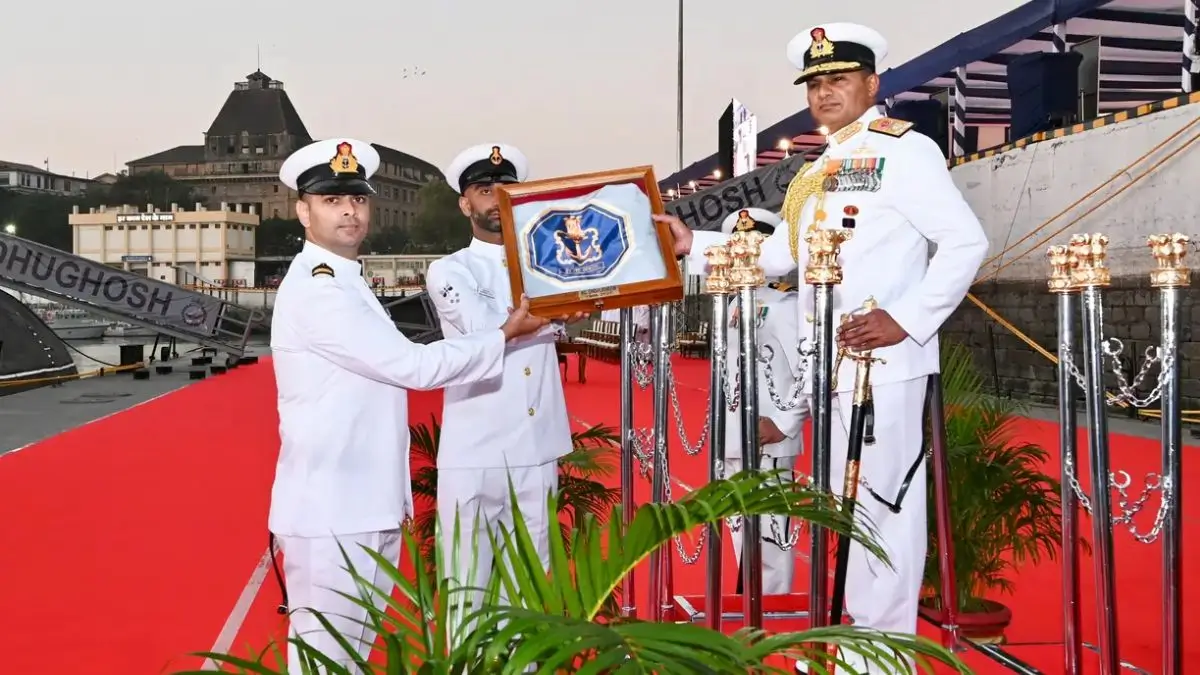
The Indian Navy recently decommissioned INS Sindhughosh — one of its most iconic submarines — after completing 40 years of distinguished service. The formal ceremony was held on 19 December 2025 at the Naval Dockyard, Mumbai, marking the end of a long, remarkable journey for this undersea warrior.
Ceremony and Dignitaries Present
The decommissioning ceremony was presided over by Vice Admiral Krishna Swaminathan, Flag Officer Commanding-in-Chief of the Western Naval Command, and was attended by
- Lt Cdr Rajat Sharma, the final commanding officer
- Capt KR Ajrekar (Retd), the second commanding officer and Guest of Honour
- Former commanding officers, commissioning crew veterans, and senior naval officers.
The solemn event symbolised respect and honour for the vessel and its crew as the ensign was lowered for the final time.
INS Sindhughosh: Backbone of Underwater Warfare
Commissioned in 1985, INS Sindhughosh was the lead submarine of her class, forming a critical foundation for India’s conventional submarine fleet. Built under the Sindhughosh-class (Kilo-class) platform, this submarine significantly strengthened India’s underwater combat capabilities, maritime deterrence, strategic surveillance, and defence preparedness in the Indian Ocean region.
During its service life, INS Sindhughosh supported numerous naval patrols, surveillance missions, and fleet exercises. Its enduring utility stemmed from its robust underwater performance, long endurance, and tactical versatility.
Technological Evolution and Operational Impact
Over four decades, INS Sindhughosh underwent updates and refits to enhance its combat relevance, including improved sonar, weapons systems, navigation, and crew support systems. Its service contributed to sustaining maritime security and deterring adversarial actions across India’s coastal approaches.
The submarine’s operational readiness remained noteworthy amid a rapidly evolving maritime environment, spearheading numerous joint exercises with allied navies and participating in critical naval drills — showcasing India’s underwater warfare prowess.
Strategic Implications of the Retirement
The retirement of INS Sindhughosh reflects a transition in naval strategy, where the Indian Navy is gradually phasing out older diesel-electric submarines in favour of modern and more advanced platforms. This shift aligns with efforts to enhance maritime dominance and embrace indigenous capabilities under programmes like Project 75I and indigenously built submarines like the Kalvari (Scorpene)-class.
Future of India’s Submarine Fleet
With the retirement of INS Sindhughosh, the Navy’s focus shifts toward fleet modernisation — emphasising advanced stealth, long-endurance undersea vessels equipped with air-independent propulsion (AIP) systems and modern weaponry. These efforts aim to counter growing submarine forces in the Indo-Pacific and safeguard India’s maritime interests.

Why This News is Important for Government Exam Aspirants
Significance for Defence and National Security
The decommissioning of INS Sindhughosh marks the end of a historic chapter in India’s naval defence history. For aspirants appearing in exams for Defence, Civil Services, and PSC Exams, understanding this event is crucial because it highlights how India is modernising its defence forces — especially its maritime security apparatus — in response to changing geopolitical realities.
Relevance to Current Affairs and Strategic Thinking
This news is relevant for General Awareness and Current Affairs sections, as it reflects:
- India’s long-term strategic deployment of conventional submarines.
- The shift from legacy platforms toward advanced modern systems.
- The importance of naval power in securing the Indian Ocean Region (IOR).
Understanding such developments helps students grasp broader topics such as defence policy, maritime strategy, military modernisation, and national security priorities — all of which are increasingly being tested in competitive exams like UPSC, SSC, Banking, Railways, and State PSCs.
This event also underlines India’s strategic focus on indigenisation and defence manufacturing, aligning with national schemes such as Atmanirbhar Bharat (Self-Reliant India), making it relevant for questions related to government initiatives and defence partnerships.
Historical Context
Origin and Service Entry (1985–1986)
INS Sindhughosh was commissioned into the Indian Navy in 1985/1986 as the first of the Sindhughosh-class submarines, a class that formed the backbone of India’s conventional submarine fleet for decades. These submarines were part of India’s effort to significantly enhance its underwater warfare and surveillance capabilities during the Cold War era and beyond.
Role in Maritime Deterrence
Over its service life of 40 years, the submarine operated in strategic waters, conducting patrols, surveillance, anti-ship and anti-submarine exercises, and fleet integration drills — contributing substantially to deterrence and naval presence in the Indian Ocean.
Modernisation and Upgrades
Throughout the years, INS Sindhughosh and her sister submarines underwent mid-life upgrades to extend operational relevance. These enhancements included improved sonar systems, navigation gear, and weaponry to adapt to evolving maritime threats.
Transition to Newer Platforms
As global naval technologies advanced, India began inducting Scorpene-class (Kalvari-class) submarines under indigenous production. With INS Sindhughosh’s retirement, the Navy’s strategic focus has shifted toward more advanced, stealthier, and long-endurance platforms capable of meeting emerging defence challenges.
Key Takeaways from INS Sindhughosh Decommissioning
| S.No. | Key Takeaway |
|---|---|
| 1 | INS Sindhughosh was decommissioned on 19 December 2025 after 40 years of service. |
| 2 | The submarine’s decommissioning ceremony was held at the Naval Dockyard, Mumbai. |
| 3 | Vice Admiral Krishna Swaminathan was the Flag Officer Commanding-in-Chief present. |
| 4 | INS Sindhughosh was the lead submarine of the Sindhughosh-class and strengthened India’s underwater warfare capabilities. |
| 5 | Its retirement underscores India’s shift towards modern and indigenous submarine platforms under naval modernisation efforts. |
FAQs: Frequently Asked Questions
1. What is INS Sindhughosh?
INS Sindhughosh is a lead submarine of the Sindhughosh-class (Kilo-class) that served the Indian Navy for over 40 years, strengthening India’s underwater warfare capabilities.
2. When was INS Sindhughosh decommissioned?
The submarine was officially decommissioned on 19 December 2025 at the Naval Dockyard, Mumbai.
3. Who presided over the decommissioning ceremony?
The ceremony was presided over by Vice Admiral Krishna Swaminathan, Flag Officer Commanding-in-Chief of the Western Naval Command.
4. What role did INS Sindhughosh play in India’s defence?
INS Sindhughosh conducted maritime patrols, surveillance missions, anti-ship exercises, and fleet integration drills, contributing significantly to maritime security and deterrence in the Indian Ocean Region.
5. Why is the decommissioning important for India?
The retirement signifies a transition to modern submarine platforms, including indigenous and stealthier vessels, under India’s naval modernization and defence strategy.
6. What are the future plans of the Indian Navy after INS Sindhughosh’s retirement?
The Indian Navy is focusing on indigenous submarines like Kalvari-class and next-generation submarines with Air Independent Propulsion (AIP) for enhanced endurance and stealth.
7. How long was INS Sindhughosh in service?
INS Sindhughosh served the Indian Navy for over four decades (1985–2025).
8. What type of submarine is INS Sindhughosh?
It is a diesel-electric submarine, part of India’s conventional submarine fleet.
9. What is the significance of Sindhughosh-class submarines?
Sindhughosh-class submarines form the backbone of India’s conventional submarine fleet and have been critical in maritime deterrence and underwater combat preparedness.
10. Who attended the decommissioning ceremony?
Apart from the commanding officer and Vice Admiral, the ceremony included former commanding officers, commissioning crew veterans, and senior naval officers.
Some Important Current Affairs Links