



India hydrogen fuel cell vessel begins commercial service in Varanasi, showcasing zero-emission technology, sustainable inland waterway transport, and Make in India initiatives.
India’s First Indigenous Hydrogen Fuel Cell Passenger Vessel Begins Commercial Service in Varanasi
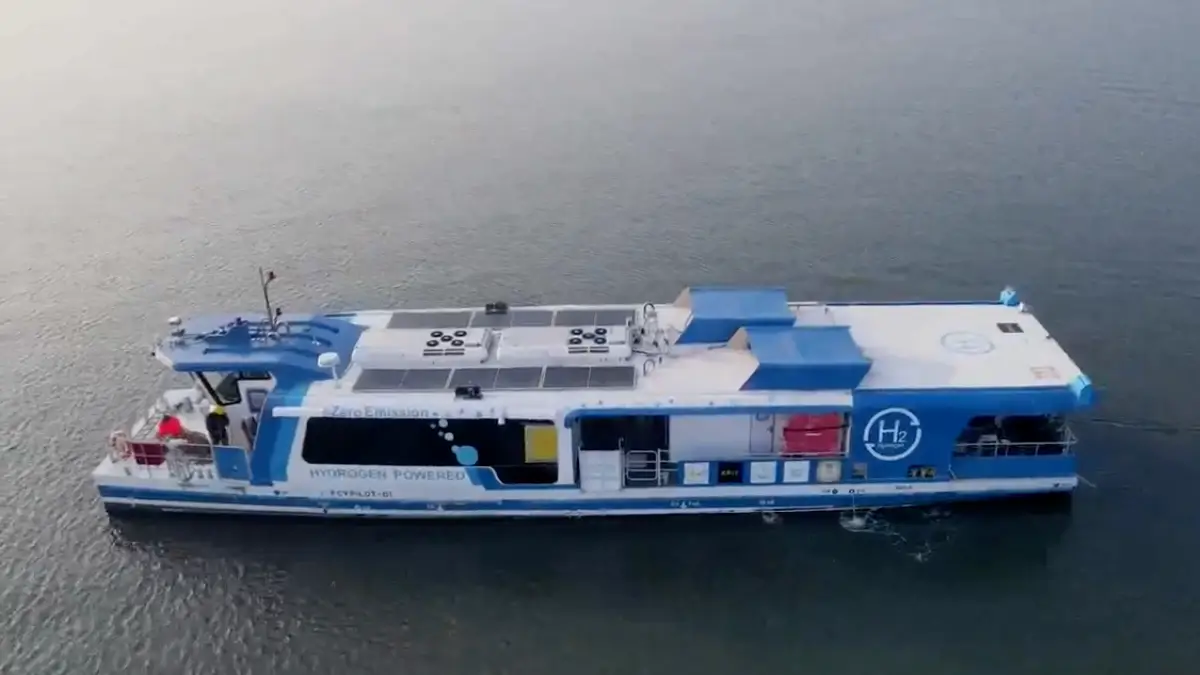
India recently achieved a major milestone in the field of clean and sustainable transportation with the launch of its first indigenous hydrogen fuel cell-powered passenger vessel, now operating commercially in Varanasi. The vessel was flagged off from Namo Ghat on the banks of the Ganga by Union Minister for Ports, Shipping and Waterways Sarbananda Sonowal, representing a pioneering shift in the country’s inland water transport sector.
The innovative vessel, designed and built by Cochin Shipyard Ltd. (CSL), operates on a Low Temperature Proton Exchange Membrane (LT-PEM) hydrogen fuel cell system that generates electricity by converting stored hydrogen into power, emitting only water as a byproduct. This technology makes the vessel zero-emission and environmentally friendly, eliminating traditional fuel pollution from waterways.
Operating on National Waterway-1, the hydrogen vessel covers commercial service between important ghats of Varanasi, symbolising the integration of sustainable mobility with cultural and economic development. Equipped with an air-conditioned cabin, it can carry up to 50 passengers, and on a single hydrogen refill, it can run for about eight hours, offering smooth and noise-free travel.
Union Minister Sonowal highlighted that this deployment reflects India’s commitment to the Make in India initiative and the government’s vision of expanding green technology adoption across transportation systems. The vessel’s operation is expected to reduce pollution along the Ganga while accelerating the development of clean fuel technologies in the country
This launch sets a precedent for future hydrogen-based inland water transport projects, paving the way for larger fleets and encouraging the gradual replacement of conventional fossil fuel systems with sustainable alternatives in maritime applications nationwide.

Why This News Is Important for Competitive Exams
Understanding the launch of India’s first indigenous hydrogen fuel cell passenger vessel is crucial for aspirants preparing for government exams such as UPSC, PSC, SSC, Railways, Banking, and Police Services because it touches upon multiple key themes in the syllabus:
1. Environment and Sustainable Development
This initiative directly aligns with India’s climate goals, national commitments to reduce greenhouse gas emissions, and efforts to promote zero-pollution technologies. It showcases the government’s focus on green transitions in transportation, an important GS-3 topic.
2. Science and Technology
The vessel utilises hydrogen fuel cell technology, an emerging field representing advanced clean energy solutions. Questions on new technologies, fuel cells, and alternative energy sources are frequently asked in both prelims and mains examinations
3. Infrastructure and Transport
This development is significant for the Inland Waterways Authority of India (IWAI) and reflects broadening efforts in modernising India’s infrastructure network, which is an important aspect under transport and economic development sections of various exams.
4. Government Policies and Initiatives
It connects with broader policy frameworks such as Make in India, Maritime India Vision 2030, and the Harit Nauka initiative, underlining the government’s effort to integrate innovation with sustainable infrastructure development
Thus, this news encapsulates multi-disciplinary relevance, making it highly important for current affairs preparation across different government exam sectors.
Historical Context: Evolution of Hydrogen Technology in India
India’s journey towards leveraging hydrogen fuel cell technology for transportation began several years ago with research collaborations and pilot projects aimed at reducing reliance on fossil fuels and cutting carbon emissions. Early work included initiatives such as pilot hydrogen vessels under testing phases and agreements between Inland Waterways Authority of India and Cochin Shipyard Limited (CSL) to build zero-emission vessels.
In February 2024, Prime Minister Narendra Modi inaugurated the first indigenously developed hydrogen fuel cell inland waterway vessel under the Harit Nauka initiative, signalling a national commitment to green maritime propulsion systems. This initiative laid the foundation for further trials and eventual commercial deployment.
Hydrogen fuel cell technology has been a focus area globally and in India due to its high energy efficiency and zero harmful emissions, converting hydrogen into electricity while releasing only water vapour. Such capabilities have led policymakers to consider hydrogen systems for various transport modes, including waterways, road vehicles, and potentially trains and buses in future explorations.
The Varanasi vessel’s launch marks a transition from pilot and demonstration phases to actual commercial utilisation, emphasising India’s advancing technical capability and strategic push towards sustainable transport infrastructure that complements national goals like Net Zero 2070.
Key Takeaways from India’s First Indigenous Hydrogen Fuel Cell Passenger Vessel Service in Varanasi
| S. No. | Key Takeaway |
|---|---|
| 1 | India’s first fully indigenous hydrogen fuel cell passenger vessel commenced commercial operations in Varanasi. |
| 2 | The vessel was flagged off from Namo Ghat by Union Minister Sarbananda Sonowal. |
| 3 | Built by Cochin Shipyard Ltd. (CSL), it uses LT-PEM hydrogen fuel cell technology with zero emissions. |
| 4 | The vessel can carry 50 passengers and operates for about eight hours on a single hydrogen refill. |
| 5 | This development supports India’s goals for sustainable transport, environmental protection, and technological advancement. |
FAQs: Frequently Asked Questions
1. What is India’s first indigenous hydrogen fuel cell passenger vessel?
It is a passenger vessel designed and built by Cochin Shipyard Ltd. that runs on Low Temperature Proton Exchange Membrane (LT-PEM) hydrogen fuel cell technology, producing zero emissions.
2. Where did the hydrogen fuel cell vessel begin commercial operations?
The vessel began commercial service in Varanasi, operating on National Waterway-1.
3. Who flagged off the vessel?
The vessel was flagged off by Union Minister for Ports, Shipping and Waterways, Sarbananda Sonowal from Namo Ghat, Varanasi.
4. How many passengers can the vessel carry, and how long can it operate on a single hydrogen refill?
It can carry up to 50 passengers and operate for about eight hours on a single hydrogen refill.
5. Why is this vessel significant for India?
It represents India’s push for sustainable transport, aligns with Make in India and Net Zero 2070 goals, reduces waterway pollution, and demonstrates advancement in hydrogen fuel cell technology.
6. What is the environmental impact of the hydrogen fuel cell vessel?
The vessel emits only water vapour, eliminating traditional fossil fuel pollution from waterways.
7. Which government initiatives are associated with this project?
The project aligns with Make in India, Harit Nauka initiative, and Maritime India Vision 2030, promoting clean technology in inland waterways.
8. What technology does the vessel use?
It uses LT-PEM hydrogen fuel cell technology, converting hydrogen into electricity for propulsion without carbon emissions.
Some Important Current Affairs Links




