








Hindi language promotion takes center stage as Amit Shah inaugurates the 5th Rajbhasha Sammelan in Gandhinagar 2025, emphasizing Hindi in administration, science, education, and technology.
“Amit Shah Inaugurates 5th Akhil Bharatiya Rajbhasha Sammelan in Gandhinagar – Hindi Beyond Administration”
Inauguration and Venue Details
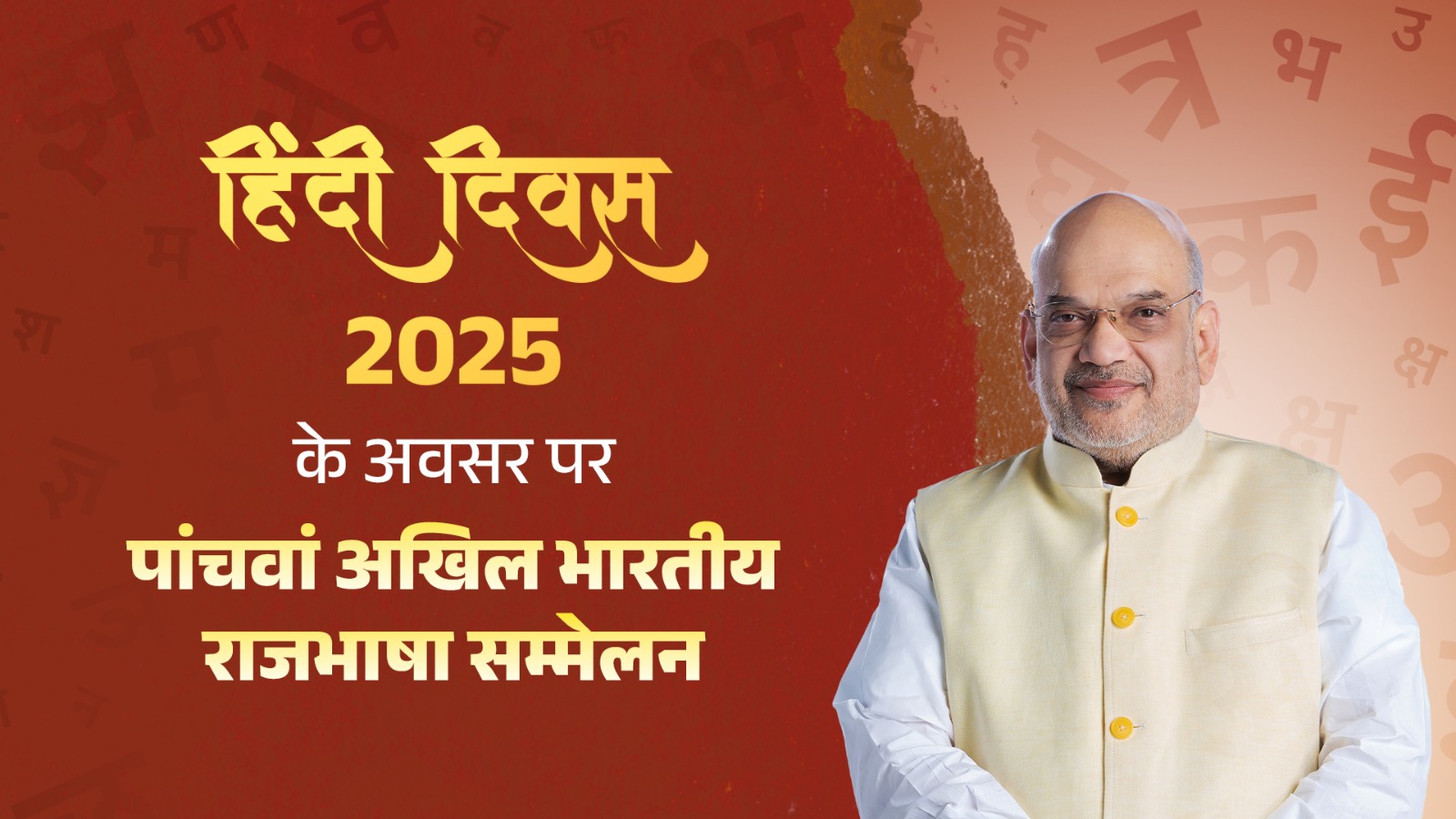
On 14 September 2025, coinciding with Hindi Diwas, Union Home Minister Amit Shah inaugurated the 5th Akhil Bharatiya Rajbhasha Sammelan at the Mahatma Mandir Convention Centre in Gandhinagar, Gujarat. The event reflects renewed emphasis by the central government on the official language (Rajbhasha) policy and its implementation across various domains.
Core Message: Expanding Hindi’s Role
During his address, Mr. Shah emphasized that Hindi should not be limited to spoken or administrative usage. He urged that Hindi be developed and adopted in fields like science, technology, the judiciary, and law enforcement, to enable better connection and communication with the public.
Harmony Among Indian Languages
An important theme of his speech was reassurance that there is no conflict between Hindi and other Indian regional languages. He pointed out Gujarat as a positive example where Gujarati and Hindi coexist, both thriving without one supplanting the other. He cited historical leaders like Mahatma Gandhi, Dayanand Saraswati, K. M. Munshi, and Sardar Vallabhbhai Patel as figures who promoted Hindi while respecting regional linguistic identity.
Linguistic Tools & Technological Support
To support Hindi’s expansion into advanced sectors, the government has undertaken technological interventions. Mentioned among these are the ‘Bahubhashi Anuvad Sarthi’, a tool for multilingual translation and communication, and the growth of the Hindi Shabd Sindhu dictionary, which started with about 51,000 words and has expanded significantly, now projected to contain over 700,000 words by 2029.
Educational Implications
Shah also pointed out that using one’s mother tongue in education improves learning outcomes. He stressed educationalists’ findings that when a language other than native/mother tongue is used, up to 25-30% of a child’s mental capacity gets consumed in translation rather than understanding or learning. Thus, promoting Hindi (and by extension, regional languages) in education is both cultural and pedagogical imperative.
Why This News Is Important
Significance for Language Policy and Governance
This event is a critical marker in India’s language policy framework. By pushing Hindi into domains like science, judiciary, policing, and technology, the government is signaling a shift from purely administrative use to functional and operational use. This has implications for legislation, official communication, public service exams, and service delivery, making understanding this shift essential for candidates preparing for civil services, teaching, judiciary, and policing exams.
Impact on Social Cohesion and Federalism
The emphasis on there being no conflict among languages is politically and socially significant in a multilingual country. It seeks to balance national identity (through Hindi) with regional identity (regional languages), reinforcing that promotion of one is not suppression of others. For students appearing for exams that test Indian polity, languages, constitutional provisions, and state-centre relations, this is an example of how language policy is handled in practice avoiding linguistic tensions.
Historical Context
The Origin of Hindi Diwas & Rajbhasha Policy
- Hindi Diwas, observed every 14 September, commemorates the adoption of Hindi in Devanagari script as one of the official languages of India, as per Article 343 of the Indian Constitution.
- The concept of Rajbhasha (official language) has roots both in the Indian freedom struggle and in post-independence efforts to establish a national linguistic standard, while preserving regional diversities.
Past Sammelans & Language Promotion Efforts
- The Akhil Bharatiya Rajbhasha Sammelan has been held periodically to review, discuss, and promote implementation of the Official Languages Act and related constitutional provisions (e.g. Articles 343-351).
- Previous efforts have included expanding Hindi’s usage in official documents, translations of government content, awards for Rajbhasha excellence (e.g., “Kirti Puraskar” to institutions like Delhi Metro).
Language in Education & Technology
- For decades, the debate has existed over the medium of instruction in education—mother tongue or regional language vs. Hindustani/Hindi/English. Educational policies (like the Three-Language Formula) have sought to balance this.
- In recent years, technology (translation tools, large lexicons, digital archives) has begun to play a large role in enabling regional and other Indian languages to participate in modern fields such as digital governance, AI, science, etc.
Key Takeaways from “Rajbhasha Sammelan: Hindi’s Expanded Role”
| S. No. | Key Takeaway |
|---|---|
| 1 | The 5th Akhil Bharatiya Rajbhasha Sammelan was inaugurated by Amit Shah in Gandhinagar on 14 September 2025 (Hindi Diwas) to promote Hindi’s expanded role. |
| 2 | Hindi is being encouraged to grow beyond administrative or conversational use into science, technology, law, policing, and other professional fields. |
| 3 | There is no conflict between Hindi and regional languages; Indian states like Gujarat are models for harmonious coexistence of Hindi and regional tongues. |
| 4 | Government initiatives like Bahubhashi Anuvad Sarthi (translational tool) and the Hindi Shabd Sindhu lexicon expansion (from ~51,000 to over 700,000 words by 2029) support this goal. |
| 5 | In education, using one’s mother tongue or native language enhances learning; imposing non-native languages may cost 25-30 % of cognitive capacity in translation efforts. |
FAQs: Frequently Asked Questions
1. What is the 5th Akhil Bharatiya Rajbhasha Sammelan?
The 5th Akhil Bharatiya Rajbhasha Sammelan is a national-level conference aimed at promoting the use of Hindi (Rajbhasha) in administration, education, science, technology, and professional fields. It was held in Gandhinagar on 14 September 2025.
2. Who inaugurated the 5th Rajbhasha Sammelan?
Union Home Minister Amit Shah inaugurated the event at the Mahatma Mandir Convention Centre in Gandhinagar, Gujarat.
3. Why was Hindi emphasized beyond administrative use?
Amit Shah highlighted that Hindi should be developed and promoted in science, technology, judiciary, policing, and other professional domains to strengthen public communication and national integration.
4. What tools support Hindi’s expansion into professional and technological fields?
The government is promoting tools like Bahubhashi Anuvad Sarthi, a multilingual translation tool, and expanding the Hindi Shabd Sindhu lexicon from 51,000 words to over 700,000 words by 2029.
5. How does promoting Hindi impact education?
Using a child’s mother tongue or native language in education improves learning efficiency. Studies show that up to 25–30% of cognitive capacity can be lost in translation when non-native languages are used.
6. Is promoting Hindi a threat to regional languages?
No. The government emphasizes that Hindi promotion does not conflict with regional languages. States like Gujarat demonstrate that Hindi and regional languages can coexist harmoniously.
7. When is Hindi Diwas celebrated?
Hindi Diwas is celebrated every year on 14 September to mark the adoption of Hindi in Devanagari script as one of India’s official languages.
Some Important Current Affairs Links