


Introduction to the Role of COAS
The Chief of Army Staff (COAS) is the highest-ranking officer in the Indian Army, serving as the professional head and principal military advisor to the Government of India. The position was established after India gained independence in 1947, with the first Indian COAS appointed in 1949. Since then, the COAS has played a pivotal role in shaping India’s military strategies and policies.
🗓️ List of COAS from 1947 to 2024
| S.No. | Name | Tenure | Notable Contributions |
|---|---|---|---|
| 1 | General Sir Rob Lockhart | 1947–1948 | Last British COAS; oversaw transition period |
| 2 | General K.M. Cariappa | 1949–1953 | First Indian COAS; led during Kashmir conflict |
| 3 | General Maharaj Shri Rajendra Singhji Jadeja | 1953–1955 | Oversaw post-independence restructuring |
| 4 | General K.S. Thimayya | 1957–1961 | Resigned post Sino-Indian War |
| 5 | General P.N. Thapar | 1961–1962 | Led during 1962 Sino-Indian War |
| 6 | General J.N. Chaudhuri | 1962–1965 | Oversaw military reforms post-1962 war |
| 7 | General S.H.F.J. Manekshaw | 1965–1973 | Led during 1971 Indo-Pak war; instrumental in Bangladesh Liberation |
| 8 | General G.G. Bewoor | 1973–1975 | Focused on modernization of forces |
| 9 | General S.K. Sinha | 1975–1978 | Emphasized on internal security |
| 10 | General O.P. Malhotra | 1978–1981 | Strengthened border security |
| 11 | General A.S. Vaidya | 1983–1986 | Led during Operation Blue Star |
| 12 | General K. Sundarji | 1986–1988 | Advocated for mechanization of forces |
| 13 | General S.F. Rodrigues | 1988–1990 | Oversaw peacekeeping operations |
| 14 | General B.C. Joshi | 1990–1993 | Led during insurgency in Kashmir |
| 15 | General V.P. Malik | 1997–2000 | Led during Kargil War |
| 16 | General N.C. Vij | 2000–2002 | Focused on counter-terrorism operations |
| 17 | General J.J. Singh | 2005–2007 | First Sikh COAS; led during peacekeeping missions |
| 18 | General Deepak Kapoor | 2007–2010 | Advocated for jointness in operations |
| 19 | General V.K. Singh | 2010–2012 | Focused on modernization and welfare of troops |
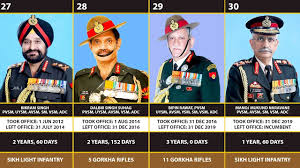
| 20 | General Bikram Singh | 2012–2014 | Led during Doklam standoff |
| 21 | General Dalbir Singh | 2014–2016 | Emphasized on cyber warfare |
| 22 | General Bipin Rawat | 2016–2019 | First Chief of Defence Staff; led during Balakot airstrike |
| 23 | General Manoj Mukund Naravane | 2019–2022 | Led during Galwan Valley clash |
| 24 | General Manoj Pande | 2022–2024 | First officer from Corps of Engineers; led during modernization initiatives |
| 25 | General Upendra Dwivedi | 2024–Present | Appointed as COAS on June 30, 2024; currently serving |
Note: The list above is based on available data up to 2024. For the most current information, please refer to official sources.
📌 Why This News Is Important
🪖 Understanding India’s Military Leadership
The role of the COAS is crucial in shaping India’s defense policies and strategies. By studying the tenure and contributions of each COAS, aspirants can gain insights into the evolution of India’s military doctrines and operational strategies.
📚 Relevance for Competitive Exams
For students preparing for government exams, especially those related to defense services, knowledge about the COAS and their contributions is essential. Questions related to the leadership and reforms in the Indian Army are frequently asked in exams like UPSC, CDS, and NDA.
🕰️ Historical Context
🇮🇳 Post-Independence Military Leadership
After India gained independence in 1947, the need for a professional Indian military leadership became paramount. The appointment of General K.M. Cariappa as the first Indian COAS marked a significant step in indigenizing the armed forces and reducing British influence.
🪖 Evolution of the COAS Role
Over the decades, the role of the COAS has evolved from merely overseeing military operations to actively participating in national security decision-making processes. The establishment of the Chief of Defence Staff (CDS) in 2019 further emphasized the need for integrated defense strategies.
✅ Key Takeaways from “List of Chief of Army Staff (COAS) of India: 1947–2024”
| S.No. | Key Takeaway |
|---|---|
| 1. | The COAS is the highest-ranking officer in the Indian Army, responsible for overseeing military operations and advising the government on defense matters. |
| 2. | General K.M. Cariappa was the first Indian COAS, serving from 1949 to 1953. |
| 3. | The role of COAS has evolved over time, with officers like General S.H.F.J. Manekshaw playing pivotal roles in major conflicts such as the 1971 Indo-Pak war. |
| 4. | The establishment of the Chief of Defence Staff (CDS) in 2019 aimed at achieving greater synergy among the three armed forces. |
| 5. | The current COAS, General Upendra Dwivedi, assumed office on June 30, 2024, bringing with him decades of experience in various command roles. |
FAQs: Frequently Asked Questions
1. Who was the first Chief of Army Staff (COAS) of India?
General K.M. Cariappa was the first Indian to be appointed as the Chief of Army Staff, serving from 1949 to 1953.
2. What is the role of the Chief of Army Staff (COAS)?
The COAS is the highest-ranking officer in the Indian Army, responsible for overseeing all army operations, strategic planning, and advising the Government of India on defense matters.
3. When was the position of Chief of Defence Staff (CDS) created?
The position of Chief of Defence Staff (CDS) was created in 2019 to facilitate better coordination between the three armed forces (Army, Navy, and Air Force).
4. Who was the Chief of Army Staff during the 1971 Indo-Pak War?
General S.H.F.J. Manekshaw served as the COAS during the 1971 Indo-Pak War, which led to the creation of Bangladesh.
5. Who is the current Chief of Army Staff (COAS) as of 2024?
General Upendra Dwivedi is the current COAS, who took office on June 30, 2024.
Some Important Current Affairs Links