










New Giant Radio Galaxy Discovered by MeerKAT
A groundbreaking discovery has been made by scientists using the MeerKAT telescope in South Africa, which has identified a new giant radio galaxy (GRG) located approximately 8 billion light-years away from Earth. This discovery adds a significant contribution to the study of cosmic phenomena, offering fresh insights into the mysterious and expansive universe.
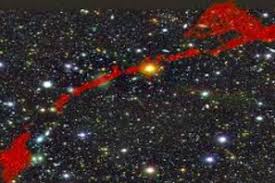
The MeerKAT telescope, part of the South African Radio Astronomy Observatory (SARAO), was instrumental in detecting this newly identified GRG, which stretches an astonishing 5.4 million light-years across, making it one of the largest galaxies ever observed. The galaxy, named J1333-3157, has been classified as a giant radio galaxy due to its massive radio emission lobes that extend far beyond the galaxy’s core.
What is a Giant Radio Galaxy (GRG)?
Giant radio galaxies are a class of galaxies that emit enormous radio waves from their active galactic nuclei (AGN). These galaxies are known for their vast radio lobes, which extend far beyond the optical components of the galaxy itself. These lobes are formed by high-energy electrons that travel along magnetic fields, emitting radio waves in the process. GRGs can be seen as the largest single objects in the universe.
The Role of the MeerKAT Telescope
MeerKAT, a state-of-the-art radio telescope, is located in the Karoo region of South Africa. It consists of 64 parabolic dishes, which allow for high-resolution imaging of cosmic objects. The advanced technology of MeerKAT has enabled astronomers to detect distant cosmic phenomena, and this discovery of J1333-3157 showcases the immense potential of this telescope in the field of astronomy.
What Makes J1333-3157 Unique?
The discovery of J1333-3157 is significant due to its size and the distance from Earth. Being 8 billion light-years away, this galaxy is located in the distant universe, providing scientists with an opportunity to study galaxies as they were in their early stages. The colossal size of J1333-3157 challenges existing models of galaxy formation, suggesting that the formation and evolution of galaxies might be more complex than previously thought.
Why This News is Important
Advancing Our Understanding of the Universe
The discovery of J1333-3157, a new giant radio galaxy, plays a crucial role in advancing our understanding of the cosmos. By observing a galaxy located 8 billion light-years away, scientists are not only learning about the physical characteristics of distant galaxies but also about their evolution over time. Understanding how galaxies like J1333-3157 form and evolve can lead to deeper insights into the origins of the universe.
New Insights Into Galaxy Formation
The sheer size of J1333-3157, stretching 5.4 million light-years, presents a challenge to current models of galaxy formation. Such massive radio galaxies are not well understood, and this discovery may help refine or even revise existing theories about the birth and growth of galaxies. The identification of such a distant and colossal galaxy could revolutionize how astronomers view the processes that shape our universe.
Impact on Radio Astronomy
The success of the MeerKAT telescope in discovering this giant radio galaxy highlights its growing importance in the field of radio astronomy. The telescope’s ability to detect and analyze distant objects with unparalleled precision makes it a key tool in understanding cosmic phenomena. As MeerKAT continues to gather data, it is expected to unveil many more significant discoveries in the years to come.
Historical Context
Radio Astronomy and Early Discoveries
Radio astronomy, the study of celestial objects through the detection of radio waves, has revolutionized our understanding of the universe. Pioneering discoveries in the mid-20th century, such as the identification of cosmic radio sources, laid the foundation for modern radio astronomy. Early radio telescopes, like the one at Jodrell Bank in the UK, revealed the existence of quasars and other distant cosmic objects emitting powerful radio waves.
The Development of the MeerKAT Telescope
MeerKAT, one of the newest and most advanced radio telescopes, has significantly contributed to the expansion of radio astronomy. Constructed by the South African Radio Astronomy Observatory (SARAO), MeerKAT’s location in the remote Karoo region provides an ideal environment for radio observations, free from interference caused by human-made signals. Since its operation began in 2018, MeerKAT has led to groundbreaking discoveries, including the detection of distant galaxies, black holes, and cosmic phenomena that were previously beyond the reach of other telescopes.
Giant Radio Galaxies and Their Importance
Giant radio galaxies, though known for some time, are still not fully understood. Their discovery and study are critical for understanding the formation and evolution of galaxies, particularly the mechanisms behind the enormous radio lobes they emit. The study of GRGs helps astronomers explore how galaxies interact with their environments and how they evolve over billions of years.
Key Takeaways from “New Giant Radio Galaxy Discovered by MeerKAT”
| No. | Key Takeaway |
|---|---|
| 1 | The newly discovered galaxy, J1333-3157, is located 8 billion light-years away. |
| 2 | This galaxy stretches an incredible 5.4 million light-years across. |
| 3 | The discovery was made using the MeerKAT telescope in South Africa. |
| 4 | J1333-3157 is classified as a Giant Radio Galaxy (GRG) due to its massive radio lobes. |
| 5 | The discovery challenges existing models of galaxy formation and evolution. |
Important FAQs for Students from this News
What is a Giant Radio Galaxy (GRG)?
- A Giant Radio Galaxy (GRG) is a type of galaxy that emits large-scale radio waves, particularly from its active galactic nucleus. These galaxies are characterized by massive radio lobes that can extend millions of light-years across.
What is the significance of the discovery of J1333-3157?
- The discovery of J1333-3157 is significant because it challenges existing models of galaxy formation and evolution. Its enormous size and distance from Earth provide new insights into the structure and behavior of distant galaxies.
How far is the newly discovered galaxy, J1333-3157, from Earth?
- The newly discovered galaxy, J1333-3157, is located approximately 8 billion light-years away from Earth.
What is the role of the MeerKAT telescope in this discovery?
- The MeerKAT telescope, located in South Africa, played a crucial role in discovering J1333-3157. Its advanced technology allowed astronomers to detect and analyze distant cosmic objects with high precision.
What are the main characteristics of the MeerKAT telescope?
- The MeerKAT telescope consists of 64 parabolic dishes and is known for its ability to provide high-resolution images of distant cosmic objects. It is part of the South African Radio Astronomy Observatory (SARAO).
Some Important Current Affairs Links