










Euclid Captures a Perfect Einstein Ring: A Remarkable Cosmic Discovery
Introduction
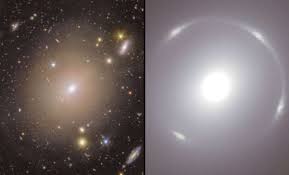
The European Space Agency’s (ESA) Euclid telescope has captured a striking image of a perfect Einstein Ring, a rare cosmic phenomenon predicted by Albert Einstein’s general theory of relativity. This remarkable image showcases the gravitational lensing effect, where a massive celestial object bends and magnifies the light of a distant galaxy behind it.
Understanding Einstein Rings
An Einstein Ring is formed when light from a distant galaxy or quasar is bent due to the gravitational influence of a massive foreground object, such as a galaxy or black hole. This gravitational lensing effect occurs when the observer, the massive object, and the distant light source align perfectly, creating a complete ring-like structure.
Significance of Euclid’s Discovery
The Euclid space telescope, launched to study the dark universe, is specifically designed to observe distant cosmic structures. The discovery of a perfect Einstein Ring is significant as it allows astronomers to:
- Study the distribution of dark matter.
- Measure cosmic distances with greater accuracy.
- Understand the expansion of the universe and the nature of gravity.
Role of Euclid in Dark Universe Exploration
Euclid is a cutting-edge telescope developed by ESA to map the large-scale structure of the universe. By observing such phenomena, it provides invaluable insights into dark matter and dark energy, which constitute about 95% of the universe’s total mass-energy content. The Einstein Ring captured by Euclid is a direct consequence of these mysterious cosmic forces at play.
Potential Applications in Astrophysics
The observation of Einstein Rings can help researchers refine models of gravitational lensing and galactic evolution. This discovery could aid in detecting exoplanets, measuring cosmic mass distribution, and testing fundamental physics theories, making it a crucial breakthrough in astrophysics.
Why This News Is Important?
Advancement in Astrophysical Research
This discovery marks a significant milestone in astrophysics, providing further evidence of gravitational lensing, a concept that helps astronomers explore hidden cosmic structures.
Improved Understanding of Dark Matter and Energy
By analyzing Einstein Rings, scientists can better understand dark matter and dark energy, the two biggest mysteries in cosmology. Euclid’s observations contribute valuable data for studying their properties.
Enhanced Space Exploration Capabilities
The Euclid mission demonstrates the effectiveness of advanced space telescopes in capturing precise cosmic phenomena, paving the way for future explorations of the universe.
Historical Context
Albert Einstein’s Theory of Relativity
In 1915, Albert Einstein proposed the general theory of relativity, which introduced the concept of gravitational lensing. This theory predicted that massive objects bend the light traveling from distant sources.
First Observations of Einstein Rings
The first confirmed Einstein Ring was discovered in the 1980s using ground-based telescopes. Since then, advancements in space observatories have led to more refined and detailed images of such cosmic structures.
The Euclid Mission’s Scientific Goals
Launched in 2023, the Euclid space telescope was developed by ESA to map the universe’s large-scale structure and investigate the nature of dark matter and dark energy. Its latest discovery reaffirms its mission’s success in exploring cosmic mysteries.
Key Takeaways from Euclid’s Einstein Ring Discovery
| S.No | Key Takeaway |
|---|---|
| 1 | Euclid telescope captured a perfect Einstein Ring, demonstrating gravitational lensing. |
| 2 | Einstein Rings help scientists study dark matter, cosmic distances, and universal expansion. |
| 3 | The Euclid mission is dedicated to exploring dark energy and mapping cosmic structures. |
| 4 | This discovery validates Albert Einstein’s theory of general relativity. |
| 5 | The findings pave the way for future advancements in astrophysics and space exploration. |
Important FAQs for Students from this News
1. What is an Einstein Ring?
An Einstein Ring is a circular image of a distant galaxy or quasar caused by gravitational lensing when a massive object bends and magnifies its light.
2. How does the Euclid telescope contribute to space exploration?
Euclid maps cosmic structures, helping scientists study dark matter, dark energy, and the universe’s expansion.
3. Why is gravitational lensing important in astronomy?
Gravitational lensing allows astronomers to detect hidden cosmic structures, measure cosmic distances, and test Einstein’s theory of relativity.
4. How does this discovery impact our understanding of dark matter?
By studying Einstein Rings, scientists can infer the presence and distribution of dark matter, which does not emit or reflect light.
5. When was the first Einstein Ring discovered?
The first Einstein Ring was confirmed in the 1980s using ground-based telescopes.
Some Important Current Affairs Links