









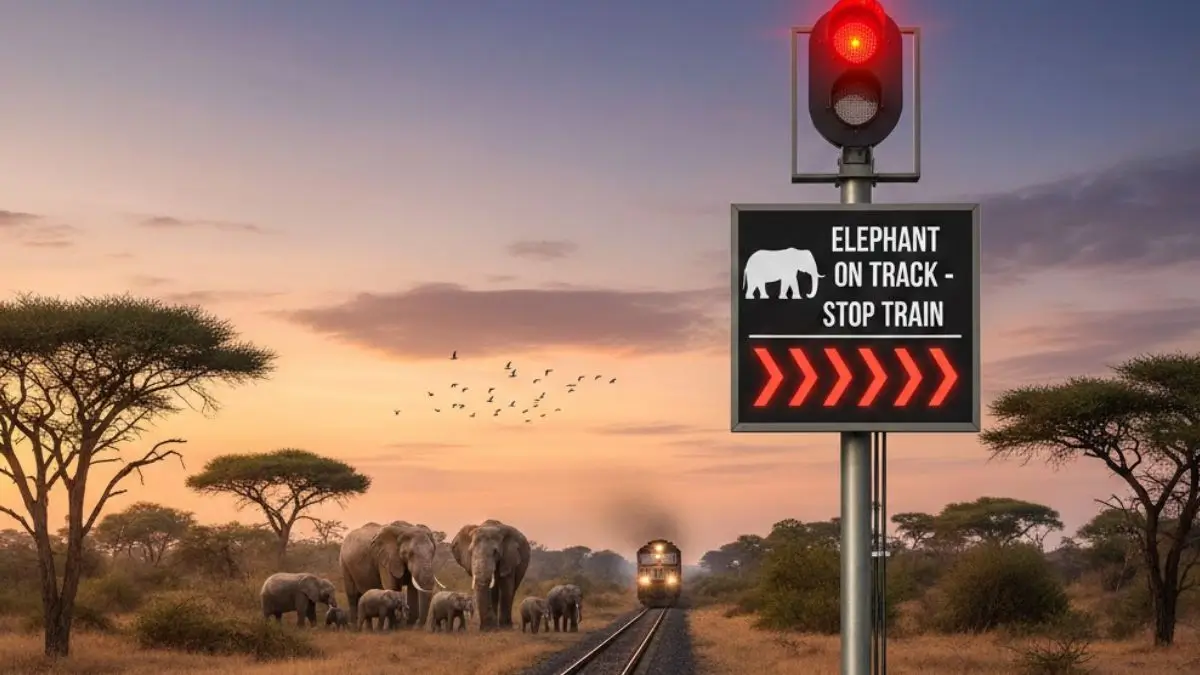
AI wildlife protection on Indian Railways ensures real-time monitoring and alerts to prevent animal-train collisions, enhancing ecological safety and rail efficiency.
Railways Boost AI Surveillance to Safeguard Wildlife Along Tracks
Introduction: Indian Railways’ Tech-Driven Wildlife Protection Initiative
Indian Railways has significantly strengthened its Artificial Intelligence (AI)-based surveillance system to protect wildlife along railway tracks passing through forests and ecological corridors. This innovative step comes as a part of the nation’s broader commitment to animal conservation and safe rail operations. The system employs AI-enabled cameras and Distributed Acoustic Sensing (DAS) technology to detect animals such as elephants, lions, and tigers in advance and send real-time alerts to train operators and control rooms.
AI and Distributed Acoustic Sensing (DAS): How It Works
The core of this initiative is the AI-powered Intrusion Detection System (IDS), which uses Distributed Acoustic Sensors aligned alongside or under railway tracks. These sensors pick up vibrations and signals caused by the movement of large animals. Once animal presence is detected, the system instantly sends alerts up to 0.5 kilometres ahead to loco pilots, station masters, and control room officials. This gives timely chances to slow down or stop trains before any accident occurs.
Complementing this are AI-enabled cameras installed at vulnerable points along track stretches. These cameras capture visuals in real time, helping the system to identify different species and minimize false alerts.
Expansion Across Railway Zones
Initially, the AI-based system covered about 141 route kilometres on the Northeast Frontier Railway, which includes critical elephant corridors. Because of its early success, Indian Railways has extended its implementation over an additional 981 kilometres, taking the total coverage to approximately 1,122 route kilometres on identified wildlife-prone sections nationwide.
Success and Future Prospects
Railway officials and conservation experts have remarked that the enhanced surveillance system is an impactful fusion of technology and ecology. Real-time alerts not only reduce the risk of wildlife fatalities but also help in improving overall train safety on forest routes. This initiative is slated for further development, with continuous monitoring and upgrades planned in new zones and corridors based on terrain and wildlife intensity.

Why This News Is Important for Government Exam Aspirants
Relevance to Environment and Conservation Sections
This news is particularly important for government exam aspirants preparing for sectors like Railways, Civil Services (e.g., UPSC/PCS), Defence, SSC, and State Service Exams because it blends environmental conservation with technology and infrastructure. Questions in competitive exams increasingly focus on real-world applications of artificial intelligence in public systems and sustainable development. This railway initiative is a prime example.
Policy and Governance Significance
The expansion of AI surveillance on railways reflects the government’s commitment to fulfilling wildlife protection policies and sustainable development goals. It also highlights integration between transportation infrastructure and ecological safety, an area frequently tested under general awareness, current affairs, and government schemes segments of competitive exams.
Interlinkage with UPSC/PSC Syllabus
For aspirants of UPSC Civil Services and State PCS exams, this initiative is relevant for:
- Environment and Ecology (human-wildlife conflict mitigation)
- Science and Technology (AI in public services)
- Infrastructure & Transport (Railways modernization)
- Government policies/initiatives related to wildlife conservation and tech integration.
Historical Context: Background to AI in Wildlife Protection on Railway Tracks
Traditional Challenges with Wildlife and Railways
India’s vast railway network often passes through dense forests and wildlife corridors. Over the years, animal–train collisions, especially involving elephants, became a major concern. In the past decade, incidents of trains striking elephants and other animals sparked debates over balancing development with conservation.
Early Technological Interventions
Earlier efforts included:
- Gajraj System & IDS pilot projects in elephant-dense regions under the Northeast Frontier Railway.
- Use of optical fiber cables and vibration sensors to detect large animals on or near tracks.
- Experimentation with thermal cameras and acoustic devices to identify wildlife movement in real time.
These pilot systems showed promise by significantly reducing animal fatalities in trial corridors, laying the groundwork for the current AI-enabled, scaled-up approach.
Integration of AI and DAS Technology
The advancement to AI and Distributed Acoustic Systems marks a technological upgrade from earlier systems to more accurate prediction and alert capabilities. This transition exemplifies how India is adopting cutting-edge tech to mitigate human-wildlife conflict without hindering rail connectivity.
Key Takeaways from AI-Enabled Wildlife Protection on Railway Tracks
| S. No. | Key Takeaway |
|---|---|
| 1 | Indian Railways has strengthened its AI-based wildlife surveillance system to safeguard animals along tracks |
| 2 | The system uses Distributed Acoustic Sensing (DAS) and AI cameras for real-time detection and alerts. |
| 3 | Alerts are sent up to 0.5 km in advance to loco pilots and control rooms for preventive action. |
| 4 | Initially implemented in 141 km on Northeast Frontier Railway, now expanded to 1,122 route kilometres. |
| 5 | This initiative reinforces sustainable development goals, merging technology with conservation in India’s transport sector. |
FAQs: Frequently Asked Questions
1. What is the main purpose of AI surveillance on Indian Railways tracks?
The AI surveillance system is designed to protect wildlife along railway tracks by detecting animals in real time and alerting train operators, preventing collisions and fatalities.
2. Which technology is used to detect animals along the railway tracks?
Indian Railways uses Artificial Intelligence (AI) and Distributed Acoustic Sensing (DAS) systems, along with AI-enabled cameras to monitor animal movement.
3. How far in advance can the AI system alert train operators about wildlife presence?
The system sends alerts up to 0.5 kilometres in advance to loco pilots and control rooms for timely preventive actions.
4. Which railway zones were initially covered under this initiative?
The Northeast Frontier Railway zone was the first to implement the AI surveillance system, covering 141 route kilometres initially.
5. What is the current total coverage of the AI wildlife surveillance system?
The initiative has expanded to cover 1,122 route kilometres in wildlife-prone areas across India.
6. Why is this news important for government exam aspirants?
It integrates technology, environment, and governance, making it relevant for general awareness, environment, science and technology, and government initiatives sections of competitive exams.
7. Which animals are primarily protected by this system?
The system primarily safeguards elephants, tigers, lions, and other wildlife species in forest and corridor areas along railway tracks.
8. What previous systems were used before AI implementation?
Earlier efforts included Gajraj System, IDS pilot projects, optical fiber sensors, thermal cameras, and acoustic devices, but AI provides more accuracy and real-time alerts.
9. How does AI improve upon previous wildlife detection methods?
AI analyzes sensor data and camera feeds in real-time, reduces false alerts, and identifies species-specific movement, enhancing safety for both wildlife and trains.
10. How does this initiative align with India’s Sustainable Development Goals (SDGs)?
It promotes sustainable development by balancing transport infrastructure expansion with conservation of biodiversity, especially in sensitive forest areas.
Some Important Current Affairs Links