








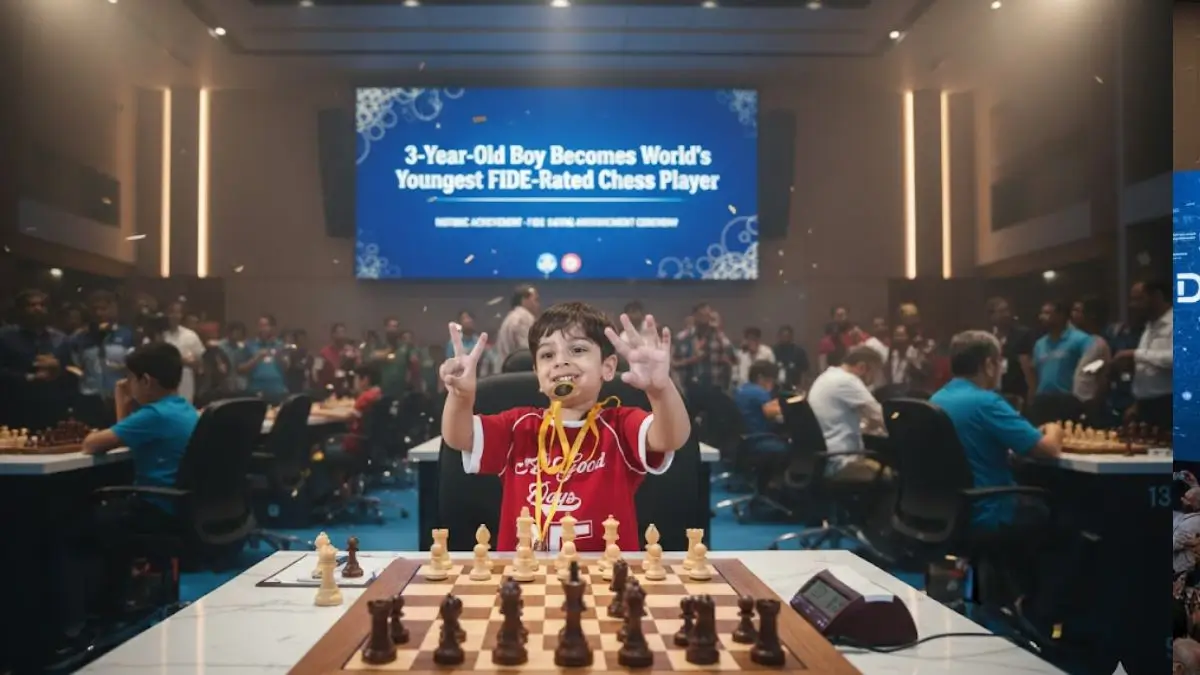
Youngest FIDE-rated chess player Sarwagya Singh Kushwaha from India achieves a historic record at age 3. Learn about his journey, rating, and significance for competitive exams.
3-Year-Old Indian Boy Becomes World’s Youngest FIDE-Rated Chess Player
Introduction: A New Chess Phenomenon Emerges
In December 2025, the global chess community witnessed a remarkable milestone as Sarwagya Singh Kushwaha, a 3-year-old boy from Sagar, Madhya Pradesh, became the youngest official FIDE-rated chess player in the world. At the tender age of three years, seven months, and 20 days, Sarwagya gained a FIDE rapid rating of 1572 — a level of skill exceptionally rare even among experienced players.
Chess, a game rooted in strategy, patience, and deep thinking, has traditionally been dominated by older teenagers and adults. Yet Sarwagya defied all norms and expectations, mastering complex tactics and earning his rating by competing against multiple rated players in official tournaments. His achievement underscores India’s growing reputation as a global hub for chess prodigies.
The Journey to a FIDE Rating
Early Start and Rapid Progress
Sarwagya was introduced to chess at roughly 2.5 years old. What began as an activity to reduce screen time quickly transformed into a passion. With consistent practice — 4 to 5 hours daily — he absorbed tactics and strategies at an extraordinary pace.
Defeating Older, Rated Opponents
To earn his FIDE rating, Sarwagya had to fulfill strict requirements, including competing against at least five officially rated players and achieving a performance above the minimum threshold. He successfully secured wins against adult players, with ratings ranging from around 1542 to 1696, demonstrating not only enthusiasm but competitive strength.
Impact on India’s Chess Legacy
Setting a New World Record
This achievement surpasses the previous record held by another Indian child, Anish Sarkar, who had earned a rating at three years and eight months in 2024. Sarwagya’s success highlights India’s consistent contribution to nurturing chess talent from a very young age.
Attention from Global Chess Community
Chess analysts worldwide have taken note of Sarwagya’s rapid rise. His journey has been covered by major sports and news outlets, further enhancing India’s visibility in chess excellence and inspiring other young aspirants.
Challenges and Controversies
Despite praise, the achievement has not been without scrutiny. Recent reports suggest that some observers have raised questions about the competitive conditions under which Sarwagya earned his rating, although the family and coaches have dismissed these allegations. While such discussions remain subject to FIDE’s internal review processes, the primary focus continues to be on Sarwagya’s undeniable progress and skill.

✨ Why This News Is Important
Understanding Its Significance for Competitive Exams
This news carries importance for government exam aspirants for several reasons:
A Marker of India’s Growing Talent Pool
Sarwagya’s achievement is not just a feel-good human interest story; it reflects a broader trend in India’s rise as a global chess powerhouse. In recent years, Indian players like Gukesh, Praggnanandhaa, and Nihal Sarin have made headlines internationally, marking a sustained improvement in strategic sports. This record contributes to India’s reputation in cognitive and mind sports — something that often features in current affairs sections of competitive exams
Relevance to Sports & Youth Achievements
Government exams increasingly emphasize youth achievements, sports milestones, and record-breaking accomplishments. Stories like Sarwagya’s demonstrate the potential of early education, child psychology, and talent nurturing, which are valuable in questions related to education policy, sports, and cultural achievements.
Broader Social Implications
This achievement also touches upon important contemporary themes such as child development, early learning, and national pride, which are often tested under general awareness and societal development topics in exams like UPSC, SSC, Bank PO, and others.
📜 Historical Context: India and Chess Excellence
Chess originated in India, historically evolving from the ancient game of Chaturanga around the 6th century CE. Over centuries, the game spread to Persia and later to Europe, eventually becoming the globally structured sport we recognize today. India’s historical connection to chess provides cultural depth to Sarwagya’s achievement.
India has, in recent decades, become a chess powerhouse, with legend Viswanathan Anand inspiring generations of players. In the 21st century, India produced several young grandmasters such as Gukesh Dommaraju, Praggnanandhaa R, and Nihal Sarin, who have consistently challenged the world’s best. Sarwagya’s success connects this legacy to the very roots of chess, and also highlights India’s expanding role in shaping the future of mind sports. The Times of India
📌 Key Takeaways from “3-Year-Old Indian Boy Becomes World’s Youngest FIDE-Rated Chess Player”
| S.No. | Key Takeaway |
|---|---|
| 1 | Sarwagya Singh Kushwaha from Madhya Pradesh became the youngest FIDE-rated chess player at 3 years, 7 months, and 20 days. |
| 2 | He achieved a rapid rating of 1572 by defeating multiple older rated players |
| 3 | To earn a FIDE rating, players must compete against rated opponents and cross a performance threshold. |
| 4 | This achievement broke the previous record held by another Indian child, Anish Sarkar. |
| 5 | The achievement highlights India’s strong and growing presence in the global chess community. |
FAQs: Frequently Asked Questions
1. Who is Sarwagya Singh Kushwaha?
Sarwagya Singh Kushwaha is a 3-year-old boy from Sagar, Madhya Pradesh, India, who became the youngest FIDE-rated chess player in the world.
2. What is Sarwagya’s FIDE rating?
He achieved a FIDE rapid rating of 1572 by competing against multiple rated opponents in official tournaments.
3. At what age did Sarwagya get introduced to chess?
Sarwagya started learning chess at around 2.5 years old and practiced extensively for 4–5 hours daily.
4. What record did Sarwagya break?
He broke the previous record held by Anish Sarkar, who became FIDE-rated at 3 years and 8 months.
5. Why is this achievement significant for India?
It highlights India’s growing prominence in global chess, continuing the legacy of chess legends like Viswanathan Anand and inspiring future young talents.
6. What are the criteria to become a FIDE-rated player?
Players must compete in FIDE-recognized tournaments against rated players and achieve a performance above the required threshold.
7. How is this relevant for competitive exams?
It’s important for general awareness, sports achievements, youth accomplishments, and current affairs sections in exams like UPSC, SSC, Bank PO, Railways, and defence services.
Some Important Current Affairs Links