




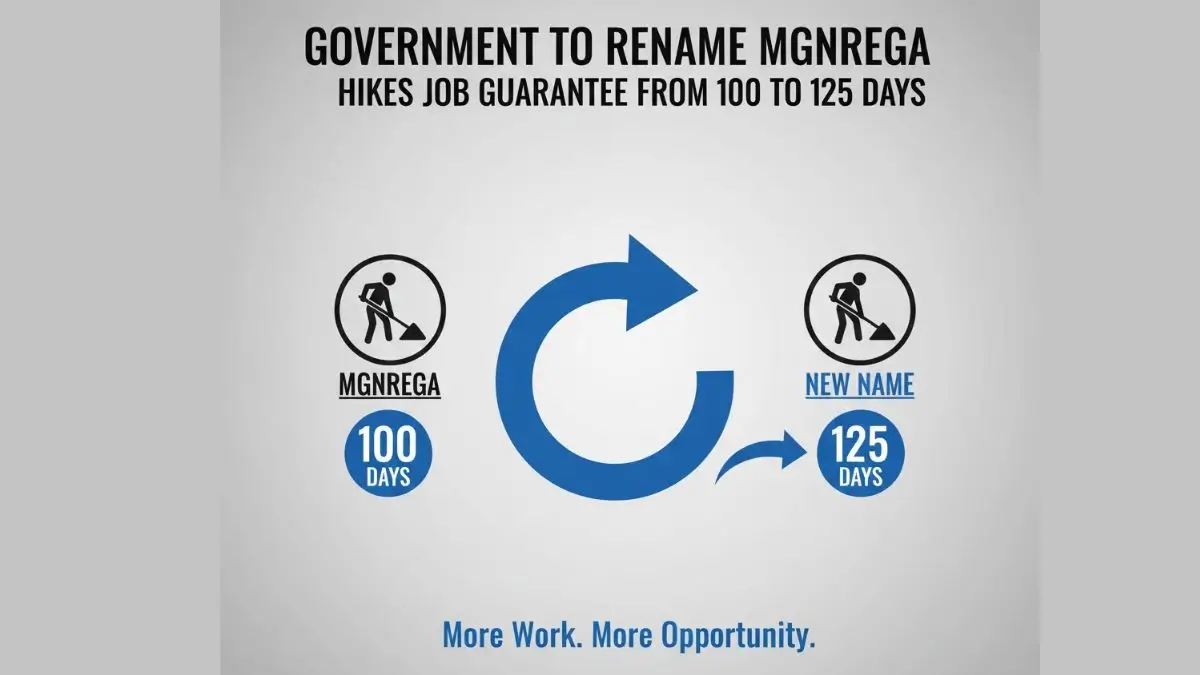
VB-G RaM G scheme 2025: India increases rural job guarantee from 100 to 125 days with the renaming of MGNREGA. Learn key features, objectives, and exam-relevant insights.
Government Renames MGNREGA and Expands Job Guarantee from 100 to 125 Days
Introduction: What Changed in India’s Largest Rural Job Scheme?
The Government of India has moved to overhaul the flagship rural employment law, the Mahatma Gandhi National Rural Employment Guarantee Act (MGNREGA), by introducing significant changes. Recently, the Union Cabinet approved the renaming of MGNREGA and proposed increasing the guaranteed number of working days in a financial year from 100 to 125 days.
Called the Viksit Bharat – Guarantee for Rozgar and Ajeevika Mission (Gramin) Bill, 2025 (VB-G RaM G), the new legislation not only increases job days but also alters the funding pattern between the Centre and the states.
These changes mark a major shift in how rural employment is structured and delivered across India. The move has sparked political debate, with some praising the extension of job opportunities and others criticizing the name change and policy redesign.
Details of the Rename and Job Guarantee Increase
The proposed VB-G RaM G Bill aims to replace the 2005 MGNREGA law. Its key objective is to reorient rural employment toward a wider mission for rural livelihood and infrastructure while guaranteeing 125 days of wage employment per household per year for those willing to perform unskilled manual work.
Under the new arrangement:
- The name Mahatma Gandhi is removed, and the scheme is rebranded around the concept of Rozgar and Ajeevika (livelihood).
- The budget sharing formula between Centre and states changes, increasing the financial role of states from the current norms.
Officials state that these changes are aligned with the government’s broader development vision and aim to make the job guarantee more productive and sustainable.
What the New Scheme Aims to Achieve
The revamped legislation focuses on merging employment goals with infrastructure and rural development. Unlike the previous scheme, which centered principally on providing income support through job days, VB-G RaM G places added emphasis on building durable rural infrastructure, such as water security and climate-resilient works.
Weekly wage payments, a pause during peak farming seasons, and stronger digital governance are some of the notable operational features in the new scheme’s design, giving it a more structured approach compared to the earlier demand-driven model.
Political and Public Reactions
The renaming and redesign of India’s longest-running rural job scheme has attracted mixed reactions. While the government defends the reform as essential modernization, opposition parties have criticized the removal of Mahatma Gandhi’s name, seeing it as an attempt to alter the legacy of a Congress-initiated program.
Public discourse also reflects views that the shift might change how rural workers access guaranteed jobs and social protection, highlighting debates around rights versus scheme-based entitlements.
Conclusion: A Landmark Policy Shift in Rural Employment
By renaming the scheme and increasing guaranteed workdays from 100 to 125, the Government has signaled a major policy shift in rural employment planning. This change not only affects millions of rural households who depend on such job guarantees but also represents a broader evolution of India’s social security architecture.

Why This News Is Important for Government Exam Preparation
Relevance to Syllabus and Current Affairs
This development is highly significant for students preparing for competitive exams such as SSC, Bank, Railways, Defence, State and Central Civil Services (UPSC/PSC), and teaching eligibility tests. It intersects key topics such as government schemes, economic policy reforms, rural development strategies, and public administration reforms.
Understanding this news helps aspirants grasp how the Indian government rethinks welfare and employment policies to adapt to changing socio-economic conditions — a core subject in General Studies and Current Affairs sections.
Additionally, the policy’s implications on federal finances, rural employment trends, and political discourse provide crucial insight into India’s fiscal federalism and governance mechanisms. Remembering the new scheme’s name, objectives, and differences from the original MGNREGA can be useful for descriptive answers, interview discussions, and essay writing.
Historical Context: Background of MGNREGA
The Mahatma Gandhi National Rural Employment Guarantee Act was enacted in 2005 as a social security measure guaranteeing a minimum of 100 days of unskilled manual work annually to rural households. The law addressed rural poverty and unemployment by legally ensuring employment and wages.
For two decades, MGNREGA has been India’s largest rural job scheme, credited with improving rural income security, empowering marginalized groups (especially women), and fostering community assets like irrigation tanks and rural roads. Over time, it became a cornerstone of India’s welfare policy under the United Progressive Alliance (UPA).
The recent cabinet decision to replace this long-standing law with a new framework therefore marks a major policy shift in the country’s rural employment landscape.
Key Takeaways from “Government Renames MGNREGA and Hikes Job Guarantee Days”
| S.No. | Key Takeaway |
|---|---|
| 1. | The Union Cabinet has approved renaming MGNREGA under a new Bill called Viksit Bharat – Guarantee for Rozgar and Ajeevika Mission (Gramin), or VB-G RaM G. |
| 2. | Guaranteed job days have been increased from 100 days to 125 days per rural household annually. |
| 3. | The funding pattern between the Centre and states is being revised, increasing the states’ share of financial responsibility. |
| 4. | The new scheme links rural employment with creating durable infrastructure and developmental projects. |
| 5. | The move has sparked political controversy, especially around removal of Mahatma Gandhi’s name from the scheme’s title. |
FAQs: Frequently Asked Questions
1. What is VB‑G RaM G?
VB‑G RaM G stands for Viksit Bharat – Guarantee for Rozgar and Ajeevika Mission (Gramin). It is the renamed and revised version of MGNREGA, aimed at increasing rural job guarantee days and linking employment with infrastructure development.
2. How many days of guaranteed employment does VB‑G RaM G provide?
The scheme guarantees 125 days of wage employment per rural household annually, up from 100 days under the original MGNREGA.
3. Why was MGNREGA renamed?
The government decided to rename the scheme to align it with broader rural livelihood and development objectives, emphasizing Rozgar (employment) and Ajeevika (livelihood) rather than just welfare.
4. What changes have been made to the funding pattern?
The new scheme revises the funding arrangement, increasing the states’ financial share, unlike MGNREGA, where the central government bore the majority of expenses.
5. What are the main objectives of VB‑G RaM G?
- Increase rural employment days from 100 to 125.
- Ensure better rural income security.
- Promote infrastructure development such as water conservation and climate-resilient works.
- Introduce a structured and efficient digital governance system for rural employment.
6. Who will benefit from this scheme?
The scheme primarily benefits rural households willing to perform unskilled manual labor, particularly marginalized and vulnerable communities.
7. What are the political implications of renaming the scheme?
The renaming has sparked debate, with opposition parties criticizing the removal of Mahatma Gandhi’s name, while the government emphasizes modernization and rural livelihood focus.
Some Important Current Affairs Links