




Renowned Filmmaker Shyam Benegal Dies at 90
Introduction: A Legacy in Indian Cinema
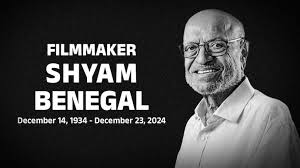
Shyam Benegal, the legendary Indian filmmaker, passed away at the age of 90. A pioneer of Indian cinema, Benegal was known for his thought-provoking, socially relevant films that shaped the landscape of Indian filmmaking. With a career spanning over six decades, he became a monumental figure in the Indian film industry, winning several prestigious awards and accolades for his exceptional contributions. His death marks the end of an era in Indian cinema, leaving behind a rich legacy that continues to inspire filmmakers and cinephiles alike.
His Cinematic Journey
Benegal’s journey in cinema began in the 1970s when he made his directorial debut with the film Ankur (1974). His work was rooted in realism, often focusing on social issues and human conditions. Known for his distinct style, Benegal’s films such as Nishant (1975), Manthan (1976), and Bhumika (1977) explored themes like rural life, gender dynamics, and social inequalities. He is regarded as a key figure in the parallel cinema movement, which was characterized by its departure from commercial formulas and focus on serious themes.
Benegal’s filmmaking was deeply influenced by his commitment to realism and his exploration of Indian culture and history. His portrayal of ordinary people facing extraordinary circumstances connected with audiences across generations. His films were not just a means of entertainment but also tools of social commentary.
Awards and Recognition
Benegal’s contribution to Indian cinema has been widely recognized both in India and internationally. He was honored with several National Film Awards, including Best Director for Bhumika and Kalyug. He also received the prestigious Padma Bhushan, one of India’s highest civilian awards, for his contributions to cinema. Beyond his filmography, Benegal’s influence as a mentor and educator in Indian cinema also left a lasting impact on the younger generation of filmmakers.
Why This News is Important
Shyam Benegal’s Impact on Indian Cinema
The death of Shyam Benegal represents a significant loss to the world of Indian cinema. Benegal was instrumental in shaping the direction of parallel cinema in India, a genre that deviated from the mainstream commercial cinema. His films addressed important social issues like caste discrimination, women’s rights, and rural challenges, thus fostering a deeper understanding of Indian society. His works were not only a reflection of India’s complex social fabric but also helped cultivate a sense of social responsibility in filmmakers and audiences alike.
Benegal’s death leaves a void in the Indian film industry, as his unique voice in the portrayal of Indian culture and social issues can never be replaced. His films have become a benchmark in Indian cinema for their realism, depth, and maturity. For students preparing for government exams, understanding the contribution of figures like Shyam Benegal is essential, as it highlights the cultural and historical developments that shape national identity.
Relevance to Cultural and Educational Studies
Benegal’s passing also serves as a reminder of the rich heritage of Indian cinema that forms part of India’s cultural narrative. For students aspiring to take exams related to Indian culture and history, it is crucial to acknowledge the role of cinema in reflecting and shaping societal values. Benegal’s death reinforces the need for a thorough understanding of Indian cinema’s evolution, and how it mirrors the nation’s social, political, and cultural changes over time.
Historical Context: Background on Shyam Benegal and Indian Cinema
The Rise of Parallel Cinema
Parallel cinema emerged in India during the 1950s and 1960s as an alternative to the mainstream, commercial Bollywood cinema. This genre, which focused on realistic themes and social issues, was seen as a way to depict life more authentically. Filmmakers like Satyajit Ray, Mrinal Sen, and Ritwik Ghatak were pioneers of this movement. Shyam Benegal entered the scene in the early 1970s and became one of the most influential figures in this genre.
The 1970s and 1980s: A Defining Era for Benegal
Benegal’s films in the 1970s and 1980s challenged the norms of Indian filmmaking. Movies like Ankur, Nishant, and Manthan dealt with complex issues like caste, feudalism, and rural poverty. His work was often political and sought to highlight the injustices in Indian society. Benegal’s films were well-received not just for their storytelling but also for their portrayal of marginalized communities, women, and the underprivileged.
Awards and Recognition
Throughout his career, Benegal received numerous accolades, including the National Film Award for Best Director and the Padma Bhushan. His work was widely regarded as a reflection of the challenges and triumphs of Indian society, making his films an essential part of the cultural and historical discourse in the country.
Key Takeaways from “Shyam Benegal’s Death”
| Serial No. | Key Takeaway |
|---|---|
| 1 | Shyam Benegal was a pioneer of Indian parallel cinema. |
| 2 | His films addressed important social issues like gender, caste, and rural poverty. |
| 3 | Benegal’s work influenced generations of filmmakers and contributed to the evolution of Indian cinema. |
| 4 | He was honored with numerous awards, including the Padma Bhushan and National Film Awards. |
| 5 | His passing marks the end of an era in Indian filmmaking and leaves a lasting legacy. |
Important FAQs for Students from this News
Q1: Who was Shyam Benegal?
A1: Shyam Benegal was a renowned Indian filmmaker known for his contributions to parallel cinema. He was celebrated for his realistic films that tackled social issues such as caste discrimination, gender inequality, and rural poverty.
Q2: What is Parallel Cinema in India?
A2: Parallel cinema is a genre of Indian films that emerged in the 1950s as an alternative to mainstream commercial cinema. It is characterized by its focus on social realism and the portrayal of serious issues such as poverty, inequality, and social justice.
Q3: What are some of Shyam Benegal’s famous films?
A3: Some of Shyam Benegal’s most famous films include Ankur (1974), Nishant (1975), Manthan (1976), and Bhumika (1977). These films were notable for their social commentary and realistic storytelling.
Q4: What awards did Shyam Benegal receive during his career?
A4: Shyam Benegal received numerous prestigious awards, including the National Film Award for Best Director and the Padma Bhushan, one of India’s highest civilian honors, for his contributions to cinema.
Q5: How did Shyam Benegal impact Indian cinema?
A5: Shyam Benegal was instrumental in shaping the Indian parallel cinema movement, bringing attention to real-life issues and marginalized communities through his films. His work inspired generations of filmmakers to explore social themes in their films.
Some Important Current Affairs Links