

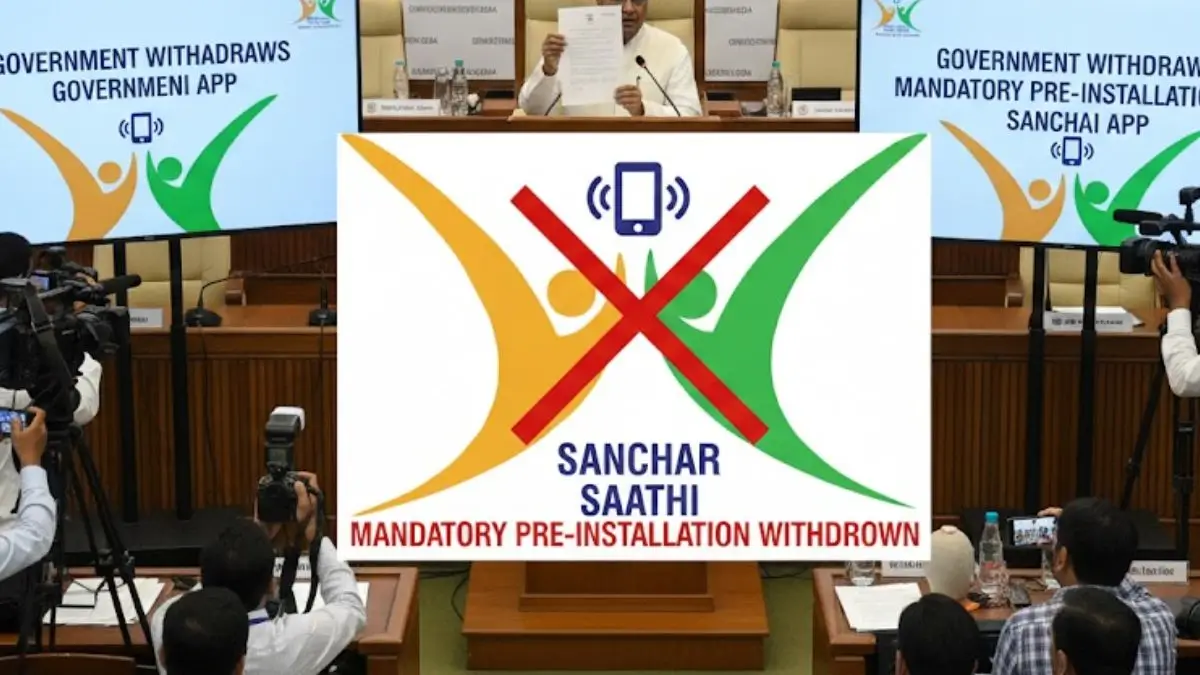
Sanchar Saathi app news: Government withdraws mandatory pre-installation on smartphones due to privacy concerns and public backlash. Know latest updates, app purpose, and exam-relevant details.
Government withdraws mandatory pre-installation of Sanchar Saathi app on smartphones
Government revokes pre-installation mandate
The Government of India has withdrawn its earlier directive requiring smartphone manufacturers to pre-install the Sanchar Saathi app on all devices sold in India. The reversal comes after widespread backlash over potential privacy and surveillance concerns.
Under the initial order issued by the Department of Telecommunications (DoT) on November 28, 2025, all new mobile handsets — including those from major manufacturers such as Apple, Samsung, Vivo, Oppo, and Xiaomi — were to come with the app preloaded. The rule also stipulated that the app should be visible during the phone’s initial setup and that manufacturers must not disable or hide any of its functionalities
However, just days later, the government — via its Ministry of Communications — issued a statement saying that given the “increasing acceptance” of Sanchar Saathi, mandatory pre-installation is no longer necessary. From now on, installation of the app will be optional.
Government’s justification and app’s purpose
At the time of the original directive, the government described Sanchar Saathi as a “citizen-centric” cybersecurity tool aimed at combating telecom fraud, fake or duplicate IMEI numbers, and stolen/lost phones. Through the app and its portal, users could reportedly check genuine device IMEI numbers, report suspicious calls or messages, and block lost or stolen phones.
Officials claimed this step would help protect citizens from telecom-related frauds, and ensure even users who are less tech-savvy have easy access to telecom-security tools.
By the time of the rollback, the government noted that Sanchar Saathi had already been downloaded by roughly 1.4 crore (14 million) users, and that the number of registrations had surged sharply — reportedly 6 lakh new users in a single day — signalling growing acceptance and reducing the perceived need for compulsion.
Opposition, privacy concerns and public pushback
Despite the stated benefits, the initial mandate triggered strong opposition from various quarters. Critics — including opposition political parties — argued that forcing pre-installation of a government-owned app violated citizens’ fundamental right to privacy and freedom of choice. There were concerns that such an app, if made non-removable, could be misused for surveillance or tracking.
Moreover, major smartphone makers were reportedly reluctant to comply — especially those whose internal policy forbids pre-installing third-party or government-owned apps without user consent (as was the case with Apple).
These factors — privacy concerns, corporate resistance, and public discontent — collectively compelled the government to retract its mandate within a few days.

Why this News matters
Relevance for digital governance and civil liberties
This decision represents a significant moment in the balance between state-led digital security initiatives and individual privacy rights. While the government’s intention to curb telecom fraud and device theft via a unified app is understandable, mandating pre-installation raised serious concerns about user autonomy, consent, and potential misuse. The withdrawal underscores the importance of public opinion, corporate compliance, and constitutional freedoms — especially in a democracy where citizens’ consent and privacy must be respected.
Importance for government exam aspirants
For aspirants of positions such as UPSC/PSC (civil services), banking, railways, defence, police etc., this event is a textbook example of policy formation, public reaction, and policy reversal — and how constitutional rights, privacy laws, and governance frameworks interact with technological interventions. Understanding this case helps in topics like digital governance, telecom regulation, citizen rights, policymaking, and data privacy, which frequently appear in Prelims and Mains.
Insight into telecom & cybersecurity policy in India
The episode also gives insight into how the government and regulators attempt to address emerging challenges in telecom and digital fraud — and how such policies can be accepted or resisted. It illustrates that tech-policy decisions are not merely technical but deeply social and political.
Historical Context
Emergence of digital fraud and telecom-security initiatives
Over recent years, India has witnessed a surge in cybercrime, mobile fraud, identity theft via duplicate SIMs/IMEIs, and theft or loss of smartphones — often leading to misuse of devices or data. To address these issues, the government has gradually rolled out various regulatory and technological measures. The launch of the Sanchar Saathi app (in January 2025) was part of a broader strategy under the ambit of cyber security and telecom regulation
Balancing regulation with rights: Past precedents
India’s regulatory steps in telecom and digital governance have repeatedly triggered debates about privacy, consent, and state surveillance. Earlier measures — such as mandatory SIM-Aadhaar linking, biometric verification, and other surveillance-adjacent policies — have often been met with resistance citing citizens’ right to privacy under Article 21 of the Constitution. The initial Sanchar Saathi mandate revived similar concerns, prompting sharp opposition from civil society and political parties.
Moreover, tech companies (especially global players) have historically been wary of installing third-party apps, especially those mandated by governments, due to user-consent norms, data-privacy standards, and international policies. The reluctance of companies like Apple and Google to comply with the mandate contributed to the government’s decision to rollback.
Thus, the withdrawal of the mandate can be seen as part of an ongoing balancing act: designing effective cyber-security frameworks while respecting citizens’ privacy, corporate norms, and democratic values.
Key Takeaways from Reversal of Sanchar Saathi Pre-Installation Mandate
| # | Key Takeaway |
|---|---|
| 1 | The government withdrew the mandatory pre-installation order for Sanchar Saathi app on all new smartphones. |
| 2 | Sanchar Saathi will now remain optional; users can choose to install or delete it. |
| 3 | The app was designed to help users verify device authenticity, block lost/stolen phones, and report telecom fraud. |
| 4 | Privacy and surveillance concerns — including fear of state snooping — triggered the backlash. |
| 5 | Within a short span, the app reportedly gained 1.4 crore downloads and many manufacturers (like Apple) were reluctant to comply. |
FAQs: Frequently Asked Questions
1. What is the Sanchar Saathi app?
Sanchar Saathi is a government-developed mobile application aimed at enhancing telecom security. It allows users to verify device authenticity (IMEI), report stolen or lost phones, and identify potential telecom frauds.
2. Why did the government initially mandate pre-installation of the app?
The government intended to ensure all smartphone users, including those who are not tech-savvy, could access telecom security tools to prevent fraud, misuse of stolen devices, and duplicate IMEIs.
3. Why was the pre-installation mandate withdrawn?
The mandate was withdrawn due to privacy concerns, public backlash, and reluctance from major smartphone manufacturers like Apple and Samsung, who opposed compulsory pre-installation of third-party apps.
4. How many users have downloaded Sanchar Saathi so far?
By early December 2025, approximately 1.4 crore (14 million) users had downloaded the app, showing rising voluntary adoption.
5. What rights were considered in the backlash against the mandate?
Citizens and privacy advocates argued that mandatory pre-installation could violate constitutional rights, particularly the right to privacy and freedom of choice under Article 21.
6. Which government department oversees the Sanchar Saathi app?
The Department of Telecommunications (DoT) under the Ministry of Communications is responsible for the app’s development and regulation.
7. Is the Sanchar Saathi app now optional?
Yes, the app is now optional and users can choose whether to install or uninstall it.
8. What issues does the app aim to prevent?
The app helps prevent telecom fraud, stolen phone misuse, fake or duplicate IMEI numbers, and unauthorized access to devices.
9. How did tech companies respond to the mandate?
Major smartphone manufacturers resisted, citing privacy norms and internal policies against pre-installing government apps without user consent.
10. What is the broader significance of this decision?
It highlights the balance between digital security initiatives and citizens’ privacy, showing how policy decisions in technology must consider constitutional rights, corporate compliance, and public opinion.
Some Important Current Affairs Links