









RDI Scheme 2025 approved with ₹1 lakh crore to enhance private-sector innovation in AI, semiconductors, biotech and clean energy. Know objectives, governance, and impact for exams.
Union Cabinet OKs ₹1 Lakh Crore RDI Scheme to Spur Private-Sector Research
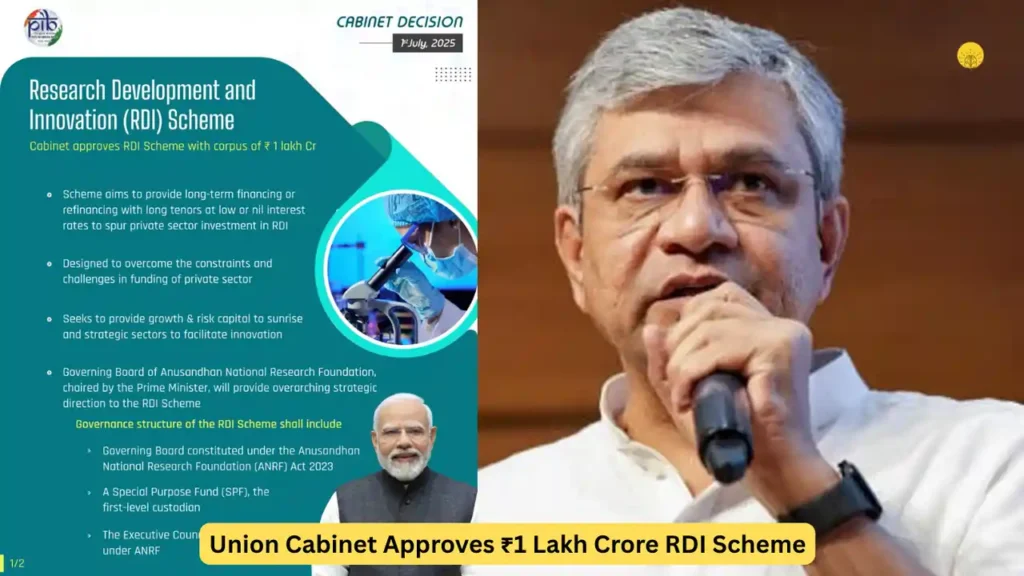
The Union Cabinet, chaired by Prime Minister Narendra Modi, approved the Research, Development and Innovation (RDI) Scheme on 1 July 2025, allocating a corpus of Rs. 1 lakh crore. Its mandate: turbocharge private-sector investment in core R&D and innovation, particularly in emerging “sunrise” and strategic sectors like artificial intelligence (AI), semiconductors, clean energy, biotechnology, and defence technologies
Filling the Private-Sector Funding Void
Traditionally, India’s private R&D spending has lagged—hovering under 0.7% of GDP—and is far behind peer nations like China, US, and EU The RDI Scheme injects much-needed long-term, concessional financing (loans, equity, 50-year interest-free capital) to remove funding constraints and foster advanced innovation
Two‑Tier Fund Mechanism
- Special Purpose Fund (SPF) within Anusandhan National Research Foundation (ANRF) acts as the primary corpus custodian.
- Second‑level fund managers (AIFs, DFIs, NBFCs, etc.) will disburse concessional loans and equity to qualified projects—especially high-tech deep‑tech ventures. A Deep‑Tech Fund of Funds is also part of the design
Strategic Governance & Oversight
- ANRF Governing Board, under the PM, guides strategic focus.
- Executive Council of ANRF vets guidelines and selects fund managers.
- Empowered Group of Secretaries (EGoS), chaired by the Cabinet Secretary, oversees evaluation, approvals, and ongoing governance.
- Department of Science & Technology (DST) will be the nodal execution agency
Transforming India’s Innovation Landscape
By enabling growth-stage innovation, catalysing technology adoption, and enhancing global competitiveness, the RDI Scheme aligns with the nation’s Viksit Bharat by 2047 aspirations. It’s not just policy—it’s a structural push to elevate private enterprises as R&D powerhouses
B) Why This News Is Important
Empowering the Private Sector
India’s private sector has historically underinvested in R&D. This scheme, with its massive ₹1 lakh crore backing and long-tenure capital, directly addresses financial barriers to private innovation, encouraging technology-rich ventures.
Strategic & Sunrise Domains Focus
With its targeted emphasis on AI, semiconductors, biotech, clean energy and national security, the scheme reinforces India’s drive toward Atmanirbharta (self-reliance) in strategic technologies.
Governance That Integrates Expertise & Oversight
The multidisciplinary governance structure—including the PM‑led ANRF and high-level oversight by EGoS—ensures that funds are deployed efficiently, transparently, and aligned with national priorities.
Boost to Deep-Tech Startups
By channeling capital through Fund-of-Funds and second‑level managers, the initiative generates a nurturing environment for startups and scale-ups to develop breakthrough technologies with deep commercial potential.
A Leap Toward Vision 2047
Aligned with the Viksit Bharat 2047 goal, this initiative represents not just a financial package but a strategic architecture aimed at placing India on the global innovation map.
C) Historical Context
R&D Spending – A Persistent Challenge
India’s R&D investment has remained steady at ~0.7% of GDP for decades—substantially below global norms. Corporate contribution is especially low at 36%, while peers like the US, China, and EU see 57–79% private contribution
Earlier Funding Models
Historically, R&D funding in India has been dominated by public-sector initiatives, with limited and fragmented assistance for private-driven efforts. Deep-tech startups, in particular, often struggled to obtain patient capital to bridge the gap from prototype to market-ready solutions.
Budget 2024–25 Announcement
The RDI Scheme was first proposed in Budget 2024–25, envisioning a ₹1 lakh crore research envelope. Cabinet approval on July 1, 2025, formalizes the execution framework—marking a turning point in innovation policy
Global Precedents
Inspired by models like the US National Sciences Fund, the scheme follows international best practices that centralize R&D capital and distribute via strong governance to spurr high-tech innovation .
D) Key Takeaways from the RDI Scheme
| S. No. | Key Takeaway |
|---|---|
| 1 | The RDI Scheme allocates ₹1 lakh crore to boost private-sector R&D across strategic and sunrise domains. |
| 2 | It offers long-tenure, low or zero-interest financing, addressing financial barriers for innovation. |
| 3 | Implements a two-tier funding structure: ANRF‑SPF and second‑level fund managers (AIFs, NBFCs, DFIs). |
| 4 | Governance involves ANRF (PM‑led), its Executive Council, EGoS, and DST as the nodal agency. |
| 5 | Aligns with Viksit Bharat 2047, emphasizing technology self-reliance and global innovation competitiveness. |
FAQs: Frequently Asked Questions
1. What is the full form of RDI Scheme?
RDI stands for Research, Development and Innovation Scheme, aimed at strengthening private-sector involvement in strategic R&D initiatives in India.
2. How much funding has been approved under the RDI Scheme?
The Union Cabinet has approved ₹1 lakh crore under the scheme to support private sector R&D and innovation over a long-term period.
3. Which agency will implement the RDI Scheme?
The Department of Science and Technology (DST) is the nodal implementing agency. Oversight will be handled by the ANRF, Executive Council, and Empowered Group of Secretaries (EGoS).
4. What sectors will the RDI Scheme focus on?
The scheme targets strategic and sunrise sectors such as AI, semiconductors, clean energy, quantum tech, biotech, and national defence technologies.
5. What is the significance of the RDI Scheme for competitive exams?
This scheme reflects a major policy shift to boost private-sector innovation, critical for questions under science & tech, economy, schemes and policy governance, especially in UPSC, State PCS, SSC, Railways, Defence, and Banking exams.
Some Important Current Affairs Links