






PRATUSH mission India uses a tiny single-board computer to detect the 21 cm hydrogen signal from the Cosmic Dawn. Learn about RRI Bengaluru’s innovation and India’s lunar far side mission.
Tiny Computer to Aid India’s Hunt for Cosmic Dawn Signals
A Compact Marvel Unveils Deep Universe Secrets
Scientists at the Raman Research Institute (RRI) in Bengaluru have designed a credit-card-sized single-board computer (SBC) that is set to play a pivotal role in tracking the faintest whispers from the universe’s infancy known as the Cosmic DawnThis SBC is central to the proposed PRATUSH mission (“Probing ReionizATion of the Universe using Signal from Hydrogen”), which aims to detect the elusive 21-cm radio signal from hydrogen atoms formed in the early cosmos
PRATUSH: A Radiometer in Lunar Orbit
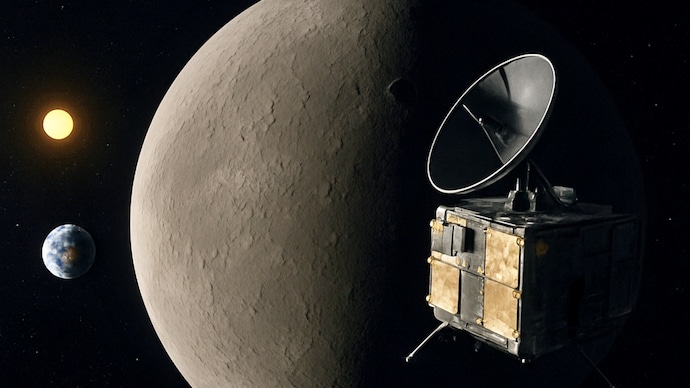
Positioned in a radiometer intended for lunar-far-side orbit, PRATUSH offers an ideal vantage point—shielded from Earth’s overwhelming radio noise and ionospheric distortions In essence, this mission plans to tune into a delicate cosmic melody usually drowned out by terrestrial interference.
Functionality That Packs a Punch
The SBC orchestrates the radiometer’s components, working as the master controller for the antenna, analog receiver, and the field-programmable gate array (FPGA), which transforms raw radio waves into digital fingerprints for signal analysis . Moreover, it records, stores, and applies real-time calibrations to the captured data—tasks accomplished within stringent Size, Weight, and Power (SWaP) limits essential for space deployment
Performance that Exceeds Expectations
In laboratory settings, the PRATUSH digital receiver system has demonstrated extraordinarily low noise levels—just a few millikelvins—after continuous operation of over 352 hours, proving its readiness to isolate the delicate 21-cm signal from the overwhelming cosmic background Armed with future software upgrades and space-qualified SBCs, the system is primed for even higher performance and resilience in space.
A New Era of Space-Efficient Technology
By embracing a minimalist, low-power SBC in place of bulkier traditional controllers, PRATUSH significantly lowers mission mass and energy requirements—making highly sensitive lunar instrumentation more feasible than ever The team envisions that similar SBC-based digital receivers will be integral to future payloads aimed at probing the universe’s earliest moments
Why This News Is Important
A Leap in Cosmic Research Infrastructure
This development marks a transformational leap in how space missions can be conceived, particularly for astronomy and cosmology. The ability to reliably detect signals from the Cosmic Dawn—when the universe’s first stars flickered into life—now hinges not on massive apparatus but on compact, cost-effective, and efficient technology.
Relevance Across Government Exam Syllabi
For aspirants preparing for UPSC, PSC, banking, or defence (e.g., CDS, NDA), this represents a key Science & Technology topic. It touches on space science, radio astronomy, government-funded R&D, and innovative engineering solutions—all of which commonly feature in General Studies papers.
Strategic and Global Implications
As India’s prowess in space science strengthens, PRATUSH exemplifies how indigenous innovation can rival global efforts in uncovering the universe’s mysteries. Plans like these reflect the nation’s advancing capabilities, reinforcing the technological edge and scientific diplomacy India brings to international astrophysics.
Eco-efficient and Cost-efficient Design
The use of an SBC aligns with a global trend toward miniaturization, sustainability, and efficiency in space technology. These gains directly influence the feasibility, scalability, and budget optimization of future space missions—an important lesson for exam candidates especially in contexts like Mission Budgeting or Public Administration of Scientific Projects.
Historical Context: A Background to PRATUSH
Unraveling the Cosmic Dawn: An Age-Old Challenge
The Cosmic Dawn refers to the epoch when the first stars and galaxies emerged, illuminating the post-Big Bang darkness. The elusive 21-cm hydrogen signal it leaves behind holds answers about early structure formation, but detection is immensely difficult due to overpowering radio noise from Earth
Earlier Efforts: Ground-based and SARAS
Historically, ground-based experiments like CLASS (Cosmology Large Angular Scale Surveyor) have detected 13-billion-year-old microwave signals, which offer glimpses into that epoch—but these have largely been feasible thanks to high-altitude locations and extremely sensitive equipment Other Indian projects, such as SARAS 2, aimed to detect the 21-cm signal via ground-based radiometers, achieving noise calibration to mere millikelvins—setting the stage for more ambitious space missions
India’s Leap: From Earth to Lunar Orbit
While ground-based instruments face limitations from terrestrial radio interference, PRATUSH represents India’s strategic shift toward deploying instruments in space—specifically the far side of the Moon, which offers an unparalleled radio-quiet environment to detect these ancient cosmic signals. The integration of an SBC underscores a move toward smarter, lighter, and more scalable payload designs in modern astrophysics.
Key Takeaways from PRATUSH Mission
| S. No. | Key Takeaway |
|---|---|
| 1 | PRATUSH stands for Probing ReionizATion of the Universe using Signal from Hydrogen—a proposed lunar orbit radiometer by RRI, Bengaluru, aimed at detecting the 21-cm hydrogen signal from the Cosmic Dawn. |
| 2 | At the core of PRATUSH is a credit-card-sized single-board computer (SBC), originally Raspberry Pi-based, serving as the master controller for antenna, analog receiver, FPGA, data processing, calibration, and storage. |
| 3 | Laboratory tests have demonstrated exceptionally low noise detection—a few millikelvins over 352-hour data collection—indicating high sensitivity for capturing faint cosmic signals. |
| 4 | Placing PRATUSH on the Moon’s far side ensures minimal radio interference, providing a pristine radio-quiet environment essential for accurate cosmic observations. |
| 5 | PRATUSH exemplifies a cost-effective, low-mass, low-power approach in space instrumentation, making advanced cosmic exploration more feasible and sustainable. |
FAQs Related to PRATUSH Mission and Cosmic Dawn
Q1. What is the PRATUSH mission?
The PRATUSH mission, short for Probing ReionizATion of the Universe using Signal from Hydrogen, is a proposed Indian space mission that aims to detect the 21-cm hydrogen signal from the universe’s Cosmic Dawn using a radiometer placed in lunar orbit.
Q2. Why is the far side of the Moon chosen for PRATUSH?
The Moon’s far side is free from Earth’s radio interference and ionospheric disturbances, making it an ideal place to capture faint cosmic signals.
Q3. What is unique about the PRATUSH mission’s hardware?
It uses a credit-card-sized single-board computer (SBC) as its master controller, which manages antenna operations, signal processing, calibration, and storage while minimizing weight and power consumption.
Q4. Which institution is leading the development of PRATUSH?
The Raman Research Institute (RRI) in Bengaluru is spearheading the mission.
Q5. What signal does PRATUSH aim to detect?
It targets the 21-cm radio emission from hydrogen atoms, which can reveal information about the formation of the first stars and galaxies.
Q6. How does the single-board computer contribute to PRATUSH?
The SBC coordinates the radiometer, processes raw data using FPGA systems, applies real-time calibrations, and ensures precise data storage.
Q7. What are the advantages of using SBC in space missions?
They are lightweight, energy-efficient, and cost-effective, making advanced space instruments more feasible and scalable.
Q8. How sensitive is the PRATUSH digital receiver system?
Laboratory tests show it can detect signals with noise levels as low as a few millikelvins, making it extremely precise.
Q9. Why is the 21-cm hydrogen signal important?
This signal is a direct tracer of hydrogen distribution during the Cosmic Dawn, helping scientists understand how the first stars and galaxies formed.
Q10. How is PRATUSH relevant for competitive exams?
It is a significant Science & Technology development in India, making it relevant for UPSC, PSCs, Banking, Railways, Defence, and Civil Service exams under topics like astronomy, innovation, and space research.
Some Important Current Affairs Links