







Param Shakti supercomputing facility at IIT Madras inaugurated by MeitY with 3.1 petaflops, part of National Supercomputing Mission, enhancing India’s high-performance computing capabilities.
MeitY Launches ‘Param Shakti’ – India’s Cutting-Edge Supercomputing Facility at IIT Madras
Introduction: India’s Leap in High-Performance Computing
The Ministry of Electronics and Information Technology (MeitY) has inaugurated a state-of-the-art supercomputing facility named Param Shakti at the Indian Institute of Technology (IIT) Madras in Chennai, marking a significant milestone in India’s technological and scientific research landscape. The facility was officially launched by Shri S. Krishnan, Secretary of MeitY, under the National Supercomputing Mission (NSM) — a collaborative project between MeitY and the Department of Science and Technology (DST).
About the Param Shakti Supercomputing Facility
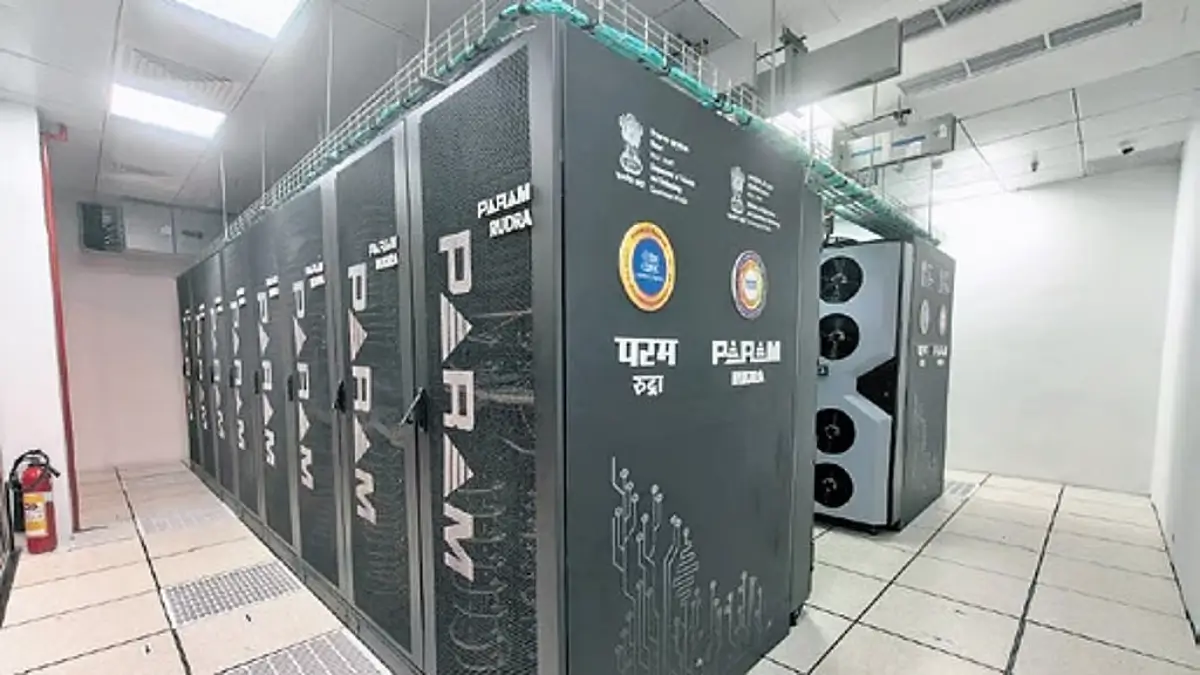
Param Shakti is built around an indigenous PARAM RUDRA supercomputing cluster designed and manufactured within India by the Centre for Development of Advanced Computing (C-DAC). The system provides a peak performance of 3.1 petaflops, meaning it can handle more than 3.1 quadrillion calculations per second — a scale of computing power essential for today’s advanced research tasks.
The facility’s hardware runs on open-source AlmaLinux and C-DAC’s own system software, making it a fully domestic computing environment. The infrastructure also includes crucial support systems like 24×7 power backup, advanced cooling technologies, and integrated data centre solutions to ensure uninterrupted high-performance operations.
Transforming Research and Innovation
Param Shakti is expected to significantly enhance India’s capabilities in high-performance computing (HPC), empowering researchers to work on some of the most complex scientific challenges. Its computational power will support work in fields such as:
- Aerospace engineering – enabling virtual simulations of complex flight dynamics.
- Climate and weather modelling – improving predictions and environmental research coverage.
- Materials science and molecular research – aiding innovations in advanced material creation.
- Drug discovery and life sciences – accelerating simulation-based medical research.
- Nuclear sciences – offering computational tools for advanced physics and energy research.
With the rapid growth of data-intensive research and artificial intelligence (AI), powerful computing resources like Param Shakti reduce dependency on time-consuming physical experiments and enable scientists to derive high-value insights quickly and efficiently.
A Boost for India’s Scientific Ecosystem
The inauguration of Param Shakti also reflects India’s broader push for technological self-reliance. The government’s focus on building indigenous hardware and software through initiatives like the NSM not only strengthens research infrastructure but also aligns with national strategies such as Make in India and Digital India.
Already, dozens of similar supercomputers have been deployed across the country, creating a powerful interconnected network of computing resources that serve premier academic, scientific, and research institutions. Param Shakti is expected to serve as a catalyst for future innovations across fields that demand high computational horsepower.

Why This News Is Important for Government Exam Aspirants
Significance in Technological and National Development
The launch of Param Shakti is a hallmark moment for India’s advancements in high-performance computing (HPC) technology. Unlike ordinary computers, supercomputers like Param Shakti can process billions of complex calculations per second — a capability critical for modern science and strategic national projects. This news reflects the government’s emphasis on strengthening domestic scientific infrastructure, a frequent topic in exams related to science & technology, national policies, and government initiatives.
Relevance for Multiple Competitive Exams
For aspirants preparing for exams such as UPSC Civil Services (IAS/PCS), SSC, Banking, Railways, and Defence, this development is relevant because it highlights:
- Government strategies to enhance research and innovation through missions like the National Supercomputing Mission.
- The role of ministries such as MeitY and DST in promoting technological self-reliance.
- Emerging areas of research infrastructure that contribute to Make in India and Atmanirbhar Bharat policies.
Understanding this news equips students with insights into India’s scientific growth trajectory, a common component of General Studies and Current Affairs sections. Furthermore, questions related to India’s supercomputing capabilities, high-performance computing initiatives, and their applications in sectors like aerospace, climate research, and healthcare are increasingly appearing in exam syllabi, especially in GS Paper-3 and technology quizzes.
Historical Context: India’s Supercomputing Journey
India’s journey in supercomputing began decades ago, when earlier systems such as PARAM 8000 and later the PARAM series were developed to reduce dependency on imported computing technologies. Over the years, under the National Supercomputing Mission (NSM) launched jointly by the Ministry of Electronics and Information Technology (MeitY) and the Department of Science and Technology (DST), multiple high-performance computing systems have been commissioned across research hubs in the country.
Earlier milestones include systems like Param Pravega at the Indian Institute of Science (IISc), Bengaluru – one of India’s most powerful academic supercomputers before Param Shakti. These installations have progressively expanded the availability of computational resources to academic and research institutions, enabling advanced simulation, data analysis, and innovation across disciplines.
The National Supercomputing Mission has not only focused on installing hardware but also on building an indigenous ecosystem of hardware manufacturing, software development, and human expertise to ensure long-term technological autonomy. Param Shakti’s launch is a continuation of this vision, making India a competitive player in global HPC research.
Key Takeaways from Param Shakti Supercomputing Facility Launch
| S.No. | Key Takeaway |
|---|---|
| 1. | Param Shakti supercomputing facility was inaugurated by MeitY at IIT Madras. |
| 2. | The facility features the indigenous PARAM RUDRA cluster with 3.1 petaflops computing power. |
| 3. | It is part of the National Supercomputing Mission (NSM) led by MeitY and DST. |
| 4. | The supercomputer will support research in aerospace engineering, climate modelling, materials science, drug discovery, etc. |
| 5. | Infrastructure includes 24×7 power, advanced cooling, data centre support, and runs on open-source AlmaLinux. |
FAQs: Frequently Asked Questions
1. What is Param Shakti?
Param Shakti is a state-of-the-art supercomputing facility inaugurated by MeitY at IIT Madras. It is designed to provide high-performance computing (HPC) capabilities for advanced research in various scientific fields.
2. What is the computing power of Param Shakti?
Param Shakti has a peak performance of 3.1 petaflops, meaning it can handle over 3.1 quadrillion calculations per second.
3. Which mission is Param Shakti a part of?
It is part of the National Supercomputing Mission (NSM), a joint initiative of the Ministry of Electronics and Information Technology (MeitY) and the Department of Science and Technology (DST).
4. What is the significance of Param Shakti for India?
Param Shakti strengthens India’s technological self-reliance, supports research in aerospace, climate, healthcare, materials science, and promotes indigenous hardware and software development.
5. What software and hardware are used in Param Shakti?
The supercomputer is built with PARAM RUDRA hardware, runs on open-source AlmaLinux, and uses C-DAC’s system software. It is fully indigenous.
6. Where will Param Shakti be primarily used?
It will be used across academic and research institutions in India for simulations, scientific modelling, and high-performance data analysis.
7. How does Param Shakti benefit competitive exam aspirants?
It is important for Science & Technology, Government Initiatives, and Current Affairs sections of exams like UPSC, SSC, Banking, Railways, and Defence exams. Questions may relate to NSM, supercomputers in India, or scientific infrastructure development.
8. What previous supercomputers are notable in India?
India’s journey began with PARAM 8000, followed by PARAM Pravega and other supercomputers installed under the NSM.
Some Important Current Affairs Links