




Open-Sea Marine Fish Farming India project launched in the Andaman Sea focuses on sustainable aquaculture, coastal livelihood development, and Blue Economy growth.
India Launches First Open-Sea Marine Fish Farming Project in the Andaman Sea
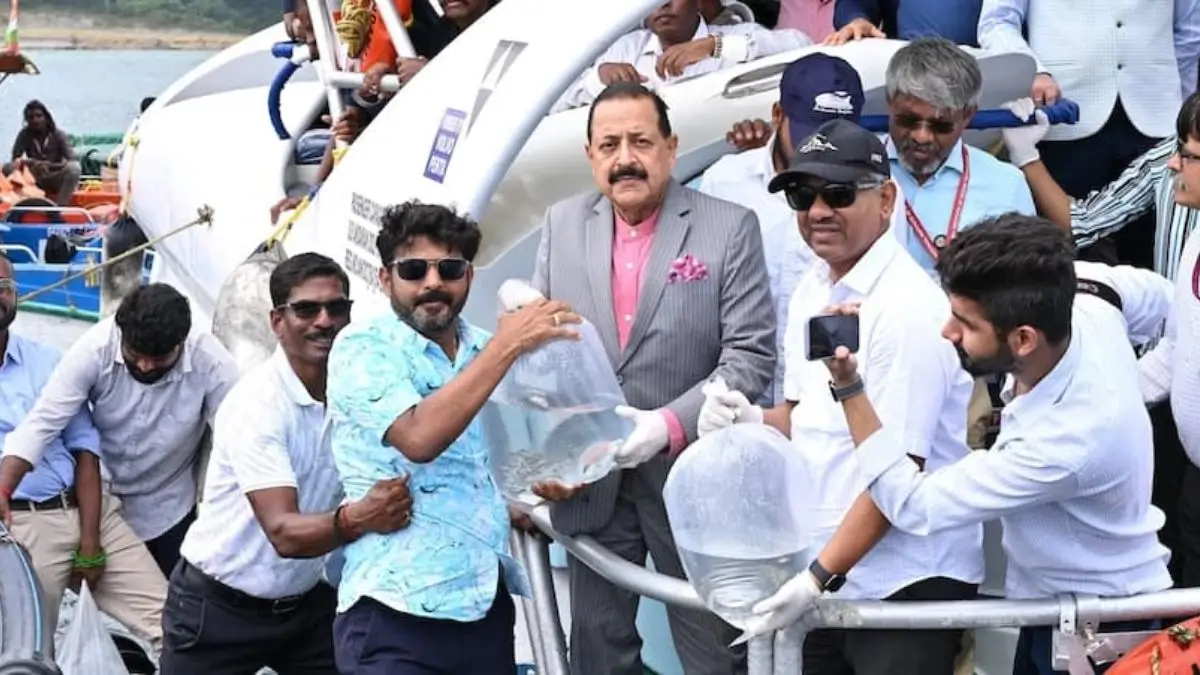
India has ushered in a new era of marine aquaculture with the launch of its first open-sea marine fish farming project in the Andaman Sea. This landmark initiative was inaugurated by Dr. Jitendra Singh, Union Minister of State (Independent Charge) for Science & Technology and Earth Sciences, at North Bay near Sri Vijaya Puram in the Union Territory of Andaman & Nicobar Islands.
The pilot project marks a major shift from traditional coastal aquaculture to open-ocean farming, focusing on the cultivation of marine finfish and seaweed under natural ocean conditions. Unlike conventional fish farming conducted near the shore, this initiative utilises scientifically designed open-sea cages that can withstand ocean currents and waves, enabling fish and seaweed to grow in their natural habitat.
Scientific Innovation and Technology Integration
At the core of this transformative project are indigenous technologies developed by the National Institute of Ocean Technology (NIOT) in collaboration with the Ministry of Earth Sciences (MoES) and the Andaman and Nicobar Islands administration. These technologies include open-sea cages engineered to resist the challenges of deep-sea conditions and techniques for seaweed cultivation, which are being distributed to local fishing communities as part of the pilot.
This initiative aims to harness India’s vast and underutilised ocean resources more sustainably. By doing so, it not only contributes to the country’s Blue Economy objectives but also opens up new livelihood opportunities for coastal and island communities, providing them with alternative sources of income and empowering them economically.
Livelihood Generation and Community Impact
During the launch, two key livelihood-oriented interventions were rolled out: distribution of seaweed seeds for deep-water cultivation and provision of finfish seeds for cage-based farming. These interventions are expected to engage local fishermen, offering them knowledge, resources, and participation in an advanced marine value chain.
Officials emphasised that successful outcomes from the pilot project could encourage expansion through public-private partnerships (PPP), allowing for the scaling up of open-sea aquaculture to other regions as well. This would further support India’s goal of creating a robust marine economy that contributes to food security, employment and sustainable growth.

Why This News is Important for Government Exam Aspirants
Relevance to Economy and Policy
The launch of India’s first open-sea marine fish farming project represents a significant policy initiative aligned with the government’s focus on Blue Economy, an emerging area in national planning that integrates sustainable ocean use with economic development. Understanding such initiatives is crucial for aspirants preparing for economy, environment, and geography sections in exams like UPSC, SSC, Banking, and Railways.
Significance for Sustainable Development
This project highlights India’s attempt to balance scientific innovation with environmental conservation by utilising open-ocean technologies that reduce pressure on coastal ecosystems and promote sustainable aquatic farming practices. This is especially relevant for current affairs and environmental studies portions of competitive exams where such sustainability initiatives are frequently tested.
Livelihood and Employment Implications
By focusing on livelihood generation for coastal and island communities, the initiative underscores the government’s commitment to inclusive growth and rural development. For aspirants preparing for government roles in public administration, social welfare, and rural development, this project provides an example of policy action that integrates science and social impact.
Historical Context: Marine Aquaculture and Blue Economy in India
India’s fisheries and aquaculture sector has long been a vital contributor to national food security, employment, and export earnings. Traditionally, marine fish farming in India was conducted near the coast in sheltered waters. However, environmental stress on near-shore ecosystems and rising demand for fish products have prompted a shift towards innovative aquaculture solutions.
The concept of the Blue Economy was introduced to maximise economic benefits from ocean resources while ensuring environmental sustainability. It encompasses sectors such as marine fisheries, renewable energy, tourism and biotechnology. The government’s increasing focus on this domain over the past decade has led to policies and initiatives like deep-sea fishing reforms and support for marine research.
India’s Exclusive Economic Zone (EEZ), one of the largest in the world, offers significant potential for marine aquaculture expansion. The launch of the open-sea fish farming project is a landmark step in leveraging this potential, and pioneers the transition from coastal to offshore aquaculture, positioning India as a forward-looking maritime economy.
Key Takeaways from India Launches First Open-Sea Marine Fish Farming Project
| S. No. | Key Takeaway |
|---|---|
| 1 | India launched its first open-sea marine fish farming pilot project in the Andaman Sea. |
| 2 | The initiative focuses on marine finfish and seaweed cultivation under natural ocean conditions. |
| 3 | The project uses indigenously developed open-sea cages by NIOT to withstand deep ocean challenges. |
| 4 | It aims to support livelihood generation and economic inclusion for coastal and island communities. |
| 5 | The initiative aligns with the government’s vision of strengthening the Blue Economy and sustainable marine resource use. |
FAQs: Frequently Asked Questions on India’s First Open-Sea Marine Fish Farming Project
Q1: What is India’s first open-sea marine fish farming project?
A1: It is a pilot initiative launched in the Andaman Sea to cultivate marine finfish and seaweed in open-sea conditions using specially designed cages.
Q2: Who inaugurated the project?
A2: The project was inaugurated by Dr. Jitendra Singh, Union Minister of State (Independent Charge) for Science & Technology and Earth Sciences.
Q3: Which organization developed the technology for open-sea farming?
A3: The National Institute of Ocean Technology (NIOT), in collaboration with the Ministry of Earth Sciences and the Andaman & Nicobar administration.
Q4: How does open-sea fish farming differ from traditional aquaculture?
A4: Unlike traditional near-shore aquaculture, open-sea fish farming uses deep-sea cages in natural ocean environments, reducing pressure on coastal ecosystems and promoting sustainable growth.
Q5: What is the significance of this project for local communities?
A5: It generates livelihood opportunities for coastal and island communities through seaweed and finfish cultivation while supporting India’s Blue Economy.
Q6: What are the potential benefits of the project for India’s economy?
A6: It strengthens sustainable marine resource use, contributes to food security, and promotes inclusive economic growth in coastal regions.
Q7: Can this project be scaled in other regions of India?
A7: Yes, if successful, the pilot could expand through public-private partnerships (PPP) to other coastal and island areas.
Some Important Current Affairs Links