






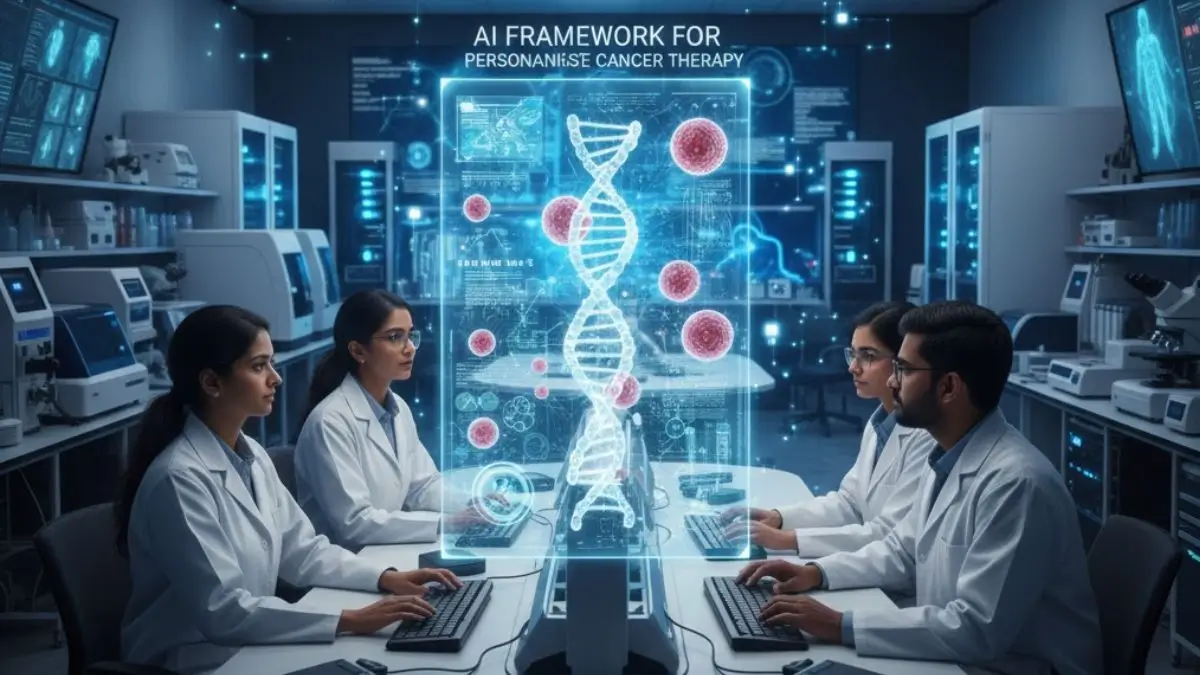
OncoMark — a new AI framework developed by Indian scientists — analyses millions of single-cell profiles to decode the molecular hallmarks of cancer, enabling personalised therapy and improved diagnosis accuracy.
Indian Scientists Develop OncoMark — AI Tool to Decode Cancer
What is OncoMark and What It Does
Researchers in India — at S N Bose National Centre for Basic Sciences (under Department of Science and Technology, DST) in collaboration with Ashoka University — have unveiled a new AI-powered diagnostic framework called OncoMark. This tool doesn’t just assess the size or spread of a tumour (as traditional cancer-staging systems do); rather, it decodes the molecular underpinnings of cancer by analysing the tumour’s “hallmarks” — biological programs that drive cancer progression.
OncoMark analyses data at the single-cell level: the developers processed around 3.1 million individual cells from 14 different cancer types, and generated synthetic “pseudo-biopsies” to model how hallmark-driven tumour states evolve across cancers.
Accuracy, Validation and Clinical Potential
Internal tests showed OncoMark achieved over 99% accuracy, and when tested across five independent cohorts its performance stayed above 96%. The model was further validated on 20,000 real-world patient samples drawn from eight major datasets — indicating its applicability across diverse tumour types and populations.
Because OncoMark reveals which hallmark processes — like metastasis, immune evasion, genomic instability, treatment resistance — are active in a given tumour, clinicians may use this information to tailor therapies more precisely. In effect, OncoMark brings us closer to personalised or precision oncology.
How OncoMark Changes the Cancer Paradigm
Traditionally, cancer diagnosis and treatment planning rely heavily on tumour size, spread (lymph nodes, metastasis), and general histopathology. But these methods often fail to capture why two patients with “similar” tumours may respond very differently to the same treatment. OncoMark bridges that gap: by reading the tumour’s molecular “personality,” it helps explain variations in aggressiveness, potential for metastasis, and likely response to therapies.
OncoMark doesn’t aim to replace standard staging systems — instead, it complements them. It offers a deeper layer of insight that could enable earlier detection of aggressive forms of cancer, guide therapeutic choices (e.g. immunotherapy vs DNA-repair targeted therapy), and avoid under- or over-treatment.

Why This News Is Important
For Medical Science and Public Health
The launch of OncoMark represents a major leap in how cancer is understood and treated. Instead of a one-size-fits-all approach based on tumour size or spread, OncoMark acknowledges that cancers are biologically diverse. This shift to molecular-level diagnostics and personalised therapy can lead to more effective treatments, improved survival rates and better management of therapy-resistant or aggressive cancers.
For India — with its large population and increasing cancer burden — the development of a domestically created, state-of-the-art AI tool shows that Indian research institutions are contributing significantly to global medical innovation. It may also help make advanced diagnostic tools more accessible and affordable for patients in India, strengthening the nation’s healthcare capabilities.
For Competitive Exam Aspirants (Science, General Studies, Medical & Allied)
For exam aspirants — whether preparing for civil services, banking exams with general awareness sections, or government-health-sector jobs — understanding OncoMark provides a relevant example of: India’s scientific progress, emerging trends in AI + medicine, and how biomedical research links to public health outcomes. Such breakthroughs often appear as questions in current affairs, general awareness or science & technology segments of competitive exams.
Historical Context
Traditional Cancer Diagnosis & Its Limitations
For decades, cancer diagnosis and treatment planning depended primarily on tumour staging (e.g. size, lymph-node involvement, presence of metastasis) and histopathological examination. Systems like the TNM classification (Tumour, Node, Metastasis) helped standardise diagnoses globally. But these methods often failed to explain clinical observations: why two patients with seemingly identical tumours had different disease progression, treatment response, or prognosis.
Medical researchers recognised cancer as more than just a “mass” — it is a systemic, biological phenomenon governed by molecular programs. Over the years, research into the “hallmarks of cancer” — traits like sustained proliferation, evasion of immune destruction, genomic instability, metastasis, etc. — laid the theoretical foundation for understanding cancer at the cellular & molecular level. However, translating that knowledge into practical diagnostics remained a challenge.
The Rise of AI and Precision Oncology
In recent years, advances in artificial intelligence, machine learning, and computational biology have opened new possibilities for analysing large-scale molecular data (like gene expression, single-cell sequencing) to detect patterns invisible to traditional pathology. Global and Indian research groups are increasingly developing AI-based tools for early detection, prognosis, and personalised therapy of cancer.
The development of OncoMark is the latest milestone in this trajectory — combining big data (millions of single-cell profiles), sophisticated neural network architectures, and biological knowledge to generate actionable insights. It marks a shift from generic cancer treatment to precision medicine, where therapy is tailored to the molecular signature of the tumour.
Key Takeaways from This News
| S. No | Key Takeaway |
|---|---|
| 1 | OncoMark is an AI-based diagnostic framework developed by S N Bose National Centre + Ashoka University to analyse the molecular hallmarks of cancer. |
| 2 | The model was trained using data from 3.1 million single cells across 14 cancer types, creating synthetic “pseudo-biopsies.” |
| 3 | OncoMark achieved over 99% accuracy in internal tests, and maintained above 96% accuracy across multiple independent cohorts. |
| 4 | It was validated on 20,000 real-world patient samples from eight major datasets — demonstrating broad applicability. |
| 5 | OncoMark can identify which hallmark processes (metastasis, immune evasion, genomic instability, therapy resistance, etc.) are active in a tumour — enabling tailored/personalised cancer therapy. |
FAQs
Q1: What makes OncoMark different from traditional cancer staging methods?
A: Traditional staging methods focus on tumour size, lymph-node spread, and metastasis. OncoMark goes deeper: it decodes the molecular “hallmark” activities inside cancer cells (like immune evasion, genomic instability, metastasis potential), thereby providing a richer biological understanding of the tumour.
Q2: How many cancer types can OncoMark handle?
A: The developers trained OncoMark using data from 14 different cancer types. Its validation across diverse datasets suggests it has broad applicability.
Q3: Is OncoMark ready for clinical use?
A: As of now, OncoMark is a research-level AI framework. While it shows high accuracy and broad validation, application in routine clinical diagnostics would require further regulatory approvals, integration with clinical workflows, and real-world trials.
Q4: Which institutions developed OncoMark?
A: OncoMark was developed by the S N Bose National Centre for Basic Sciences (under DST) in collaboration with Ashoka University.
Q5: Why is OncoMark significant for India’s healthcare?
A: OncoMark’s development within Indian institutions demonstrates India’s growing capacity for cutting-edge biomedical research. In future, it could enable affordable, precise cancer diagnosis/treatment tailored to patients — a major benefit for public health given India’s cancer burden.
Some Important Current Affairs Links