








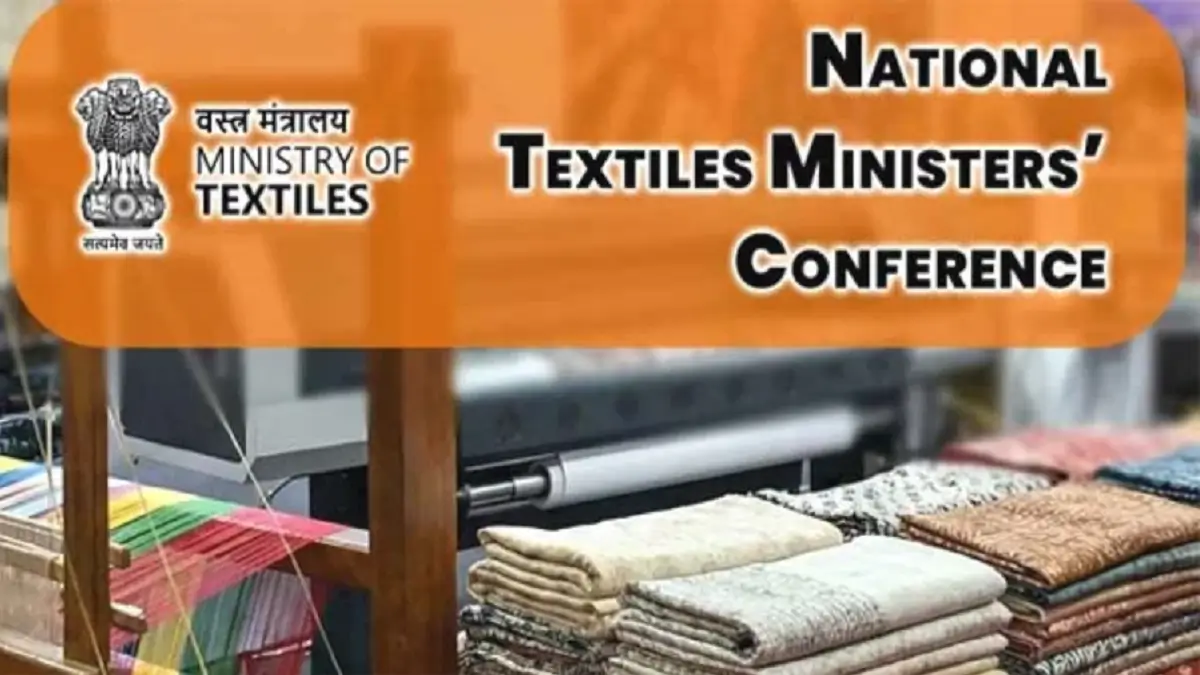
National Textiles Ministers Conference 2026 Guwahati highlights India’s textile growth, heritage preservation, and innovation strategies for global competitiveness.
National Textiles Ministers’ Conference 2026 Held in Guwahati: Charting India’s Textile Future
The National Textiles Ministers’ Conference 2026 was organised in Guwahati, Assam on 8–9 January 2026, bringing together key policymakers and stakeholders to deliberate on India’s textile sector roadmap. Hosted by the Ministry of Textiles in collaboration with the Government of Assam, the two-day conference was held under the theme “India’s Textiles: Weaving Growth, Heritage & Innovation”.
The event saw the participation of Union Minister for Textiles Giriraj Singh, Assam Chief Minister Himanta Biswa Sarma, Minister of State for Textiles Pabitra Margherita, and senior officials from States and Union Territories. It served as a national platform to align federal and state strategies, promote cooperative federalism, and shape a coordinated policy response to growing domestic and global textile challenges.
Theme and Strategic Vision
The conference’s central theme, “Weaving Growth, Heritage & Innovation,” reflects a dual focus on economic expansion and cultural conservation. This aligns with the guiding philosophy of “Vikas Bhi, Virasat Bhi”, which emphasises balanced development by integrating modern business strategies with India’s rich textile legacy.
A key objective is to position India as a global textile manufacturing hub by 2030, targeting a USD 350 billion industry size and USD 100 billion in exports. Discussions highlighted infrastructure, investment, sustainability, and export expansion as critical pillars of this vision.
Policy Deliberations and Sectoral Focus
The conference agenda was comprehensive, covering multiple strategic areas:
- Infrastructure & Investment: Strengthening domestic production capabilities and attracting capital investment.
- Export Expansion: Exploring new international markets and enhancing India’s competitiveness abroad.
- Raw Materials & Fibre Security: Addressing sustainability and supply chain integration.
- Technical Textiles & Innovation: Encouraging high-value textile segments including protective and industrial fabrics.
- Handlooms & Handicrafts: Preserving traditional sectors while facilitating innovation and market access.
The conference also highlighted new initiatives for data-driven policy planning, including MoUs with 15 states under the Tex-RAMPS scheme to improve textile data systems for better decision-making.
North-Eastern Regional Focus
A special conclave on the North-Eastern Region’s textile potential was organised, underscoring the importance of local specialties such as Muga, Eri, and Mulberry silk — a major driver of employment and cultural heritage in the region. Initiatives focused on women-led enterprises, bamboo-based textiles, and branding North-Eastern products for wider national and global market reach.
Way Forward and Outcomes
The conference concluded with a strong emphasis on cooperative governance, innovation-led growth, and sustainable production practices. Policy directions set during these deliberations aim to accelerate textile sector growth, modernise traditional industries, and enhance India’s global competitiveness in the coming decade.

Why This News Is Important
Relevance for Competitive Exams
The National Textiles Ministers’ Conference 2026 is a key current affairs topic for government exam aspirants — especially for civil services (UPSC/PSC), banking, railways, SSC, and state-level exams — due to its focus on India’s textile sector policies, economic strategy, and growth vision. Days like this reflect government priorities in economic policy and federal cooperation, making them crucial for the “Economy & Governance” and “Polity & Policy” sections of the syllabi.
Strategic Economic Influence
Textiles is one of India’s most significant employment sectors, contributing to millions of livelihoods. The conference’s vision to make India a global textile hub by 2030 aligns with broader national goals of export promotion, employment generation, infrastructure development and market diversification. This has direct implications on national GDP, trade balance, and rural development — all common themes in competitive exams.
Policy and Development Context
Understanding this event helps students grasp key policy instruments like PM MITRA Parks, Tex-RAMPS scheme, and cooperative federalism approaches, which are often asked in exam questions. The emphasis on heritage and innovation also links this topic to sectors such as culture, sustainability, and technology integration, offering a multidisciplinary perspective.
Historical Context of India’s Textile Sector
Textiles: A Historical Backbone of Indian Economy
India’s textile history dates back centuries, with ancient weaving traditions such as handloom and silk production forming integral cultural and economic foundations. From the Indus Valley Civilization to the Mughal era, textiles like cotton, silk, and muslin were globally prized. The textile industry has played a crucial role in India’s trade relations and economic development over millennia.
Textile Industry Post-Independence
After independence, India prioritised self-sufficiency, expanding textile mills and protective policies. Over the years, reforms, technological upgrades, and global trade integration reshaped the sector. Recently, India’s textile policy emphasised exports, skill development, sustainability, and innovation to compete with global producers. The present conference fits into this long trajectory by targeting future growth through modernisation and coordinated governance.
Key Takeaways from National Textiles Ministers’ Conference 2026
| S.No. | Key Takeaway |
|---|---|
| 1 | The National Textiles Ministers’ Conference 2026 was held in Guwahati, Assam on 8–9 January 2026. |
| 2 | The theme was “India’s Textiles: Weaving Growth, Heritage & Innovation.” |
| 3 | A key objective is to position India as a global textile manufacturing hub by 2030. |
| 4 | Focus areas included infrastructure & investment, export expansion, technical textiles, sustainability, and handloom preservation. |
| 5 | Special regional conclave emphasised North-Eastern silk, handloom traditions, bamboo textiles, and women-led enterprises. |
FAQs: Frequently Asked Questions
1. When and where was the National Textiles Ministers’ Conference 2026 held?
The conference was held on 8–9 January 2026 in Guwahati, Assam, bringing together central and state textile ministers and officials.
2. What was the main theme of the conference?
The theme was “India’s Textiles: Weaving Growth, Heritage & Innovation,” focusing on combining economic growth with cultural heritage preservation.
3. Who were the key participants of the conference?
Key participants included Union Minister for Textiles Giriraj Singh, Assam Chief Minister Himanta Biswa Sarma, Minister of State for Textiles Pabitra Margherita, and other senior state and union territory officials.
4. What were the main objectives of the conference?
The objectives included positioning India as a global textile hub by 2030, enhancing exports, modernising infrastructure, supporting technical textiles, and promoting traditional handloom and handicraft sectors.
5. What special focus was given to the North-Eastern region?
The conference highlighted Muga, Eri, and Mulberry silk, bamboo textiles, women-led enterprises, and branding of local North-Eastern products for national and international markets.
6. Which schemes or initiatives were highlighted during the conference?
Initiatives like Tex-RAMPS, PM MITRA Parks, and state MoUs for data-driven policy planning were discussed to strengthen India’s textile sector.
7. Why is this news important for government exam aspirants?
It is crucial for exams like UPSC, state PSC, SSC, banking, railways, and other competitive exams because it highlights policy, economy, industry growth, and employment sectors, which are commonly asked in current affairs sections.
8. What are the future targets for India’s textile sector according to the conference?
The conference aims for a USD 350 billion domestic textile market and USD 100 billion in exports by 2030, focusing on innovation, sustainability, and traditional crafts.
9. Which sectors were emphasized apart from traditional textiles?
Apart from handlooms and handicrafts, emphasis was on technical textiles, protective fabrics, industrial fabrics, and sustainable raw materials.
10. How does this event relate to cooperative federalism?
It promoted coordination between central and state governments, encouraging uniform policies and collaborative planning to boost India’s textile sector.
Some Important Current Affairs Links