







Nashik Solapur Akkalkot highway approved: The Union Cabinet clears ₹19,142 crore 6-lane greenfield corridor under BOT toll model, boosting connectivity and economic growth in Maharashtra.
Cabinet Approves 6-Lane Nashik–Solapur–Akkalkot Greenfield Corridor
Introduction: Major Infrastructure Boost in Western India
On December 31, 2025, the Union Cabinet chaired by Prime Minister Narendra Modi gave the green signal for the construction of a 6-lane greenfield corridor connecting Nashik, Solapur and Akkalkot in the state of Maharashtra. This project has been approved under the Build-Operate-Transfer (BOT) Toll mode at an investment of approximately ₹19,142 crore.
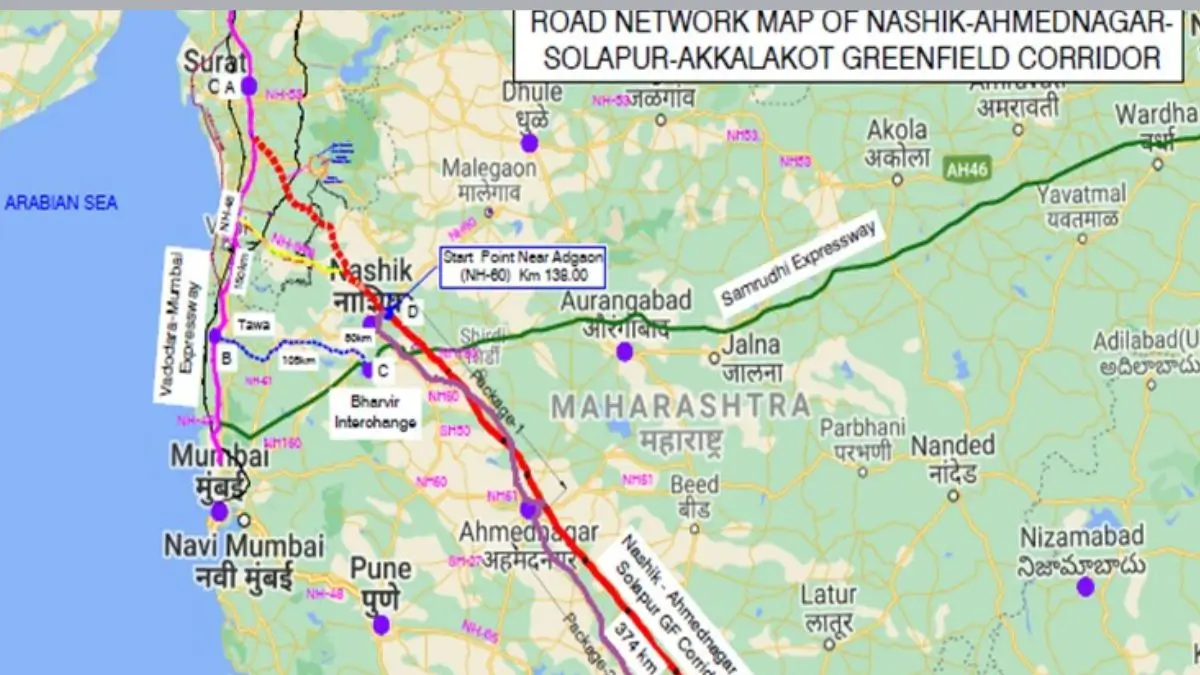
This strategic corridor will stretch for about 374 km, designed as an access-controlled, high-speed highway intended to improve connectivity, significantly reduce travel time, and enhance logistics operations across key districts in Maharashtra.
Project Details: Scope and Specifications
The newly approved corridor will feature:
- Six lanes, fully access-controlled for uninterrupted traffic flow.
- A design speed of up to 100 km/h, ensuring faster movement for both freight and passenger vehicles.
- Connectivity to major national road networks such as the Delhi–Mumbai Expressway, Agra–Mumbai corridor, and Samruddhi Mahamarg.
The corridor will link Nashik, Ahilyanagar, Solapur, and Akkalkot — significantly enhancing intercity access and minimizing travel distances.
Strategic Connectivity and Network Integration
A key highlight of the corridor is its integration with India’s broader transportation grid:
- It will intersect with the Delhi–Mumbai Expressway near the Vadhawan port interchange.
- The corridor will also connect to the Agra–Mumbai corridor and the Samruddhi Mahamarg, making travel between western and southern India more streamlined
This integration under the PM Gatishakti National Master Plan aims to strengthen the national transport infrastructure and fast-track economic activities in the surrounding regions.
Economic and Social Impacts
The corridor is expected to yield wide-ranging benefits:
- Travel time reduction by nearly 17 hours, cutting down from 31 hours to about 14 hours for long haul routes
- Enhanced logistics efficiency, helping freight vehicles cover greater distances with fewer delays.
- Economic growth across Nashik, Ahilyanagar, Dharashiv, and Solapur districts through improved market access and trade opportunities
- Generation of substantial employment: over 250 lakh man-days of direct work and more than 310 lakh man-days of indirect jobs.
Environmental and Safety Considerations
The design as an access-controlled corridor ensures:
- Reduced congestion and better road safety outcomes.
- Lower fuel consumption and emissions due to efficient road alignment and shorter travel paths.
Moreover, the corridor will support improved traffic movement and cost efficiency for both commercial and passenger transport.
Future Prospects and National Integration
Once completed, this corridor will not only serve state needs but also contribute to:
- West-to-East corridor connectivity enhancing trade across regions.
- Better access to industrial hubs and expansion of the national logistics network.
- Strengthening India’s infrastructure ecosystem in line with the government’s modernization and economic growth goals.

Why This News Is Important for Exams
Relevance for Government Exams
This development holds special importance for students preparing for exams like SSC, Railways, Banking, UPSC, PCS, Defence, and Teaching because:
- It reflects government policy on infrastructure development, a common topic in General Awareness / GS Paper I.
- The project is part of PM Gatishakti National Master Plan, often asked in syllabus areas covering economic development and national strategies.
- Questions related to national connectivity projects, BOT model, highway networks, and employment impacts may appear in current affairs sections of competitive exams.
- This also ties into the Geography and Economy syllabus since it deals with road infrastructure, connectivity, and regional development.
Understanding such government approvals and their socioeconomic impacts is key to scoring well in both objective and descriptive portions of exams. This news also helps in writing answers under infrastructure initiatives, government schemes, and national development planning topics.
Historical Context: Infrastructure Growth and Connectivity Initiatives in India
India’s focus on infrastructure enhancement has deep roots:
- The National Highways Development Project (NHDP), launched in the early 2000s, laid the foundation for modern expressways and corridors across the country.
- Follow-up programs like Bharatmala Pariyojana sought to expand export-oriented road infrastructure and foster connectivity to ports and industrial centers.
- With the launch of the PM Gatishakti National Master Plan, the government pivoted toward integrated multimodal infrastructure planning, emphasizing efficiency, logistics ease, and economic corridors.
- The Nashik–Solapur–Akkalkot corridor is part of this continuum, aimed at expanding western and southern India’s transport networks, reducing travel distances and boosting economic prospects along key trade routes.
These long-term policy directions underscore India’s commitment to strengthening physical infrastructure to support sustainable growth, urbanization, and global competitiveness.
Key Takeaways from “Cabinet Clears 6-Lane Nashik–Solapur–Akkalkot Greenfield Corridor”
| S. No. | Key Takeaway |
|---|---|
| 1. | The Union Cabinet approved the construction of a 6-lane greenfield corridor connecting Nashik, Solapur, and Akkalkot in Maharashtra. |
| 2. | Project cost is approximately ₹19,142 crore under the BOT (Toll) mode. |
| 3. | The corridor spans about 374 km and integrates with major national highways. |
| 4. | It will significantly reduce travel time by about 17 hours and enhance logistic efficiency. |
| 5. | The project will stimulate economic development and generate large-scale employment in connected districts. |
FAQs: Frequently Asked Questions
1. What is the Nashik–Solapur–Akkalkot Greenfield Corridor?
The Nashik–Solapur–Akkalkot Greenfield Corridor is a 6-lane access-controlled highway approved by the Union Cabinet in December 2025. It aims to improve connectivity, reduce travel time, and enhance logistics between Nashik, Solapur, and Akkalkot in Maharashtra.
2. What is the total estimated cost of the corridor project?
The project is estimated to cost ₹19,142 crore and will be implemented under the Build-Operate-Transfer (BOT) Toll model.
3. How long will the corridor be and what is its design speed?
The corridor spans approximately 374 km with a design speed of 100 km/h, ensuring faster and safer travel for both passenger and freight vehicles.
4. Which highways and corridors will it connect?
This corridor will integrate with Delhi–Mumbai Expressway, Agra–Mumbai corridor, and Samruddhi Mahamarg, enhancing intercity and national connectivity.
5. What are the expected economic benefits of the corridor?
The corridor will reduce travel time by around 17 hours, improve logistics efficiency, stimulate economic growth in Nashik, Solapur, and surrounding districts, and generate millions of direct and indirect employment opportunities.
6. What is the significance of this corridor under PM Gatishakti plan?
Under PM Gatishakti National Master Plan, the corridor strengthens India’s integrated multimodal transport network, supporting economic development, industrial growth, and trade expansion in western and southern India.
7. What are the environmental benefits of the project?
The corridor’s access-controlled design will reduce congestion, improve fuel efficiency, lower emissions, and enhance road safety for commuters and freight traffic.
8. Which government body approved the corridor project?
The Union Cabinet of India, chaired by the Prime Minister, officially approved the corridor on December 31, 2025.
9. How will the corridor impact travel time between Nashik and Akkalkot?
It will reduce travel time significantly from approximately 31 hours to just 14 hours, facilitating faster movement of goods and passengers.
10. Which districts in Maharashtra will benefit from the corridor?
Key districts include Nashik, Ahilyanagar, Dharashiv, Solapur, and Akkalkot, with wider economic benefits expected across Maharashtra’s western and southern regions.
Some Important Current Affairs Links