








Namo Bharat RRTS inauguration 2026 marks the launch of India’s first Delhi–Meerut Regional Rapid Transit System by PM Narendra Modi. Check key facts, corridor details, exam-relevant points, MCQs, and FAQs for UPSC, SSC, Banking, Railways, and State PSC exams.
PM Modi Inaugurates India’s First Namo Bharat RRTS on Delhi-Meerut Corridor
Prime Minister Narendra Modi inaugurated India’s first Namo Bharat Regional Rapid Transit System (RRTS) on 22 February 2026, marking a major milestone in the nation’s railway and urban transport history. The formal dedication of the Delhi – Meerut Namo Bharat Corridor to the nation took place in Meerut, Uttar Pradesh, transforming regional connectivity between the National Capital Region (NCR) and nearby urban hubs.
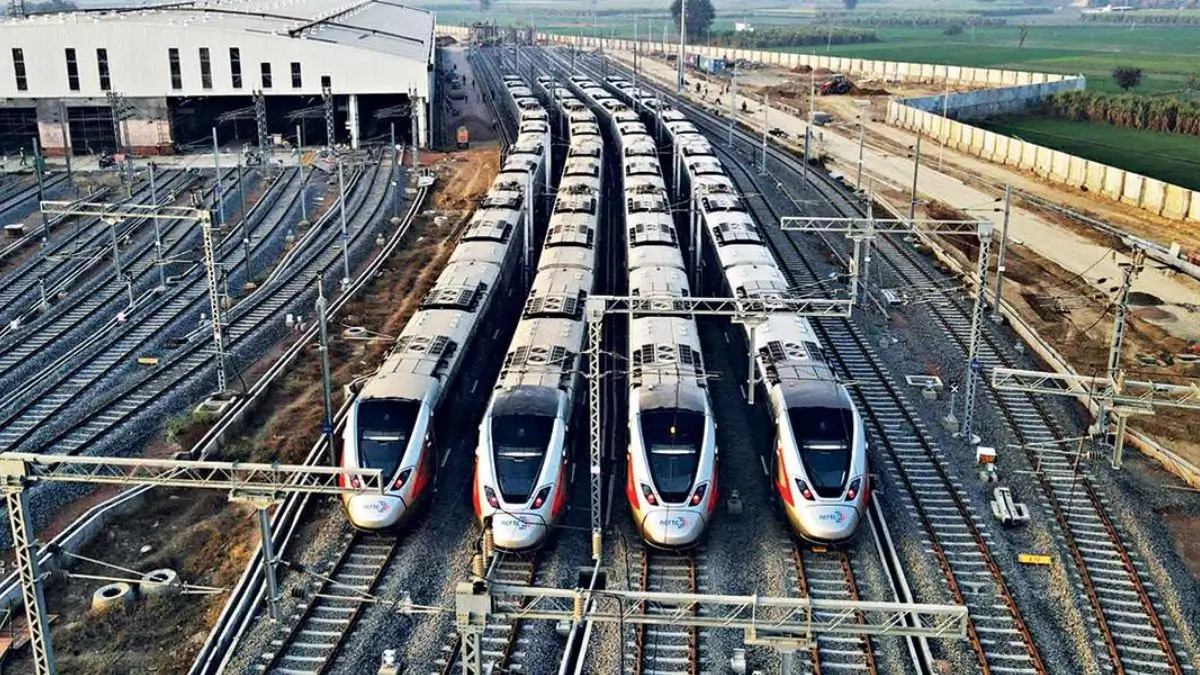
The RRTS project, driven by the National Capital Region Transport Corporation (NCRTC), represents India’s first fully operational semi-high-speed rapid rail network designed to enhance connectivity, reduce travel time, and provide world-class commuter experience. This corridor integrates state-of-the-art infrastructure where both the Namo Bharat rapid rail and metro services operate from the same station and track, enabling seamless intra-city and inter-city travel.
📍 Revolutionary Transport Integration
The unique feature of the Delhi-Meerut Namo Bharat Corridor lies in its integrated transportation model. Unlike traditional city metro systems, the RRTS combines regional rapid connectivity with urban metro services, allowing passengers to transfer conveniently between local and intercity transit at common hubs such as Sarai Kale Khan, Anand Vihar, Ghaziabad, and Meerut. This integration enhances mobility across the NCR and reduces travel dependency on road transport.
🚄 Boost to Economic Growth and Infrastructure
During the launch, PM Narendra Modi emphasized that this corridor is not only crucial for travel efficiency but also acts as a catalyst for economic development, employment generation, and regional growth. By significantly reducing travel time between Delhi and Meerut — from over three hours by road to under an hour by RRTS — the project will expand access to education, jobs, and services across the region.
The RRTS project also strengthens India’s commitment to sustainable transport solutions by offering a high-frequency rapid rail network with minimal environmental footprint — aligning with national priorities on clean and smart infrastructure development.
🌆 Women’s Empowerment Highlighted
A noteworthy aspect of this project is its focus on gender inclusion. The Prime Minister highlighted significant women participation in RRTS operations, with women constituting a large portion of train operators and station control staff — showcasing India’s focus on Nari Shakti in core sectors.

🧠 Why This News is Important (For Competitive Exams)
✨ Relevance to Government Exam Syllabus
The inauguration of the Namo Bharat RRTS corridor holds high relevance for current affairs sections of competitive exams such as SSC, Banking, Railways, UPSC (IAS/PCS), Defence, and State-level recruitment tests. Major transportation infrastructure developments are commonly asked under national infrastructure, government schemes, transport projects, and urban development topics. This launch represents a transformative leap in India’s urban transit narrative.
🚆 National Connectivity and Growth
For exams where economic development, regional balance and connectivity are important — such as UPSC or civil services interviews — this news demonstrates how the government is strengthening urban and regional mobility, thus accelerating economic integration of major cities like Delhi and Meerut. The reduction in commute time, efficiency, and connectivity reflect significant infrastructure policy decisions.
📊 Government Initiatives and Policies
This inauguration falls under broader frameworks like Smart Cities Mission, National Infrastructure Pipeline (NIP), and sustainable transportation goals. Understanding these connections helps aspirants answer questions on government initiatives and strategic infrastructure investments. The inclusion of women operators also ties into social empowerment policies — another crucial current affairs area.
🌍 Impact on Daily Life & Environment
Competitive exams frequently probe into topics linked with sustainability, carbon emission reduction, and public transport impact. The Namo Bharat RRTS serves as an example of how efficient mass rapid transit systems contribute to reduced congestion, lower pollution, and improved quality of life — key points for essay and general studies sections.
🧾 Historical Context
🚆 Background of RRTS in India
The idea of a Regional Rapid Transit System (RRTS) in India was initiated to address growing demands for fast, efficient, and high-capacity urban and inter-city transport. Prior to Namo Bharat, India’s public transit evolved through metros and suburban rail, but lacked a semi-high-speed regional system linking major urban hubs seamlessly.
📍 Development of the Delhi-Meerut Corridor
The Delhi-Meerut RRTS corridor has been under construction since 2019, with phased operations beginning in 2023. The National Capital Region Transport Corporation (NCRTC) has been the key implementing body, developing the network at strategic junctions to enhance regional mobility. The corridor was designed to shorten travel times drastically and has been a key part of India’s sustainable transport vision.
🚄 Prior Sections and Expansion
Earlier phases of the project involved partial operations between Sahibabad and New Ashok Nagar, and later segments connecting to Meerut. These expansions have gradually enhanced connectivity, leading up to the complete launch in February 2026. With travel speeds of up to 180 km/h, the RRTS network is now a benchmark in India’s rail infrastructure.
📌 Key Takeaways from Namo Bharat RRTS Inauguration
| S.No. | Key Takeaway for Exams |
|---|---|
| 1 | PM Narendra Modi inaugurated India’s first Namo Bharat RRTS on 22 February 2026. |
| 2 | The project is the Delhi-Meerut corridor — an 82 km semi-high-speed regional rail line. |
| 3 | It integrates rapid regional rail and metro services on the same station and tracks. |
| 4 | The RRTS significantly reduces travel time between Delhi and Meerut to approximately 55–60 minutes. |
| 5 | The project emphasizes women’s participation in operations and boosts economic connectivity. |
Frequently Asked Questions (FAQs)
1. What is the Namo Bharat RRTS?
The Namo Bharat Regional Rapid Transit System (RRTS) is India’s first semi-high-speed regional rail service designed to connect major cities within the National Capital Region (NCR). It operates at high speeds and provides fast, reliable, and comfortable intercity travel.
2. Who inaugurated India’s first Namo Bharat RRTS corridor?
The corridor was inaugurated by Prime Minister Narendra Modi.
3. Which corridor has been launched under the Namo Bharat RRTS?
The first operational corridor is the Delhi–Meerut RRTS Corridor, improving connectivity between Delhi, Ghaziabad, and Meerut.
4. What is the maximum speed of the Namo Bharat train?
The Namo Bharat trains are designed for a maximum speed of around 180 km/h, while operational speeds are slightly lower to ensure safety and efficiency.
5. Which organization is responsible for implementing the RRTS project?
The project is implemented by the National Capital Region Transport Corporation (NCRTC).
6. How does RRTS differ from Metro Rail?
Metro Rail mainly serves intra-city travel, while RRTS is designed for intercity regional connectivity with fewer stops and higher speeds.
7. Why is the Namo Bharat RRTS important for competitive exams?
It is significant under topics like infrastructure development, government schemes, sustainable transport, women empowerment, and economic growth, which are frequently asked in UPSC, SSC, Banking, Railways, and State PSC exams.
8. How does this project contribute to environmental sustainability?
The RRTS promotes public transport usage, reduces vehicular congestion, lowers carbon emissions, and supports sustainable urban development.
9. What is the length of the Delhi–Meerut RRTS corridor?
The corridor is approximately 82 kilometers long.
10. What is the expected impact on travel time?
The travel time between Delhi and Meerut is reduced from around three hours by road to nearly one hour via RRTS.
Some Important Current Affairs Links