




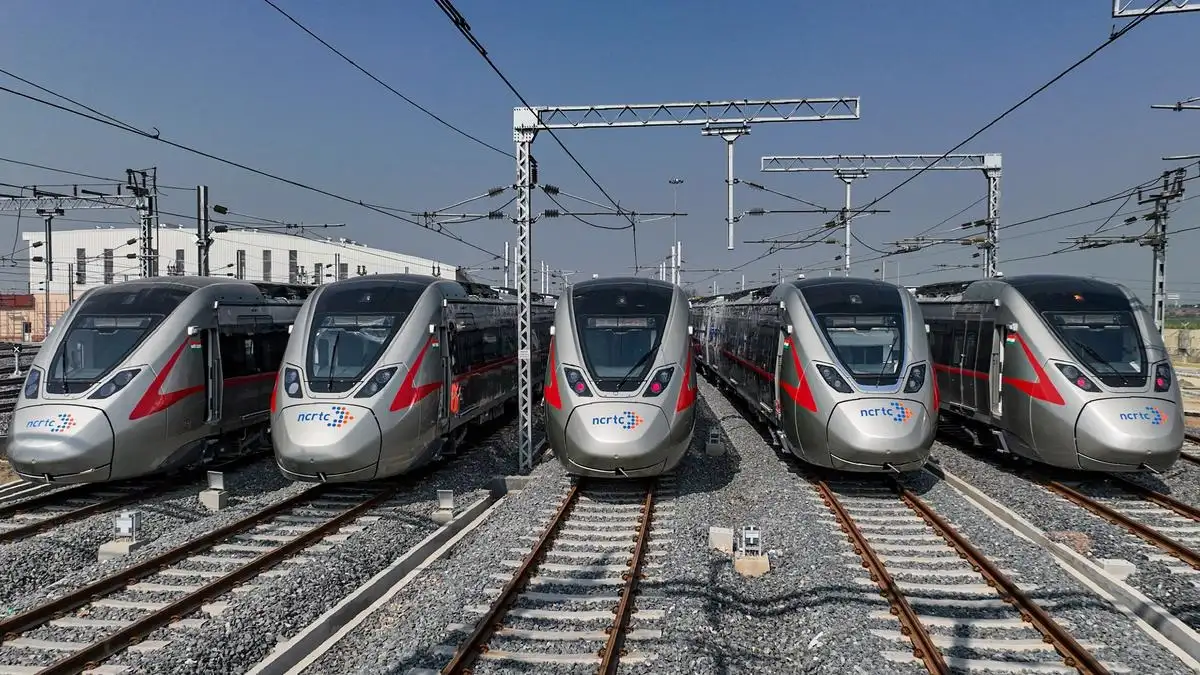
Namo Bharat fastest train achieves 160 km/h on Delhi–Meerut RRTS, reducing travel time under 1 hour and showcasing India’s modern high-speed rail infrastructure.
Namo Bharat Becomes India’s Fastest Train — A Leap in Rail Travel
Record Speed Achieved on Delhi-Meerut RRTS Corridor
Namo Bharat, the train operating on the Delhi-Meerut Regional Rapid Transit System (RRTS), has clocked a top speed of 160 km/h on the 55-kilometre stretch between New Ashok Nagar (Delhi) and Meerut South (Uttar Pradesh). This speed makes it the fastest commercial train service in India as of September 2025.
Reduction in Travel Time and Operational Details
With this speed, travel time between Delhi and Meerut is expected to be under one hour, even with intermediate station stops. The operational corridor currently spans 55 km with 11 stations, but the full stretch planned is 82.15 km, comprising 16 stations from Sarai Kale Khan (Delhi) to Modipuram (UP).
Features & Infrastructure of Namo Bharat Trains
The Namo Bharat trainsets are designed and manufactured by Alstom at its Savli plant in Gujarat. The design includes aerodynamic features and modern automation systems — Automatic Train Protection (ATP), Automatic Train Control (ATC), and Automatic Train Operations (ATO). Distances between stations vary from about 5 to 8 km, which allows the train to attain top speed in stretches where there are fewer frequent stops.
Comparisons with Previous High-Speed Trains
Prior to this, trains like the Gatimaan Express and Vande Bharat Express had held top speed records, but mostly limited to ~130 km/h on many routes. Those high speeds were restricted in practice due to track, signalling, infrastructure, and regulatory limits. The Namo Bharat pushing to 160 km/h thus signals not just faster rolling stock but improvements in overall system readiness.
Frequency and Passenger Adoption
Trains on the Delhi-Meerut RRTS corridor run every 15 minutes from each station on the operational section. Since its partial launch (especially the priority section opened on October 21, 2023), the service has already ferried over 1.5 crore passengers. This reflects strong demand.
Why This News is Important
Boost to India’s Infrastructure Modernisation
The achievement of 160 km/h for Namo Bharat demonstrates India’s growing capability in modern rail transit. It isn’t just about speed—it shows progress in signalling systems, track quality, safety mechanisms, and regional connectivity infrastructure. Such developments reinforce India’s push toward modern, efficient, sustainable transport under various national schemes.
Relevance to Competitive Exams & Policies
Government exams (Railways, Civil Services, Defence, etc.) often ask about recent infrastructure projects, fast rail corridors, smart cities, and regional rapid transit systems. Knowing about Namo Bharat, its speed record, operational corridor, and technical features (ATP, ATC, etc.) will help candidates answer current affairs and general studies questions.
Impact on Regional Development & Commuter Life
For millions commuting between Delhi and Meerut, this train reduces travel time significantly, easing traffic congestion on roads, lowering pollution, and fostering economic integration. Such projects have multiplier effects: improved mobility often boosts trade, access to education & employment, real estate, and overall urban growth.
Historical Context
Regional Rapid Transit System (RRTS) Concept & Development
The RRTS model is a relatively recent addition to India’s public transport vision. It aims to fill the gap between slower conventional trains (frequent stops, longer routes) and metro/suburban services (shorter distances, many stops). The Delhi–Meerut RRTS corridor is the first fully planned RRTS line in the country.
Prior Speeds & Precedents
Earlier high-speed and semi-high-speed train projects include the Gatimaan Express (operated at ~160 km/h on certain stretches) and Vande Bharat Express trains. However, these trains were often constrained by infrastructure limits and regulatory caps that reduced their speed to 130 km/h. Namo Bharat’s consistent operational speed sets a new standard.
Make in India & Modern Manufacturing
The trainsets are built in Savli, Gujarat by Alstom, in line with India’s Make in India initiative. The design work also involves engineering centres in India (for example, Alstom’s Hyderabad tech/design centre). This local manufacturing has implications for employment, skill development, and cost-efficient deployment of infrastructure.
Evolution of Safety and Automation in Indian Railways
Over the years, Indian Railways has been upgrading signalling and safety systems. Features like ATP, ATC, and ATO are part of this evolution, aiming for safer, more reliable, and faster train operations. The Namo Bharat’s use of these systems shows maturity in implementation.
Key Takeaways from “Namo Bharat Becomes India’s Fastest Train”
| Serial | Key Takeaway |
|---|---|
| 1 | Namo Bharat achieved a top operational speed of 160 km/h on the 55 km stretch between New Ashok Nagar (Delhi) and Meerut South, making it India’s fastest train. |
| 2 | The full planned corridor is 82.15 km long from Sarai Kale Khan (Delhi) to Modipuram (UP) with 16 stations, of which 55 km with 11 stations are already operational. |
| 3 | The train sets are manufactured by Alstom in Gujarat with features including ATP, ATC, ATO, and aerodynamic design enabling high-speed service. |
| 4 | With station spacing of about 5-8 km and frequent service (every 15 minutes), Namo Bharat offers faster, shorter travel time between Delhi and Meerut (under one hour). |
| 5 | Ridership is strong (over 1.5 crore passengers since operations began), and this corridor is expected to significantly enhance regional connectivity, reduce road congestion, and support economic development. |
FAQs — Frequently Asked Questions
1. What is Namo Bharat?
Namo Bharat is India’s fastest train, operating on the Delhi–Meerut Regional Rapid Transit System (RRTS) corridor, designed for high-speed travel with modern safety and automation features.
2. What is the top speed of Namo Bharat?
It has achieved a top operational speed of 160 km/h, making it the fastest commercial train in India.
3. Which company manufactures Namo Bharat trains?
The train sets are manufactured by Alstom at its Savli plant in Gujarat under the Make in India initiative.
4. How long is the Delhi–Meerut RRTS corridor?
The full planned corridor is 82.15 km long with 16 stations, of which 55 km with 11 stations are operational.
5. How much time does it take to travel from Delhi to Meerut on Namo Bharat?
The train reduces travel time to under one hour, even with intermediate station stops.
6. What are the safety and automation features of Namo Bharat?
The train uses Automatic Train Protection (ATP), Automatic Train Control (ATC), and Automatic Train Operation (ATO) systems to ensure safety and efficiency.
7. How frequently do trains run on this corridor?
Trains run every 15 minutes on the operational section, ensuring high commuter convenience.
8. How many passengers have used Namo Bharat so far?
Since its partial launch, the train has ferried over 1.5 crore passengers, highlighting strong demand.
9. Why is Namo Bharat important for India’s infrastructure?
It demonstrates progress in modern, high-speed rail transport, urban connectivity, and regional economic development.
10. Which cities are connected by the Delhi–Meerut RRTS corridor?
The corridor connects Delhi (Sarai Kale Khan/New Ashok Nagar) to Meerut (Modipuram/Meerut South).
Some Important Current Affairs Links