








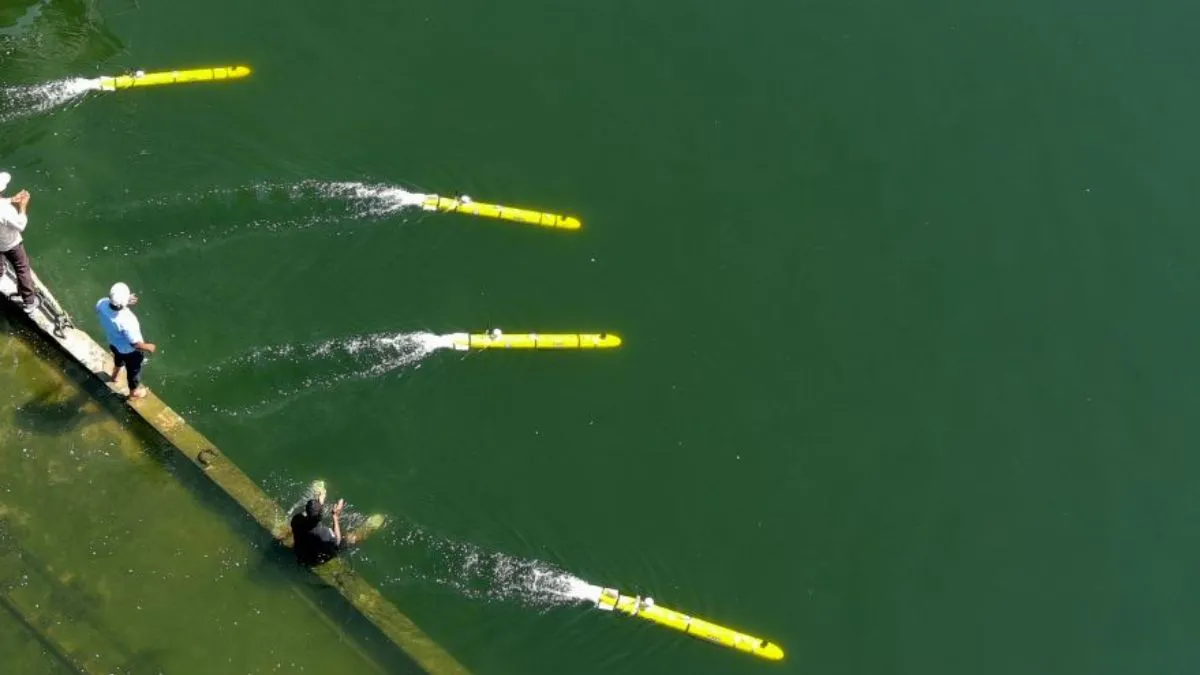
Man-Portable Autonomous Underwater Vehicles developed by DRDO enhance India’s naval mine detection capabilities using AI and underwater acoustic communication, reducing human risk in mine countermeasure missions.
DRDO Develops Man‑Portable Autonomous Underwater Vehicles
Introduction: A Quantum Leap in Underwater Defence
The Defence Research and Development Organisation (DRDO) has achieved a significant breakthrough by developing a new generation of Man‑Portable Autonomous Underwater Vehicles (MP‑AUVs). Created by the Naval Science & Technological Laboratory (NSTL) in Visakhapatnam, these compact underwater drones are engineered specifically for mine countermeasure (MCM) missions — a critical capability in modern naval strategy.
Design and Key Features: Compact, Smart & Networked
The MP‑AUVs are lightweight yet powerful. Each unit is equipped with side-scan sonar for detailed seabed mapping and underwater cameras for visual confirmation. What makes them especially advanced is the use of deep learning-based target recognition algorithms. These AI models allow the AUVs to autonomously classify “mine-like objects” (MLOs) in real time, reducing the burden on human operators. e system integrates an underwater acoustic communication network, enabling multiple AUVs to exchange data during missions. This coordination greatly enhances situational awareness and ensures that the drones can operate cooperatively.
Field Trials: Proof of Capability
Rigorous tests were carried out at NSTL’s harbour facility. During these trials, the MP‑AUVs successfully demonstrated their ability to detect and classify underwater mines, coordinate through acoustic communication, and achieve mission objectives central to mine countermeasure operations. The field tests validated the core system parameters, proving that the drones are not only technologically sound but also operationally viable.
Strategic Importance: Why This Matters
According to Dr. Samir V. Kamat, Secretary of Defence R&D and Chairman of DRDO, this development marks a “major milestone” in India’s underwater defense capabilities. He highlighted several strategic advantages:
- Rapid response in minefield situations
- Reduction of risk to naval personnel due to autonomous operation
- Lower logistical footprint, since the system is man-portable and relatively easy to deploy
By making these AUVs compact yet networked, India is pushing forward its vision of indigenized, intelligent maritime defense systems.
Industrial Collaboration & Production Plans
DRDO is not working alone on this. Multiple Indian defence industry partners are involved in the system’s realization, pointing to a collaborative “Make in India” approach. Production is expected to begin in the coming months, which suggests that the MP‑AUVs might be deployed soon in real‑world operations.
Broader Implications for Naval Warfare
These MP‑AUVs are part of a larger shift in naval warfare — away from legacy, manpower-intensive mine countermeasure ships toward smarter, autonomous platforms. The compact form factor allows deployment from a variety of vessels, not just dedicated minesweepers, and reduces the risk to human divers. Moreover, autonomous classification can speed up mine-clearance missions and improve mission efficiency.

B) Why This News Is Important
Enhancing Naval Mine Countermeasure Capabilities
Mine warfare is a major threat in maritime conflicts. Mines can block naval routes, threaten critical infrastructure, or damage warships. With these new MP‑AUVs, India’s Navy gains a powerful tool to detect and neutralize mine-like objects autonomously. This significantly strengthens the country’s defensive and offensive capabilities under the sea.
Reducing Risk to Human Personnel
Traditional mine-sweeping operations often require human divers or specialized ships that put lives at risk. The MP‑AUVs operate autonomously, thus reducing the need for direct human involvement in dangerous underwater missions. This lowers the operational risk and increases mission safety.
Speed and Efficiency Through AI & Networked Operation
The integration of deep learning allows these underwater vehicles to autonomously identify potential threats. With acoustic communication linking multiple AUVs, they can coordinate in real time, increasing efficiency and reducing mission time. This rapid, coordinated response is vital during high-stakes naval operations.
Strengthening Indigenous Defence Production
The development reflects India’s growing push for self-reliance in high-tech defence systems. Involving domestic industry partners for production is aligned with the “Make in India” policy and helps build a robust defence manufacturing ecosystem.
Strategic Edge & Future Preparedness
In an era where underwater threats (like mines and submarines) are increasingly sophisticated, having deployable, intelligent AUVs gives India a strategic advantage. These vehicles could become a critical part of future naval doctrine, contributing significantly to maritime security and power projection.
C) Historical Context: Background & Related Developments
Evolution of Unmanned Underwater Vehicles (UUVs) in India
Over the last decade, the Indian Navy and DRDO have prioritized unmanned underwater vehicles (UUVs) to modernize mine countermeasure capabilities. According to past DRDO documentation, UUVs are categorized based on endurance and deployment method — including man-portable autonomous AUVs with swarm capabilities, lightweight AUVs, heavyweight AUVs, and high-endurance platforms.
Previous Indigenous Efforts
Several earlier projects laid the foundation for this development. For example, GRSE (Garden Reach Shipbuilders and Engineers) collaborated on AUVs capable of deep-sea surveillance. These vehicles used modular architectures and side-scan sonar, similar to what the MP‑AUVs now use. Such efforts underscore a sustained, long-term strategy toward autonomous maritime systems.
Technological Trends & AI in Defence
The use of deep learning-based target recognition in the MP‑AUVs is aligned with a wider global trend: integrating AI and machine learning into defence systems. Many modern navies are exploring AI for object classification, threat detection, and autonomous decision-making under water. The MP-AUVs reflect India’s adoption of this trend for its mine warfare domain.
Strategic Maritime Challenges
India’s strategic environment — especially in the Indian Ocean Region (IOR) — demands robust undersea capabilities. With potential adversaries deploying sea mines or submarines, having quick and intelligent mine detection through AUVs is a force multiplier. Over time, such systems could reduce dependence on traditional mine countermeasure vessels and divers.
D) Key Takeaways from This News
Key Takeaways from DRDO’s MP‑AUV Development
| No. | Key Takeaway |
|---|---|
| 1 | DRDO has developed a new generation of Man‑Portable Autonomous Underwater Vehicles (MP‑AUVs) for mine countermeasure missions. |
| 2 | These AUVs are equipped with side-scan sonar and underwater cameras for real‑time detection and classification of mine-like objects. |
| 3 | The system employs deep learning-based target recognition algorithms to autonomously classify threats, reducing the workload on human operators. |
| 4 | Underwater acoustic communication enables multiple AUVs to coordinate and share data during missions, enhancing situational awareness. |
| 5 | Field trials at NSTL Harbour were successful; production is expected to begin soon, supported by Indian defence industry partners. |
FAQs: Frequently Asked Questions
1. What are MP‑AUVs developed by DRDO?
MP‑AUVs are Man‑Portable Autonomous Underwater Vehicles designed for mine countermeasure missions. They can autonomously detect, classify, and map underwater mines.
2. Which laboratory developed the MP‑AUVs?
They were developed by the Naval Science & Technological Laboratory (NSTL), a DRDO lab located in Visakhapatnam.
3. What are the key features of these AUVs?
Key features include side-scan sonar, underwater cameras, AI-based mine recognition, and underwater acoustic communication for multi-AUV coordination.
4. Why is the development of MP‑AUVs important for India?
They enhance naval mine countermeasure capabilities, reduce human risk in dangerous underwater operations, and strengthen India’s indigenous defence technology under the Make in India initiative.
5. How do MP‑AUVs use Artificial Intelligence?
The AUVs employ deep learning-based algorithms to autonomously classify mine-like objects in real time, improving efficiency and reducing operator workload.
6. Are MP‑AUVs ready for deployment?
Yes, field trials have been successful, and production is expected to start soon with involvement from Indian defence industry partners.
7. Can these AUVs operate in groups?
Yes, using underwater acoustic communication, multiple MP‑AUVs can exchange data and coordinate missions collaboratively.
8. Which strategic threats do MP‑AUVs address?
They primarily counter underwater mines, which can threaten naval routes, warships, and port infrastructure.
Some Important Current Affairs Links