


Cabinet Approves Hike in MSP for 14 Kharif Crops for 2025–26
Introduction: Government’s Commitment to Farmers
On May 29, 2025, the Cabinet Committee on Economic Affairs (CCEA), chaired by Prime Minister Narendra Modi, approved an increase in the Minimum Support Prices (MSP) for 14 Kharif crops for the 2025–26 marketing season. This decision aims to provide remunerative prices to farmers, ensuring fair compensation for their produce and promoting agricultural sustainability. The total financial outlay for this initiative is ₹2.07 lakh crore.
Key Highlights of MSP Hike
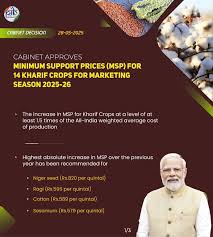
The approved MSPs reflect the government’s commitment to enhancing farmers’ income. The highest absolute increase in MSP over the previous year has been recommended for:
- Nigerseed: ₹820 increase per quintal (from ₹8,717 to ₹9,537)
- Ragi: ₹596 increase per quintal (from ₹4,290 to ₹4,886)
- Cotton (Medium Staple): ₹589 increase per quintal (from ₹7,121 to ₹7,710)
- Sesamum: ₹579 increase per quintal (from ₹9,267 to ₹9,846)
These revisions will directly benefit millions of farmers engaged in cultivating these crops across India.
Profit Margins Over Cost of Production
The expected profit margins over the cost of production are particularly promising for the following crops:
- Bajra: 63% margin
- Maize: 59% margin
- Tur (Pigeon Pea): 59% margin
- Urad (Black Gram): 53% margin
- For all other Kharif crops, the margin is estimated to be 50%
These figures reflect the government’s intent to not just raise support prices nominally, but also to substantially increase farmers’ earnings in proportion to input costs.
Focus on Nutri-Cereals and “Shree Anna”
In line with the national campaign to promote nutritional and climate-resilient crops, the government continues to offer higher MSPs for nutri-cereals, also known as “Shree Anna”. This move is not only aimed at diversifying the agricultural basket but also improving soil health, climate adaptability, and nutritional outcomes for consumers.
MSP for Raw Jute Also Increased
The Cabinet also approved a 6% hike in MSP for raw jute, revising it to ₹5,650 per quintal. This decision benefits jute growers primarily in West Bengal, Assam, and parts of Odisha and Bihar, who depend heavily on jute cultivation as their primary source of income.
Record Procurement: 2014–2025 vs 2004–2014
The government’s statement also included a comparison of procurement data over the past two decades, demonstrating a significant jump in procurement levels and MSP payouts under the Modi government:
- Paddy Procurement
- 2014–2025: 7,608 Lakh Metric Tonnes (LMT)
- 2004–2014: 4,590 LMT
- Procurement of 14 Kharif Crops
- 2014–2025: 7,871 LMT
- 2004–2014: 4,679 LMT
- MSP Payment to Farmers
- Paddy (2014–2025): ₹14.16 lakh crore
- Paddy (2004–2014): ₹4.44 lakh crore
- 14 Kharif Crops (2014–2025): ₹16.35 lakh crore
- 14 Kharif Crops (2004–2014): ₹4.75 lakh crore
Why This News Is Important
Empowering Farmers with Fair Prices
The government’s decision to increase MSPs ensures that farmers receive remunerative prices for their produce, safeguarding their income against market fluctuations. This move aligns with the Union Budget 2018–19 announcement, which set a guideline of fixing MSPs at least 1.5 times the all-India weighted average cost of production.
Promoting Agricultural Sustainability
By offering higher MSPs for pulses, oilseeds, and nutri-cereals, the government encourages crop diversification. This not only enhances soil health and climate resilience but also addresses nutritional security for consumers.
Boosting Rural Economy
The increased MSPs and the record procurement levels contribute to the overall economic development of rural areas. Higher farmer incomes lead to increased purchasing power, stimulating local economies and improving living standards.
Historical Context
Origin of MSP in India
The concept of Minimum Support Price (MSP) in India originated in response to food shortages in the 1960s, notably during the Bihar famine of 1966–1967. The Agricultural Prices Commission (APC) was established in 1965 to implement price policies like procurement at pre-decided prices and MSP.
Evolution to Commission for Agricultural Costs and Prices (CACP)
Over time, the APC evolved into the Commission for Agricultural Costs and Prices (CACP) in 1985, with broader terms of reference. The CACP recommends MSPs based on various factors, including the cost of production, demand and supply, and the impact on consumers.
Steps Involved in Fixing MSPs
The process of fixing MSPs involves several steps:
- CACP sends its recommendations to the Government of India.
- The reports are shared with state governments and concerned central ministries for comments.
- After reviewing all inputs, the Cabinet Committee on Economic Affairs (CCEA) takes the final decision on MSPs.
- Once approved, CACP publishes all its reports online, ensuring transparency and explaining the rationale behind its recommendations.
Key Takeaways from Cabinet Approves Hike in MSP for 14 Kharif Crops for 2025–26
| S.No | Key Takeaway |
|---|---|
| 1 | The Cabinet approved an increase in MSP for 14 Kharif crops for the 2025–26 marketing season. |
| 2 | The highest absolute increase in MSP was recommended for nigerseed (₹820 per quintal). |
| 3 | Expected profit margins over cost of production are highest for Bajra (63%) and Maize (59%). |
| 4 | The government’s focus on pulses, oilseeds, and nutri-cereals aims to promote crop diversification. |
| 5 | Record procurement levels and MSP payouts reflect the government’s commitment to farmer welfare. |
FAQs: Frequently Asked Questions
1. What is Minimum Support Price (MSP)?
Minimum Support Price (MSP) is the price at which the government purchases crops from farmers, ensuring them a minimum profit for their harvest even if market prices fall below this level.
2. Which body recommends MSP in India?
The Commission for Agricultural Costs and Prices (CACP) recommends MSP based on cost of production, demand-supply, and other factors, and the final MSP is approved by the Cabinet Committee on Economic Affairs (CCEA).
3. How many Kharif crops had their MSPs increased for the 2025–26 season?
MSPs for 14 Kharif crops were approved for a hike in the 2025–26 marketing season.
4. Why is the government increasing MSPs?
To ensure remunerative prices for farmers, promote crop diversification, enhance farmers’ income, and support agricultural sustainability.
5. What is the significance of ‘nutri-cereals’ or “Shree Anna” in this MSP hike?
The government is encouraging the cultivation of nutri-cereals to promote nutritional security, improve soil health, and adapt to climate changes.
6. What was the financial outlay for the MSP hike in 2025–26?
The total estimated financial outlay for the MSP hike is ₹2.07 lakh crore.
7. Which crop received the highest absolute increase in MSP for 2025–26?
Nigerseed received the highest absolute MSP increase of ₹820 per quintal.
Some Important Current Affairs Links




