








ISRO Gaganyaan air drop test validates parachute system for safe splashdown, marking a major step toward India’s first human spaceflight mission in 2027.
ISRO’s First Integrated Air Drop Test (IADT-01) for Gaganyaan: A Major Leap for India’s Human Spaceflight
A Milestone in Human Spaceflight Readiness
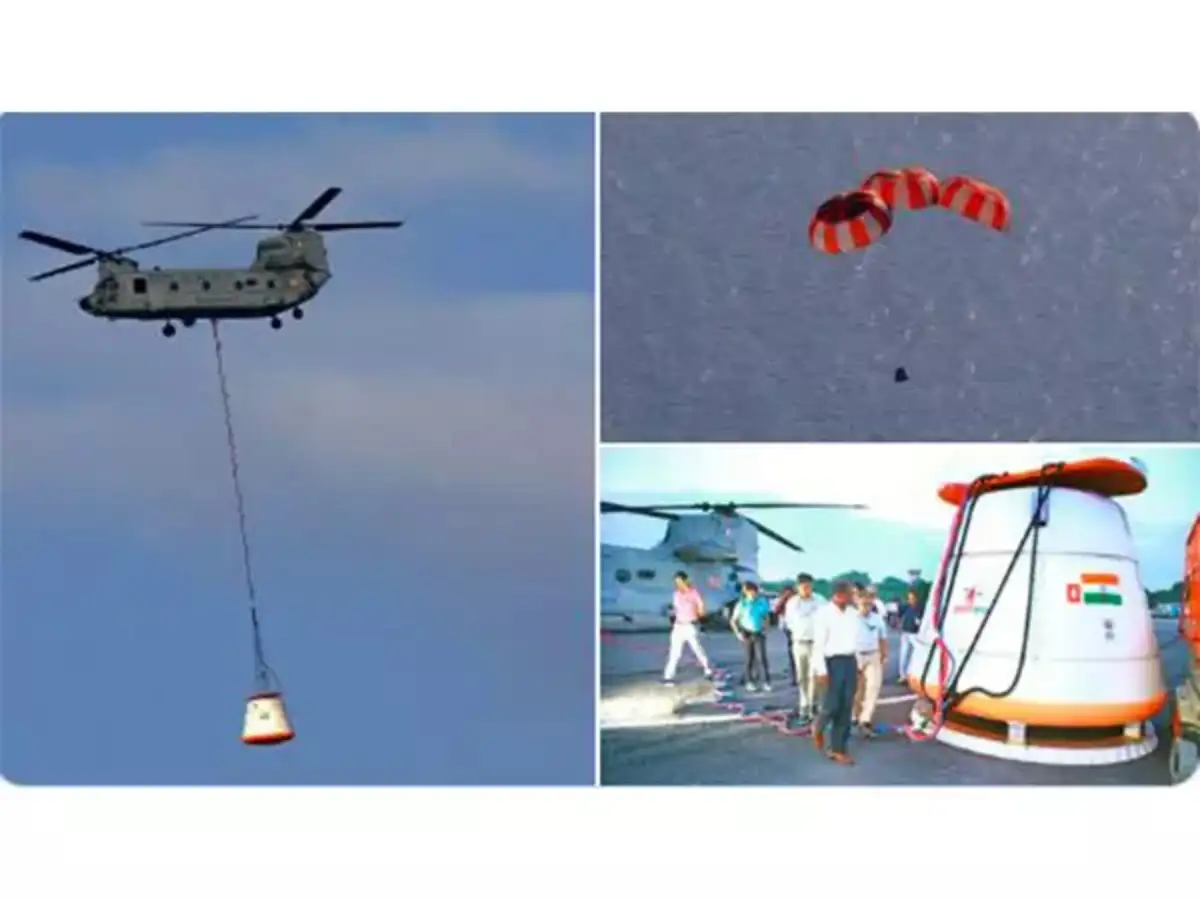
On 24 August 2025, the Indian Space Research Organisation (ISRO) successfully executed the first Integrated Air Drop Test (IADT-01) for its ambitious Gaganyaan mission at the Satish Dhawan Space Centre, Sriharikota This pivotal test, involving a dummy crew module weighing approximately 4.8–5 tonnes, saw deployment of a complex parachute system from a Chinook helicopter at around 3 kilometers altitude, culminating in a controlled splashdown in the Bay of Bengal
The Parachute Deployment Sequence
The deceleration system featured four types of parachutes deployed in a carefully timed sequence: Apex Cover Separation (ACS), Drogue, Pilot, and Main parachutes Specifically, two ACS chutes (≈2.5 m), two drogue chutes (≈5.8 m), three pilot chutes (≈3.4 m), and three main chutes (≈25 m) worked together to gradually decelerate the crew module to a safe splashdown velocity
Collaborative Defense & Space Synergy
The test underscores a strong collaborative framework among ISRO, DRDO’s ADRDE (Aerial Delivery Research & Development Establishment) based in Agra, and support from Indian Air Force, Indian Navy, and Indian Coast GuardNotably, ADRDE’s parachutes, packed for over 20 months, performed flawlessly—demonstrating an extended shelf-life beyond the usual six months
Paving the Way Ahead
IADT-01 marks a critical milestone in qualifying the parachute-based deceleration system—a foundational safety component of the Gaganyaan mission, India’s first human spaceflight slated for 2027 Following this success, upcoming trials such as TV-D2 and G1 (the first uncrewed mission with humanoid robot Vyommitra) are poised to further validate crew escape systems, propulsion units, and recovery operations
The Roadmap to Crewed Spaceflight
With the parachute system validated, ISRO is one step closer to ensuring astronaut safety during ancillary high-risk phases like ascent, re-entry, descent, and post-splashdown recovery The test signifies both technological maturity and mission-readiness in India’s journey toward becoming the fourth nation to conduct human spaceflight.
Why This News Is Important
Boosting Mission Safety and Confidence
ISRO’s IADT-01 test proves that the mission-critical parachute deceleration system works reliably under realistic conditions—a central factor in avoiding catastrophic failure during crewed missions.
A Defining Moment in India’s Space Legacy
This success cements India’s progress in achieving crew module recovery capability, bridging the gap from uncrewed test flights to safe human spaceflight—a feat shared by only a select few space nations.
Demonstrated Interagency Excellence
The collaboration across ISRO, DRDO, IAF, Navy, and Coast Guard highlights India’s integrated defense-space ecosystem, potentially setting a template for future high-stakes missions.
Enhancing Technological Reliability
The extended viability of parachute components—including those packed for 20 months—reflects robust design and reliability, which are crucial in mission-critical scenarios.
Enabling Next Phases of Gaganyaan
By clearing the parachute test, ISRO opens the door for upcoming tests (TV-D2, G1) and sets the stage for India’s first human spaceflight by 2027 — enhancing national and exam-relevant significance.
Historical Context
The Gaganyaan Journey
Launched as India’s first human spaceflight initiative, Gaganyaan began with ground validations like Pad Abort Tests (PAT), Crew Module Atmospheric Re-entry Experiments (CARE), and Test Vehicles (TV-D1)
Parachute Systems Development
Earlier, in 2022, VSSC and DRDO conducted the Integrated Main Parachute Airdrop Test (IMAT) using a 5-ton dummy module dropped from an IAF aircraft to simulate parachute deployment dynamics Tests of drogue and apex cover parachutes were also performed, including sled-based trials and rocket sled facilities to validate phased deployment sequences
Recent Mission Milestones
In October 2023, India successfully performed the TV-D1 abort test, ensuring safe escape capabilities for the crew module—a milestone that positioned India alongside Russia, USA, and China in human space safety technology Following this, parachute systems were delivered from ADRDE in Agra to ISRO in May 2025, facilitating integration and testing of the full recovery system
Towards Crewed Flights
The first uncrewed mission G1, carrying the humanoid robot Vyommitra, is planned for late 2025, while the flagship crewed mission is targeted for 2027—both milestones signal India’s transition from testing to actual human spaceflight operations
Key Takeaways from “ISRO’s First Integrated Air Drop Test (IADT-01)”
| No. | Key Takeaway |
|---|---|
| 1 | ISRO successfully conducted the IADT-01, validating the end-to-end parachute deceleration system for Gaganyaan. |
| 2 | The test involved deploying ACS, drogue, pilot, and main parachutes sequentially to ensure controlled descent and splashdown. |
| 3 | The parachute system—designed by DRDO’s ADRDE—performed reliably even after being packed for over 20 months. |
| 4 | The test was a collaborative effort involving ISRO, DRDO, IAF, Navy, and Coast Guard, reflecting strong interagency synergy. |
| 5 | IADT-01’s success clears the way for upcoming tests (TV-D2, G1) and progress toward India’s crewed Gaganyaan mission scheduled for 2027. |
FAQs Related to ISRO’s IADT-01 Test for Gaganyaan
Q1. What is the Integrated Air Drop Test (IADT-01) conducted by ISRO?
The IADT-01 was a parachute deployment test for the Gaganyaan mission, designed to validate the crew module’s deceleration and splashdown system using a dummy module dropped from a Chinook helicopter.
Q2. Why is the parachute system crucial for the Gaganyaan mission?
It ensures safe descent and controlled splashdown of the crew module carrying astronauts, preventing damage or fatalities during re-entry and landing.
Q3. Who developed the parachute system used in the test?
The parachute system was developed by the Aerial Delivery Research & Development Establishment (ADRDE), a DRDO laboratory located in Agra.
Q4. How many parachutes were involved in the IADT-01 sequence?
The system included multiple parachutes: 2 Apex Cover Separation, 2 Drogue, 3 Pilot, and 3 Main parachutes—each with specific functions for safe deceleration.
Q5. When is India’s first crewed Gaganyaan mission expected to launch?
India’s first human spaceflight mission is scheduled for 2027, following a series of uncrewed test missions.
Q6. Which organizations collaborated in the successful execution of IADT-01?
The test involved joint efforts by ISRO, DRDO, Indian Air Force, Indian Navy, and Indian Coast Guard.
Q7. What is the significance of the parachutes performing well after being packed for 20 months?
It demonstrates their long shelf-life and reliability, exceeding the usual six-month timeframe, which is critical for space missions requiring extended storage.
Q8. What are the next upcoming tests after IADT-01?
The upcoming trials include TV-D2 and the G1 mission, which will carry the humanoid robot Vyommitra.
Q9. How does this success position India globally?
With Gaganyaan progressing, India is set to become the fourth nation to achieve human spaceflight, after the USA, Russia, and China.
Q10. Why is this development important for government exam aspirants?
Such milestones are frequently asked in current affairs sections of UPSC, SSC, Defence, Banking, Railways, and State PSC exams.
Some Important Current Affairs Links