



INS Nistar Commissioned on 18 July 2025 as India’s first indigenously built diving support vessel. Built by Hindustan Shipyard Ltd, this DSV enhances India’s submarine rescue and deep-sea operational capabilities under the Eastern Naval Command.
INS Nistar Commissioned: India’s First Indigenous Diving Support Vessel
Strategic Maritime Leap
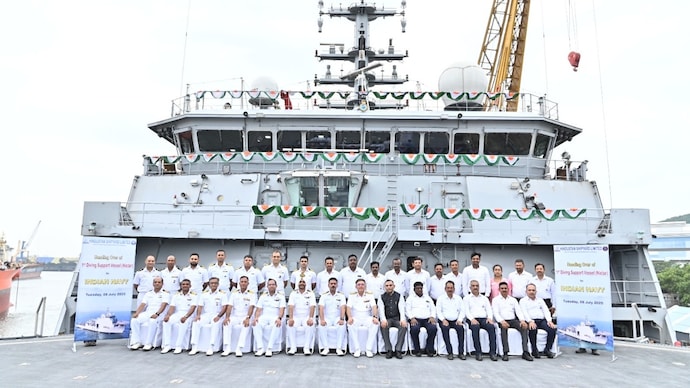
On July 18, 2025, the Indian Navy inducted INS Nistar, marking the nation’s first diving support vessel (DSV) entirely designed and built in India. The commissioning ceremony took place at Visakhapatnam with Defence Minister Ranajay Seth and CNS Admiral Dinesh K Tripathi present This 118 m, 10,000-tonne vessel, constructed by Hindustan Shipyard Ltd (HSL), enhances India’s deep-sea diving, submarine rescue, and SSRO (subsea salvage) capabilities
State-Of-The-Art Capabilities
INS Nistar features a hyperbaric diving system that supports saturation diving up to 300 m and remotely operated underwater vehicles (ROVs) reaching depths of 1,000 m. It serves as the mothership for Deep Submergence Rescue Vehicles (DSRVs), equipped with advanced launch-and-recovery systems, dynamic positioning thrusters, medical decompression chambers, side-scan sonar, a 15‑tonne subsea crane, and a helicopter deck
Indigenous Prowess & Economic Impact
The vessel carries more than 80% indigenous content, sourced from over 120 MSMEs, aligning seamlessly with the Atmanirbhar Bharat initiative and bolstering local defense manufacturing
Enhancing Regional Reach & Readiness
Commissioned into the Eastern Naval Command, INS Nistar boosts India’s submarine rescue readiness on both coasts. This vessel places India among the elite group of navies with deep-water submarine rescue and recovery capabilities, reinforcing its position as a net security provider in the Indo‑Pacific
Why This News Matters
For Aspirants of Government Exams
This commissioning underscores India’s strategic emphasis on indigenous defense technology—crucial for topics like Make in India, Defense Modernisation, and Maritime Security, which are frequently tested in UPSC, SSC, defence, railways, banking, and police exams.
Relevance to Syllabus
The development aligns with areas like National Security, Defence Production, and Foreign Policy, strengthening aspirants’ understanding of India’s self-reliance and regional naval posture.
Broader Implications
Equipping the Navy with a purpose-built DSV signifies enhanced capabilities in submarine rescue operations and underwater salvage—vital in emergency scenarios and multi-national exercises. It also positions India as a reliable partner in regional humanitarian operations under SAGAR (Security and Growth for All in the Region).
Historical Context: Legacy & Technological Evolution
Reclaiming the ‘Nistar’ Legacy
The current INS Nistar revives the name of a Soviet-era vessel commissioned in 1971. That earlier ship played a key role in locating the Pakistan Navy submarine Ghazi during the Indo‑Pakistan War, before being decommissioned in 1989
Journey to Indigenization
Initiated in September 2018, the contract with HSL involved simultaneous construction of two DSVs. The keel of Nistar was laid in December 2019, with both vessels launching in September 2022. Sea trials followed early 2024, culminating in delivery on July 8, 2025, ahead of commissioning
India’s Evolving Rescue Infrastructure
Until now, submarine rescue relied on the ageing INS Nireekshak (1989–present), retrofitted from a commercial ship, and interim motherships. INS Nistar represents a leap forward—with purpose-built features, modern technology, and mission readiness
Key Takeaways from INS Nistar Commissioning
| No. | Key Takeaway |
|---|---|
| 1 | Date and Location: INS Nistar commissioned on 18 July 2025 at Visakhapatnam. |
| 2 | Capability: Supports saturation diving to 300 m, ROV ops to 1,000 m, and submarine rescue with DSRVs. |
| 3 | Indigenous Content: Over 80% Indian-made parts, showcasing MSME participation. |
| 4 | Strategic Impact: Enhances India’s deep-sea rescue capacity and bolsters regional maritime security. |
| 5 | Legacy Connection: Name revives WWII‑era INS Nistar that served in 1971 and was decommissioned in 1989. |
FAQs: Frequently Asked Questions
Q1. What is INS Nistar?
INS Nistar is India’s first indigenously designed and built Diving Support Vessel (DSV), used for submarine rescue, deep-sea salvage operations, and saturation diving missions.
Q2. When and where was INS Nistar commissioned?
INS Nistar was commissioned into the Indian Navy on 18 July 2025 at Visakhapatnam, Andhra Pradesh.
Q3. Who built INS Nistar?
The vessel was built by Hindustan Shipyard Limited (HSL) in collaboration with over 120 Indian MSMEs under the Make in India initiative.
Q4. What is the operational capability of INS Nistar?
It can conduct saturation diving up to 300 metres, deploy ROVs up to 1,000 metres, and support Deep Submergence Rescue Vehicles (DSRVs).
Q5. Why is INS Nistar important for India’s naval power?
It significantly enhances India’s submarine rescue and underwater salvage capabilities and positions India among the few countries with such deep-sea operational infrastructure.
Q6. What percentage of indigenous content does INS Nistar have?
The ship includes over 80% indigenous content, sourced primarily from Indian MSMEs.
Q7. Which command will operate INS Nistar?
INS Nistar will be operated by the Eastern Naval Command of the Indian Navy.
Q8. What is the significance of the name ‘Nistar’?
The name revives the legacy of the Soviet-built INS Nistar that played a key role during the 1971 Indo-Pak war in locating the sunken Pakistani submarine PNS Ghazi.
Q9. How does INS Nistar contribute to SAGAR?
By enhancing regional maritime rescue capabilities, INS Nistar supports India’s vision of Security and Growth for All in the Region (SAGAR).
Q10. What equipment does INS Nistar carry for underwater missions?
It includes a 15-tonne subsea crane, dynamic positioning systems, decompression chambers, helideck, sonar systems, and advanced navigation and recovery technology.
Some Important Current Affairs Links