







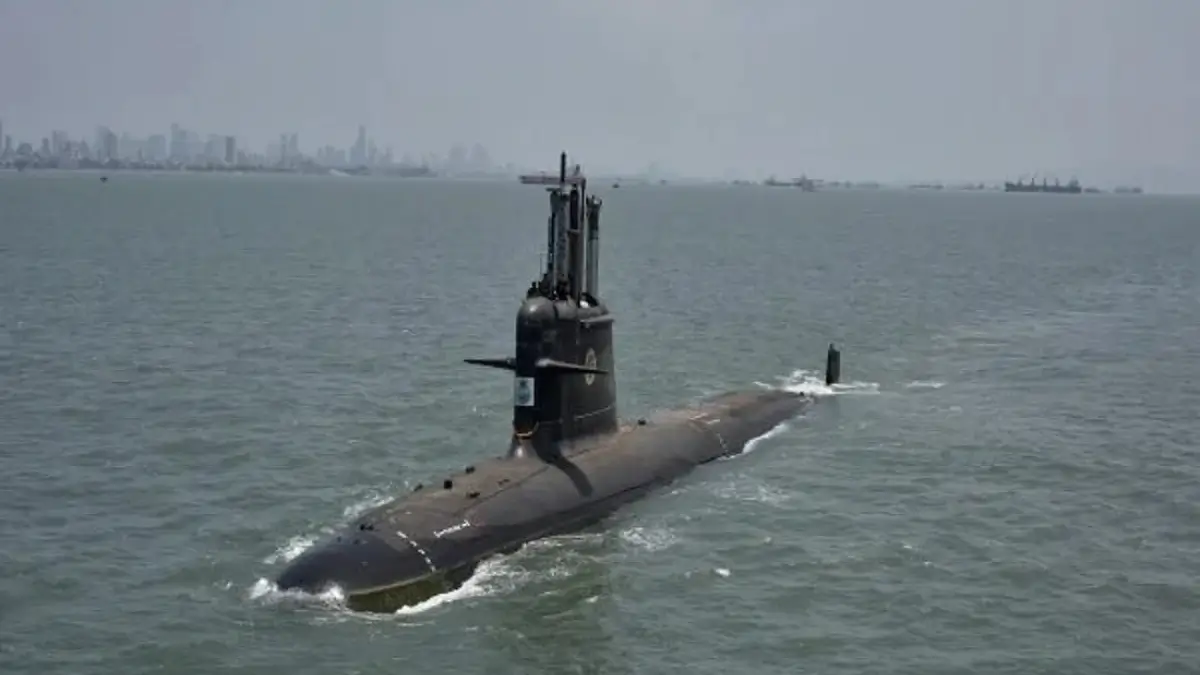
INS Aridhaman commissioning marks a major leap in India’s sea-based nuclear deterrent, enhancing second-strike capability and strategic maritime security.
India Prepares to Launch INS Aridhaman, Boosting Sea-Based Nuclear Deterrent
A Major Leap for India’s Underwater Strategic Capability
India is on the verge of commissioning INS Aridhaman — the third indigenously built nuclear-powered ballistic missile submarine (SSBN) — marking a significant milestone in the country’s maritime defence ambitions. The submarine has completed extensive sea trials and is ready to join the fleet under the command of the Indian Navy.
INS Aridhaman belongs to the Arihant-class of SSBNs. With advanced design improvements over its predecessors, it boasts enhanced stealth, endurance, and strike capabilities. Once inducted, it will operate alongside existing SSBNs: INS Arihant and INS Arighaat — collectively strengthening India’s sea-based nuclear deterrent.
Technical Features & Capabilities of INS Aridhaman
- Displacement & Size: The submarine has a submerged displacement of about 7,000 tonnes, making it larger and more capable than the earlier 6,000-tonne Arihant-class boats. Its increased size supports greater payload and endurance.
- Nuclear Reactor: Powered by an upgraded 83 MW pressurized light-water reactor (PWR) developed indigenously by the Bhabha Atomic Research Centre (BARC). This reactor offers enhanced efficiency, a lower acoustic signature (improved stealth), and sustains underwater endurance limited mainly by crew supplies rather than fuel.
- Armament: Equipped with an advanced vertical launch system (VLS), INS Aridhaman can carry a mix of submarine-launched ballistic missiles (SLBMs): either up to 24 shorter-range K-15 (Sagarika) missiles with a range of approx. 750 km, or fewer but longer-range K-4 missiles with a strike range around 3,500 km. It is also expected to be compatible with future K-5 missiles (with projected ranges up to 5,000–6,000 km).
- Stealth & Detection Systems: The boat features advanced sensor and sonar suites — including bow, flank, and towed-array sonar systems — along with anechoic coatings to dampen acoustic signature. These improvements enhance its ability to evade detection and conduct covert deterrent patrols.
- Endurance & Patrol Capability: The reactor and design allow submerged operations for extended durations — constrained mainly by food, crew rotations, and maintenance rather than fuel — enabling long-duration strategic patrols critical for credible second-strike capability.
Strategic Significance of Aridhaman for India’s Defence Posture
The induction of INS Aridhaman significantly elevates India’s underwater deterrence architecture. By expanding the fleet to three operational SSBNs, the Indian Navy ensures that at least one submarine can remain on continuous patrol — a key requirement for credible sea-based deterrence under the country’s nuclear doctrine.
Given increasing maritime competition and naval deployments in the Indo-Pacific — particularly from powers with submarine capabilities — having a stealthy, nuclear-armed submarine with long-range strike reach underlines India’s resolve to protect its maritime interests and maintain strategic balance. The move also advances the national ambition for defence self-reliance under the Atmanirbhar Bharat initiative, as INS Aridhaman is built largely with indigenous technology and expertise.

Why This News Is Important
Strengthening Nuclear Triad: Ensuring Second-Strike Capability
The commissioning of INS Aridhaman fills a critical gap in India’s nuclear doctrine by solidifying the underwater leg of its triad (land, air, and sea). SSBNs like Aridhaman are much harder to detect and neutralize compared to land-based or air-launched platforms, thereby assuring a credible second-strike capability even if first-strike assets are compromised. This enhances deterrence, increasing the risk for any adversary considering a pre-emptive strike.
Boost to Indigenous Defence Manufacturing and Strategic Autonomy
INS Aridhaman is largely built using Indian technology and materials — from nuclear reactor to hull construction and missile systems. This reflects growing self-reliance in critical defence manufacturing, aligning with the Atmanirbhar Bharat vision. Such developments reduce dependency on foreign imports, strengthening India’s defense industrial base and giving New Delhi greater autonomy in strategic planning and procurement.
Regional Maritime Balance & Security in the Indo-Pacific
With growing Chinese and Pakistani submarine capabilities — and increasing maritime activity in the Indian Ocean — Aridhaman’s induction sends a strong strategic message. It improves India’s ability to patrol, monitor, and, if necessary, respond in the maritime domain, thereby contributing to regional stability and safeguarding national maritime interests, sea-lines of communication, and island territories.
Importance for Civil-Service, Defence & Strategic Awareness Aspirants
For students preparing for civil-services, defence, railways, banking or police exams — where current affairs and national security topics are common — this development highlights a major strategic shift. It’s a key example of India’s evolving defence architecture and geopolitical posture, and understanding its implications can be crucial for essay-writing, interview-discussions or general-knowledge sections.
Historical Context
Origin of India’s SSBN Programme: From Project 932 to Arihant
India’s journey towards a sea-based nuclear deterrent dates back decades. After the demonstration of nuclear capability in the 1970s and 1990s — marked by tests and an evolving nuclear doctrine — Indian strategists recognized the vulnerability of land-based and air-launched assets to a first strike. To counter this, the indigenous SSBN programme was initiated under what later became known as the Advanced Technology Vessel project (ATV).
The first success came with INS Arihant, commissioned in August 2016. As the first indigenously built SSBN, Arihant marked India as the first country outside the five permanent UN Security Council members to build and deploy an SSBN.
Subsequently came INS Arighaat (commissioned August 2024), featuring improved systems and capabilities. The expansion to a third boat with INS Aridhaman represents the maturation of India’s SSBN fleet — shifting from a nascent deterrent platform to a credible, continuous sea-based nuclear deterrent posture.
Over time, India has incrementally built technological, manufacturing, and strategic competence — from reactor design by BARC, to missile and sonar systems by DRDO, and hull construction by Indian shipyards — reflecting a larger trajectory of defence modernization and strategic autonomy.
Key Takeaways from INS Aridhaman’s Commissioning
| No. | Key Takeaway |
|---|---|
| 1 | INS Aridhaman is India’s third indigenously built nuclear-powered ballistic missile submarine (SSBN), soon to be commissioned. |
| 2 | The submarine has a submerged displacement of ~7,000 tonnes and is powered by an 83 MW indigenously developed reactor for extended underwater endurance. |
| 3 | It can carry a versatile missile load — up to 24 K-15 SLBMs (750 km range) or multiple long-range K-4 missiles (≈3,500 km), and is expected to be compatible with future K-5 missiles (5,000–6,000 km). |
| 4 | Advanced stealth technology (acoustic damping, sonar suites) increases covert patrol capability, ensuring survivability and credible second-strike potential. |
| 5 | Induction of Aridhaman strengthens India’s sea-based nuclear deterrent, reinforces the nuclear triad, and enhances strategic deterrence posture under the Atmanirbhar Bharat defence framework. |
FAQs: Frequently Asked Questions
1. What is INS Aridhaman?
INS Aridhaman is India’s third indigenously built nuclear-powered ballistic missile submarine (SSBN), designed to strengthen the country’s sea-based nuclear deterrent.
2. Which class does INS Aridhaman belong to?
INS Aridhaman belongs to the Arihant-class of nuclear-powered ballistic missile submarines.
3. What are the missile capabilities of INS Aridhaman?
It can carry up to 24 K-15 (Sagarika) SLBMs with a 750 km range or multiple K-4 missiles with ~3,500 km range. Future compatibility with K-5 missiles (5,000–6,000 km range) is planned.
4. What is the significance of INS Aridhaman for India’s nuclear deterrent?
The submarine strengthens the underwater leg of India’s nuclear triad, ensuring a credible second-strike capability and enhancing strategic deterrence.
5. Which Indian organization developed the reactor for INS Aridhaman?
The 83 MW pressurized light-water reactor (PWR) for INS Aridhaman was developed by the Bhabha Atomic Research Centre (BARC).
6. How does INS Aridhaman enhance India’s maritime security?
Its advanced stealth, sonar, and long-endurance capabilities allow covert strategic patrols in the Indian Ocean and Indo-Pacific region, ensuring regional balance and maritime safety.
7. When was India’s first SSBN commissioned?
INS Arihant, India’s first indigenously built SSBN, was commissioned in August 2016.
8. What is the displacement of INS Aridhaman?
INS Aridhaman has a submerged displacement of approximately 7,000 tonnes.
9. How long can INS Aridhaman stay submerged?
The submarine’s underwater endurance is primarily limited by crew supplies and maintenance, rather than fuel, due to its nuclear reactor.
10. Why is INS Aridhaman important for civil-service exam aspirants?
It is relevant for topics in national security, defence modernization, and India’s strategic nuclear capabilities, which frequently appear in exams like UPSC, SSC, and banking GK sections.
Some Important Current Affairs Links