







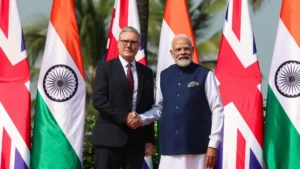
India UK Joint Statement 2025 highlights CETA trade agreement, defense deals, and strategic partnership aimed at doubling trade and strengthening bilateral relations.
India–UK Joint Statement 2025: Strengthening Strategic Ties
📅 Official Visit and Bilateral Engagement
On October 8–9, 2025, British Prime Minister Sir Keir Starmer visited India at the invitation of Prime Minister Narendra Modi. This marked Starmer’s first official visit to India and underscored the growing strategic partnership between the two nations. The visit followed Prime Minister Modi’s trip to the UK in July 2025, where both countries signed the India–UK Comprehensive Economic and Trade Agreement (CETA) and adopted the India–UK Vision 2035 and a Defence Industrial Roadmap.
🤝 Strengthening the Comprehensive Strategic Partnership
During their talks in Mumbai, both leaders reaffirmed their commitment to a robust and multifaceted partnership. They emphasized shared values such as democracy, freedom, and the rule of law, recognizing the India–UK partnership as a pillar of global stability and economic progress. The discussions covered various sectors, including trade, defense, technology, education, and climate action.
📈 Advancements in Trade and Economic Cooperation
The India–UK Comprehensive Economic and Trade Agreement (CETA), signed in May 2025, aims to eliminate tariffs on 99% of Indian exports to the UK and 90% of UK exports to India. This agreement is expected to double bilateral trade to USD 120 billion by 2030. Notably, the gem and jewelry sector is anticipated to benefit significantly, with exports to the UK expected to double to $2.5 billion within three years, creating over 1.4 lakh new jobs.
🛡️ Enhancing Defense and Security Cooperation
In the defense sector, India and the UK are moving closer to a joint naval propulsion deal, aiming to enhance India’s indigenous naval capabilities. Additionally, the UK has signed a £350 million ($468 million) contract to supply India with lightweight multirole missiles, marking a significant step in strengthening defense and commercial ties between the two nations.
🌐 Commitment to Global Peace and Stability
Both leaders expressed satisfaction with the upward trajectory of the India–UK Comprehensive Strategic Partnership and reaffirmed their common commitment to global peace, stability, and a rules-based international order. They also discussed global and regional issues of mutual interest, including climate change, terrorism, and regional security.
🧠 Why This News Is Important
🔍 Relevance to Government Exams
The India–UK Joint Statement 2025 is a significant development in international relations and has implications for various sectors. Understanding this partnership is crucial for students preparing for government exams, as it encompasses areas such as trade, defense, technology, and global diplomacy.
📚 Key Areas of Focus
- Trade and Economic Cooperation: The CETA agreement and its impact on bilateral trade and job creation are important topics for exams focusing on economic policies and international trade agreements.
- Defense and Security: The joint naval propulsion deal and missile supply contract highlight the strengthening of defense ties, relevant for exams covering national security and defense policies.
- Global Diplomacy: The reaffirmation of commitment to global peace and stability reflects the evolving role of India in international relations, pertinent for civil services and foreign affairs examinations.
🕰️ Historical Context
🇮🇳 India–UK Relations: A Historical Overview
India and the United Kingdom share a long history, marked by colonial ties and subsequent independence. Post-independence, both nations have worked towards building a partnership based on mutual respect and shared values. The signing of the India–UK Comprehensive Economic and Trade Agreement (CETA) in May 2025 and the adoption of the India–UK Vision 2035 during Prime Minister Modi’s visit to the UK in July 2025 signify a new chapter in their bilateral relations, focusing on strategic cooperation across various sectors.
✅ Key Takeaways from “India–UK Joint Statement 2025”
| S.No | Key Takeaway |
|---|---|
| 1 | First Official Visit: UK Prime Minister Keir Starmer’s visit to India in October 2025 marked a significant step in strengthening bilateral ties. |
| 2 | CETA Agreement: The India–UK Comprehensive Economic and Trade Agreement aims to eliminate tariffs on 99% of Indian exports to the UK and 90% of UK exports to India, expected to double bilateral trade to USD 120 billion by 2030. |
| 3 | Defense Collaboration: India and the UK are moving closer to a joint naval propulsion deal and have signed a £350 million contract for missile supply, enhancing defense cooperation. |
| 4 | Job Creation: The CETA agreement is projected to create over 1.4 lakh new jobs, particularly benefiting the gem and jewelry sector. |
| 5 | Global Commitment: Both leaders reaffirmed their commitment to global peace, stability, and a rules-based international order, discussing mutual global and regional issues. |
FAQs: Frequently Asked Questions
1. What is the India–UK Comprehensive Economic and Trade Agreement (CETA)?
CETA is a trade agreement signed in May 2025 between India and the UK. It eliminates tariffs on 99% of Indian exports to the UK and 90% of UK exports to India, aiming to double bilateral trade to USD 120 billion by 2030.
2. When did UK Prime Minister Keir Starmer visit India?
Sir Keir Starmer visited India on October 8–9, 2025, at the invitation of Prime Minister Narendra Modi. This was his first official visit to India.
3. What are the key sectors covered under India–UK strategic cooperation?
The partnership includes trade, defense, technology, education, climate action, and global security collaboration.
4. How does CETA impact job creation in India?
The agreement is expected to generate over 1.4 lakh new jobs, particularly in the gem and jewelry sector, boosting exports to the UK.
5. What defense initiatives were announced in the India–UK joint statement 2025?
India and the UK are moving closer to a joint naval propulsion deal and have signed a £350 million contract to supply India with lightweight multirole missiles, strengthening defense ties.
6. Why is this joint statement important for global stability?
Both nations reaffirmed their commitment to global peace, a rules-based international order, and cooperation on issues like climate change, terrorism, and regional security.
Some Important Current Affairs Links