




India sugar exports 2025 cross 2 lakh tonnes in the 2025–26 marketing year under government export quota policy. Check key facts, exam relevance, MCQs, and analysis for UPSC, PSC, SSC, Banking and Defence exams.
India’s Sugar Exports Cross 2 Lakh Tonnes in 2025-26 Marketing Year
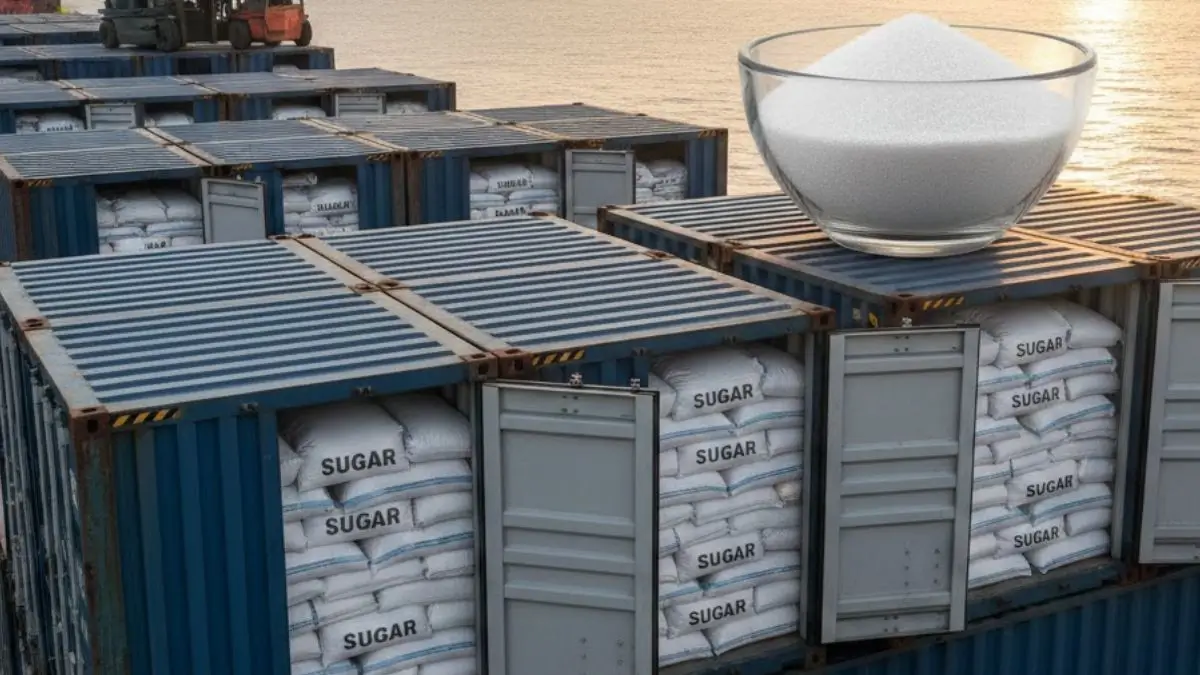
In a significant development for India’s agricultural and foreign-trade landscape, India’s sugar exports crossed the 2 lakh tonnes mark in the ongoing 2025-26 marketing year (October–September), reflecting rising global demand and effective export policy implementation. According to the All India Sugar Trade Association (AISTA), the cumulative shipments reached 2,01,547 tonnes by February, conveying a positive sign for surplus production and export-oriented strategies.
Government Export Quota and Policy Framework
The Central Government has maintained a quota-based control over sugar exports to balance domestic supply and export needs. For the 2025-26 marketing year, authorities approved a total export quota of 2 million tonnes — including an additional 500,000 tonnes added to the initial allocation — allowing sugar mills to align their export operations with industry capacity.
The quota system ensures that while surplus national production enters international markets, domestic sugar availability remains stable and protective of consumer interests. Under this system, quotas are distributed among sugar mills proportionally based on production levels, with strategic encouragement for export shipments.
Leading Export Destinations
Key foreign markets accounted for substantial shares of the exported sugar volume. Among the top recipients were:
- United Arab Emirates (UAE) — the largest importer at over 47,000 tonnes
- Afghanistan — with around 46,000 tonnes
- Djibouti — more than 30,000 tonnes
- Bhutan — over 20,000 tonnes
These figures illustrate India’s growing competitiveness in the global sugar export market and the strengthening trade relationships with neighbouring and Middle Eastern countries.
White and Refined Sugar Exports
The export data further indicates that white sugar dominated shipments, accounting for about 163,000 tonnes, while refined sugar shipments amounted to 37,638 tonnes. This trend highlights India’s capability to meet diverse global requirements for both raw and value-added sugar products.
Projected Production and Surplus Outlook
Industry estimates suggest that India’s sugar production for the 2025-26 marketing year is set to increase by approximately 13%, reaching an estimated 29.6 million tonnes. This projected boost in output, even after accounting for sugar diverted toward ethanol production, provides a strong base for sustained export performance throughout the season.

Why This News is Important for Government Exam Aspirants
Relevance in Current Affairs and Economy
The story of India’s increasing sugar exports holds high relevance for aspirants preparing for competitive exams such as UPSC Civil Services, PSCs, Banking, Railways, SSC and Defence entries due to its connection with key economic concepts such as foreign trade, agricultural policy, quota systems, and international commerce.
Sugar, being one of India’s major agro-exports, impacts trade balance, rural economy, farmer incomes, and agricultural GDP. Understanding how export quotas are set, how agricultural exports are regulated, and which countries are major buyers provides valuable insight into India’s trade policy framework and market dynamics.
Furthermore, discussions around sugar production also intersect with energy policy, especially where sugarcane is increasingly diverted for ethanol production — a key element in India’s renewable energy and biofuel strategy. Knowledge of such policy linkages and their socio-economic implications is commonly tested in government exams.
Policy and Market Impact
This news highlights how the Indian government balances domestic needs with export opportunities through regulatory mechanisms like export quotas, which are important components of macroeconomic policy. Students should thus pay attention to how agricultural exports are managed to prevent domestic shortages while leveraging surplus production to boost external earnings.
Additionally, the emphasis on destinations such as the Middle East and neighbouring regions reflects India’s shifting trade relationships, which is useful for topics under international relations and trade agreements.
Historical Context: Evolution of Sugar Exports in India
India has historically been one of the largest sugar producers in the world, alongside Brazil and European countries. In recent years, the Indian sugar industry has undergone multiple policy shifts aimed at tackling surplus production and managing price stability:
- Quota Systems: Export quotas have been used periodically to prevent domestic shortages and control price volatility. For the 2024-25 season, India permitted about 1 million tonnes of exports and shipped significant volumes globally.
- Policy Adjustments: In previous years, industry bodies like the Indian Sugar & Bio-energy Manufacturers’ Association (ISMA) advocated for higher export quotas in response to bumper production forecasts, pushing policymakers to increase allocations for global markets.
- Ethanol Diversion: Recently, sugarcane diversion to ethanol production has become a policy priority to support renewable fuels and absorb surplus stock. This has influenced export availability and domestic pricing dynamics.
- Export Destinations: Traditionally, India’s sugar exports have catered to markets in West Asia, Africa, and South Asia — reflecting evolving bilateral trade preferences driven by demand patterns and price competitiveness.
Understanding these policy trends and historical developments helps aspirants connect the present news with ongoing agricultural and trade policy directions, a common focus area in government exams.
Key Takeaways from “India’s Sugar Exports Cross 2 Lakh Tonnes”
| S. No. | Key Takeaway |
|---|---|
| 1. | India exported 2,01,547 tonnes of sugar by February in the 2025-26 marketing year. |
| 2. | The government approved a total export quota of 2 million tonnes for the year. |
| 3. | UAE was the largest importer, followed by Afghanistan, Djibouti and Bhutan. |
| 4. | White sugar comprised the majority of shipments, with refined sugar also exported. |
| 5. | India’s estimated sugar production is projected to grow by about 13% in 2025-26, supporting export potential. |
FAQs for Government Exam Preparation
1. What is the current status of India’s sugar exports in the 2025–26 marketing year?
India’s sugar exports have crossed 2 lakh tonnes (2,01,547 tonnes) in the 2025–26 sugar marketing year (October–September). This reflects improved export momentum and stable surplus production.
2. What is the duration of the sugar marketing year in India?
The sugar marketing year in India runs from October to September of the following year. This cycle is important for tracking production, stock levels, and exports in competitive exams.
3. Which organization released the export data?
The export data was released by the All India Sugar Trade Association (AISTA), which regularly monitors and reports sugar trade statistics.
4. What is the total export quota approved for 2025–26?
The Government of India has approved an export quota of 2 million tonnes for the current marketing year to balance domestic supply and international demand.
5. Which country is the largest importer of Indian sugar this year?
The United Arab Emirates (UAE) has emerged as the largest importer of Indian sugar so far in 2025–26.
6. Why does the government impose export quotas on sugar?
Export quotas help maintain domestic price stability, prevent shortages, and ensure sufficient stock availability for consumers while allowing mills to benefit from international markets.
7. How does sugar export impact India’s economy?
Sugar exports improve foreign exchange earnings, support farmer incomes, strengthen rural employment, and contribute positively to the agricultural GDP.
8. How is ethanol production linked to sugar exports?
Part of sugarcane production is diverted toward ethanol manufacturing under India’s biofuel policy. Higher ethanol diversion may reduce sugar export availability but supports renewable energy goals.
9. What types of sugar are exported by India?
India mainly exports white sugar and refined sugar, with white sugar forming the larger share.
10. Why is this topic important for competitive exams?
It is relevant for Economy, Agriculture, International Trade, Government Policy, and Current Affairs sections in UPSC, State PSCs, SSC, Banking, Railways, and Defence exams.
Some Important Current Affairs Links