






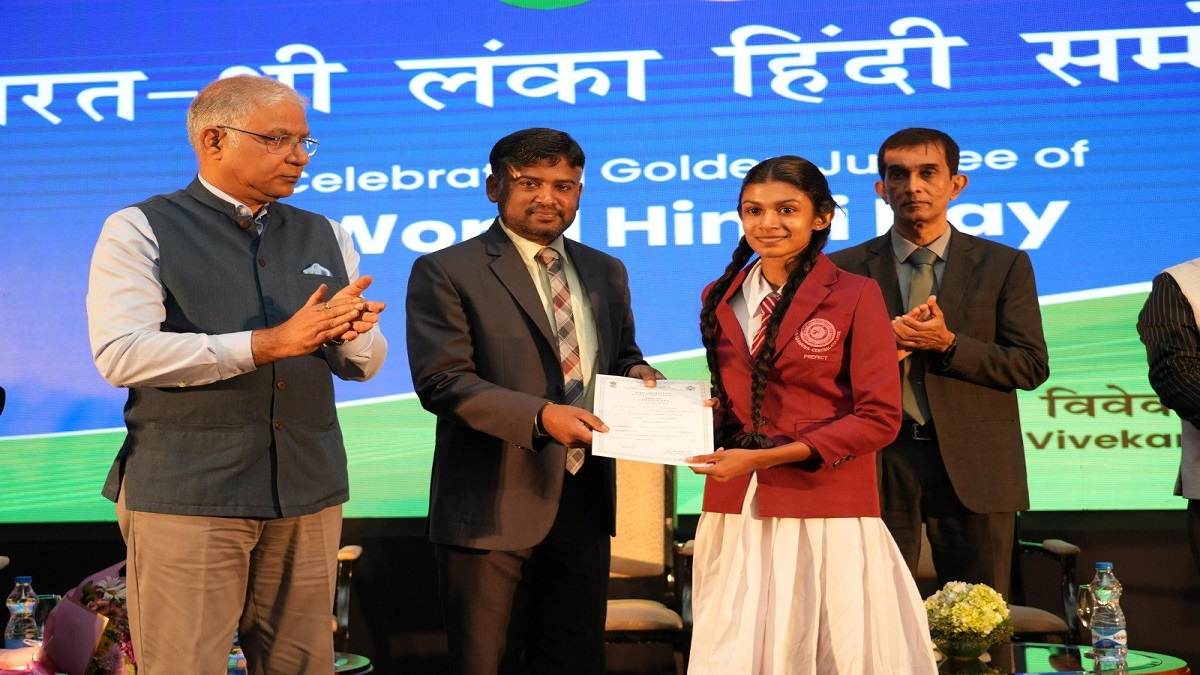
India Sri Lanka educational relations take a leap as a new Hindi language course launches at KDU Colombo, promoting cultural ties and academic collaboration.
🇮🇳 India–Sri Lanka Educational Ties Grow Stronger with New Hindi Course at KDU
Introduction
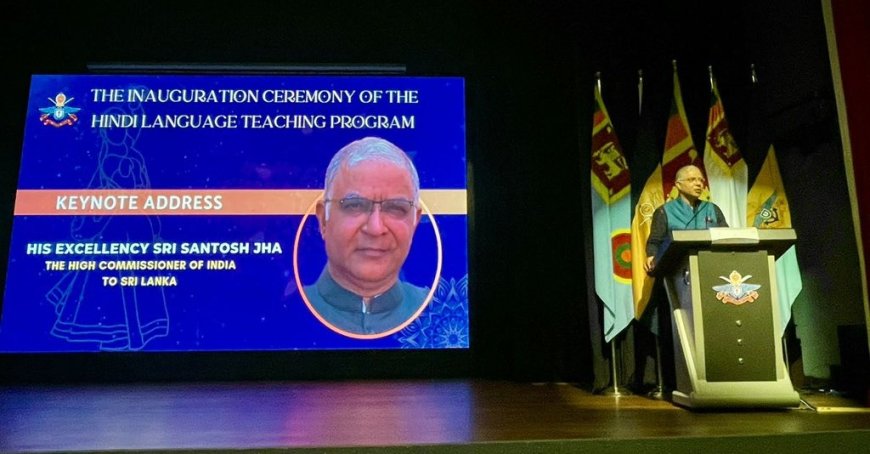
In a strategic effort to deepen educational and cultural links, General Sir John Kotelawala Defence University (KDU) in Colombo has launched a Hindi Language Learning Programme in collaboration with Swami Vivekananda Cultural Centre (SVCC), the cultural arm of India’s High Commission in Sri Lanka The official inauguration took place on July 2, 2025, featuring dignitaries such as India’s High Commissioner Santosh Jha and KDU’s Vice‑Chancellor, Rear Admiral HGU Dammika Kumara
Programme Features and Curriculum
Offered as an elective for undergraduate students, the course is open to both military cadets and civilian scholars. Instruction, provided by qualified teachers from India, incorporates foundational skills—reading, writing, speaking, and comprehension—alongside deep cultural immersion The curriculum emphasizes practical usage in academic, diplomatic, and media contexts.
Diplomatic & Cultural Significance
High Commissioner Jha underscored that with over 600 million native speakers, Hindi opens doors to India’s vibrant literature, digital media, philosophical traditions, and professional opportunities Vice‑Chancellor Kumara added that formal language training enhances Sri Lankan engagement with Bollywood, Hindi music, and broader cultural narratives, nurturing people‑to‑people diplomacy
Building on Previous Initiatives
The programme follows earlier steps taken in January 2025, when SVCC collaborated with the Open University of Sri Lanka to launch the country’s first distance‑learning Hindi course This momentum indicates rising interest in Hindi as a vital tool for regional cooperation.
Broader Educational & Strategic Context
This course is part of a broader strategy involving teacher training. For instance, 35 Sri Lankan school educators have been selected for a Hindi Teacher Training Programme at India’s Central Institute of Hindi (Agra)—a premier national institution under the Ministry of Education Additionally, 88 schools across Sri Lanka now offer Hindi as a subject, marking an expanding educational footprint
Why This News Matters for Government Exam Aspirants
Strengthening Bilateral Diplomacy
Language initiatives such as these reflect India’s broader ‘Neighbourhood First’ policy, fostering long-term inter‐governmental cooperation and cultural diplomacy with Sri Lanka. Government exam aspirants—especially in UPSC, PSCs, and diplomatic services—should appreciate such soft‑power frameworks as integral to foreign policy and regional strategy
Education and Human Resource Development
For exams in teaching, banking, defence, and others, candidates must value educational collaboration. Knowledge of India’s role in training foreign educators, establishing language courses abroad, and supporting regional education strengthens answers on international cooperation in education .
Cultural Bridge and Media Exposure
Hindi, as the world’s widely spoken language, enhances access to India’s film, journalism, and academic resources. This initiative illustrates how language proficiency serves as a tool for cultural integration and media diplomacy, a current trend in soft-power projection.
Institutional Roles
The involvement of bodies such as High Commission SVCC, KDU, and Central Institute of Hindi showcases institutional diversity in cultural diplomacy—a key understanding for questions on government and public sector institutions.
Exam-Relevant Precedents
This programme builds upon a series of initiatives—distance education, teacher training, school-level Hindi teaching—that exemplify sustained policy efforts rather than ad‑hoc measures. Recognizing this helps frame answers on government strategy in international education.
Historical Context: Legacy of Language and Diplomacy
Roots of Indo‑Sri Lankan Cultural Exchange
India and Sri Lanka share millennia-old links in religion, language, trade, and migration. Their Indo‑Aryan and Dravidian heritage pre-dates colonialism Modern cultural policies—such as language promotion, educational exchange, and mutual heritage projects—are extensions of this shared cultural continuum.
Post‑Independence Policies
Following independence, India promoted Hindi as a national unifier. Sri Lanka reciprocated with language and educational initiatives, especially after becoming a republic in 1972. Over decades, both have leveraged Hindi teaching in each other’s educational spheres to nurture mutual understanding.
Recent Developments
The launch of distance‑learning Hindi (January 2025), teacher‑training in Agra, and now the on‑campus elective at KDU reflect a clear progression in the stage‑wise implementation of India’s cultural diplomacy strategy in Sri Lanka. These actions echo earlier collaborative initiatives like Buddhist monastery restorations, vaccine donations, and economic aid
Key Takeaways from “India–Sri Lanka Educational Ties Grow Stronger”
| # | Key Takeaway |
|---|---|
| 1 | KDU in Colombo launched a Hindi course on 2 July 2025 in partnership with SVCC. |
| 2 | The elective is open to both undergraduate cadets and civilians, offering reading, writing, speaking, and cultural immersion. |
| 3 | Over 600 million people speak Hindi; this course enhances access to India’s cultural and media landscape. |
| 4 | The initiative builds on the January 2025 distance-learning Hindi course launched by SVCC and Open University. |
| 5 | As part of the initiative, 35 Sri Lankan Hindi teachers were sent to the Central Institute of Hindi, Agra for advanced training. |
Frequently Asked Questions (FAQs)
1. What is the objective of the Hindi language course launched at KDU, Sri Lanka?
The objective is to promote linguistic and cultural ties between India and Sri Lanka by offering students, including military cadets, the opportunity to learn Hindi as an elective subject.
2. Who is offering the Hindi language course at KDU?
The course is offered through a partnership between General Sir John Kotelawala Defence University (KDU) and the Swami Vivekananda Cultural Centre (SVCC), under the High Commission of India in Colombo.
3. When was the course officially launched?
The Hindi Language Learning Programme at KDU was launched on 2nd July 2025.
4. Who inaugurated the Hindi course at KDU?
The programme was inaugurated by India’s High Commissioner to Sri Lanka, Santosh Jha, and KDU Vice-Chancellor Rear Admiral HGU Dammika Kumara.
5. Are there any related initiatives for Hindi promotion in Sri Lanka?
Yes, SVCC had earlier launched a distance-learning Hindi course in January 2025 with the Open University of Sri Lanka, and 35 school teachers are undergoing training at the Central Institute of Hindi, Agra.
6. Why is Hindi important in India-Sri Lanka relations?
Hindi acts as a cultural bridge, enhancing media access, diplomatic communication, and mutual understanding between the two nations.
7. What type of students are eligible for the course?
The course is available to undergraduate students, including both military cadets and civilian students enrolled at KDU.
Some Important Current Affairs Links