







India quantum valley project to be launched in Amaravati by January 2026, featuring IBM’s 156-qubit system, academic partnerships, and quantum governance. A landmark move under National Quantum Mission.
India’s First Quantum Valley in Amaravati: A Leap into Deep‑Tech Future
Quantum Valley: A Transformational Deep-Tech Hub
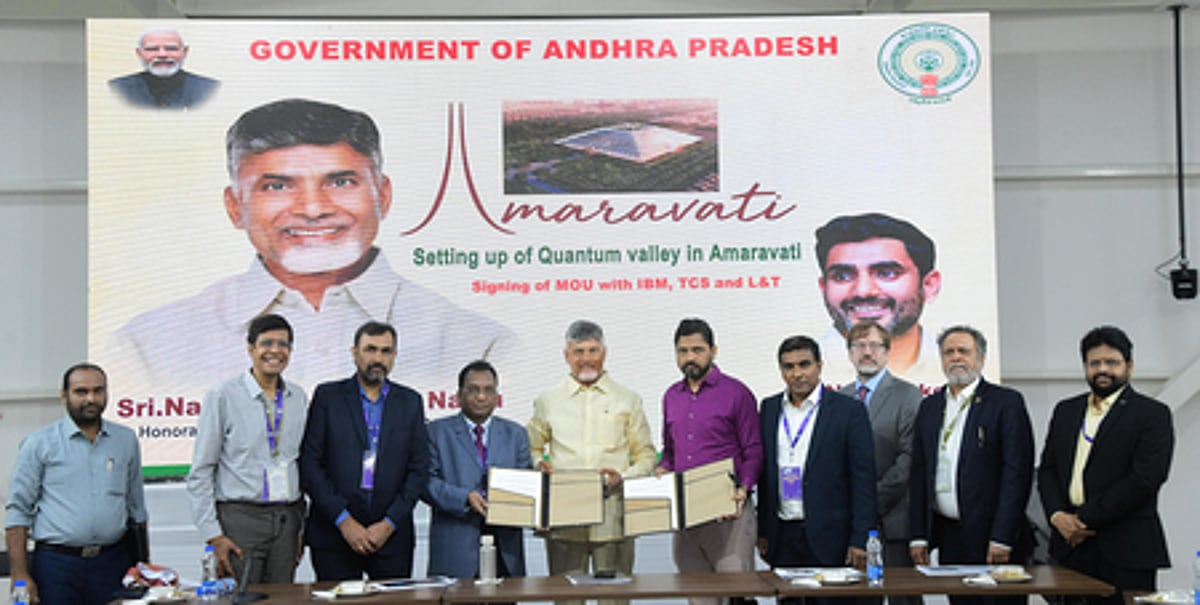
Andhra Pradesh is set to establish India’s maiden Quantum Valley Tech Park in Amaravati by January 2026, under the National Quantum Mission Spanning 50 acres, this full-stack ecosystem will integrate quantum computing, semiconductors, AI, defence innovation, and applied research.
Major Industry Collaborations
Leading global and national players—IBM, TCS, and L&T—will spearhead the project. IBM is set to deploy its 156‑qubit Quantum System Two, India’s most powerful quantum computer to date TCS will focus on industry‑ready applications, and L&T will execute infrastructure development.
Academic and Global Tie‑Ups
The Andhra Pradesh State Council of Higher Education mandates quantum computing courses in all state universities, with Andhra University rolling out relevant degrees from the 2025–26 academic session International partnerships have also been forged with Purdue University (USA) and University of Tokyo (Japan) for collaborative research and innovation
Smart & Sustainable Infrastructure
Aligned with Amaravati’s ambition to be a fully renewable-powered city, the Valley will feature rooftop solar installations, district cooling systems, EV infrastructure, and circular economy processes—ensuring reduced carbon emissions and energy optimization It’s set to be a beacon for smart, green urban infrastructure.
Focus on Security, Governance & Deep-Tech
The Valley aims to pioneer India’s first quantum governance framework, boosting cyber resilience, public transparency, and administrative efficiencyIt will also support post‑quantum cryptography, HPC, photonics, and defence‑aligned research—serving national priorities.
High‑Impact Innovation & Startup Support
The Ratan Tata Innovation Hub, housed within Quantum Valley, will support startups in quantum and deep-tech domains, driving translational R&D and facilitating IP creation This collaboration—state, academia, industry—aims to stimulate job creation, tech innovation, and support Atmanirbhar Bharat goals.
B) Why This News is Important 🎯
Strategic Edge in Global Tech Race
Quantum computing is revolutionizing sectors like cybersecurity, pharmaceuticals, finance, and defence. With Quantum Valley, India positions itself among global leaders—joining the likes of the US, China, and European powers—in this nascent field
Boost to Career‑Linked Syllabus
Aspiring candidates for UPSC, state PSCs, SSC (railways, banking), and defence exams must be familiar with emerging technologies. Knowledge of National Quantum Mission, quantum governance, and state-level initiatives like Quantum Valley is key to current affairs sections.
Driving Skill Development
By incorporating quantum computing into university curricula and launching innovation hubs, Andhra Pradesh is nurturing a talent pool aligned with Industry 4.0 standards—quite relevant for questions on skill missions, education, or technology policies.
C) Historical Context 🏛️
India’s Quantum Journey So Far
India began its quantum push in 2018 via the QuEST programme, later followed by the 2020 National Mission on Quantum Technologies & Applications (NM-QTA), supported with ₹8,000+ cr In April 2025, India saw its first homegrown 25‑qubit quantum computer developed by QpiAI—marking milestone progress
National Quantum Mission & Thematic Hubs
The revised National Quantum Mission (2023–31) allocated ₹6,003 cr and established thematic hubs across IITs and IISc to focus on computing, sensing, communication, and materials
Amaravati’s Rise as Quantum Capital
Building on this foundation, the Quantum Valley Tech Park, set to launch in January 2026, consolidates the state-level hub for deep-tech R&D, driven by government, academia, and industry linkages
D) Key Takeaways from India’s First Quantum Valley 🌟
| # | Key Takeaway |
|---|---|
| 1 | Launch Timeline – Scheduled for January 2026 in Amaravati, Andhra Pradesh, covering 50 acres under the National Quantum Mission. |
| 2 | Industry Partnership – Led by IBM (156 qubit system), TCS, and L&T for tech deployment and infrastructure. |
| 3 | Academic Integration – State universities to introduce quantum degrees; global tie‑ups with Purdue & Tokyo Univ. |
| 4 | Sustainability & Smart Tech – Renewable energy‑powered infrastructure with EVs, smart utilities, and green norms. |
| 5 | Govt‑Industry Synergy – Quantum governance, post‑quantum cryptography, startup support, and deep‑tech R&D aligned with Atmanirbhar Bharat. |
FAQs: Frequently Asked Questions
Q1. What is Quantum Valley and where will it be set up?
Quantum Valley is India’s first integrated quantum technology hub that will host facilities for quantum computing, AI, semiconductors, defence R&D, and innovation. It will be set up in Amaravati, Andhra Pradesh, by January 2026.
Q2. Who are the key collaborators in the Quantum Valley project?
Major industry players include IBM (deploying Quantum System Two), TCS (application development), and L&T (infrastructure development). The project also includes academic tie-ups with Purdue University (USA) and University of Tokyo (Japan).
Q3. What is India’s National Quantum Mission?
The National Quantum Mission (NQM) aims to advance research and development in quantum technology. Launched with a budget of over ₹6,000 crore, it includes the establishment of quantum computing hubs, sensing and materials labs, and industry-academia partnerships.
Q4. How is the Andhra Pradesh government promoting quantum education?
The Andhra Pradesh State Council of Higher Education (APSCHE) has made quantum computing part of the university curriculum from 2025–26. Andhra University will be one of the first to roll out degree courses in the subject.
Q5. Why is Quantum Computing important for exams?
Quantum technology is part of India’s strategic future in defence, cybersecurity, and emerging tech. Understanding its implications is crucial for UPSC, SSC, banking, railways, defence, and teaching exams where science, technology, and current affairs intersect.
Some Important Current Affairs Links